


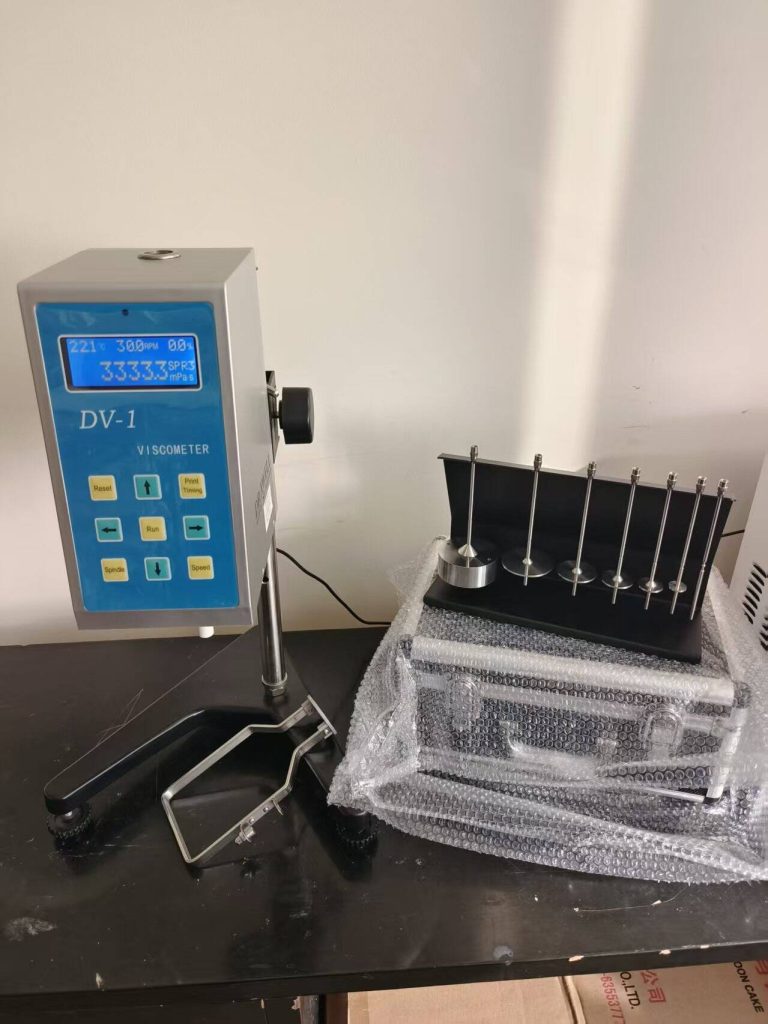
The viscosity meter for food is used to measure how easily various types of liquid and semi-fluid food products flow, such as fruit juice, milk, sauces, honey, and syrup. In the laboratory, food products can be analyzed for many purposes including consistency and product uniformity between food manufacturing lots.
Viscosity analysis results help food processors understand what flow properties different food products have. Many factors, including product type, temperature, and testing instrument, affect the food viscosity and the food’s flow properties. Because food matrices vary widely in flow behavior, testing protocols must be tailored to each specific product. In the food industry, different rotational viscometers will be used to control different speeds and spindles for viscosity testing.
In addition, the viscometers can be used to control different testing temperatures, speeds, and test durations, which allow food scientists to conduct more complex tests. For these types of tests, viscosity is known as apparent viscosity. Food scientists often refer to the apparent viscosity values for new products and for quality control testing during manufacturing.
Why Is Viscosity Measurement Important in Food Processing?
- Maintaining Texture and Mouthfeel
Viscosity determines texture. It affects many products such as yogurt and ketchup, dressing, etc., as well as pourability. Viscosity tests are only one measure of food texture.
- Ensuring Batch-to-Batch Consistency
Small changes in the composition of a food, its temperature, or its method of preparation will alter its final consistency and its flow properties.
To maintain food quality control and uniform consistency between manufacturing runs, laboratory testing methods must be developed to measure viscosity, temperature, and use of various sizes of spindles at various test speeds. Testing methods used in different runs of the same product should be as close as possible.
For consistency, laboratory measurements will always use consistent temperature control and record test parameters. Testing can be used to ensure that subsequent production runs meet food quality control guidelines.
- Supporting Food Processing and Filling
In food production, the most expensive stage is the processing stage. It is during this stage that the largest volume of food materials must be handled. At this stage, it is critical to determine the properties of the food materials to assure adequate processing equipment capacity and minimize cost.
Laboratory testing methods for food material properties are primarily used for material analysis during production design, rather than processing control during manufacture. These properties will change from one processing stage to another and between batches during manufacture.
Understanding viscosity in food processing helps optimize process parameters, but laboratory offline sampling is mainly for material evaluation and cannot replace inline viscometers for real-time continuous monitoring.
Which Food Products Require Viscosity Testing?
Dairy Products: Milk, Yogurt, and Cream
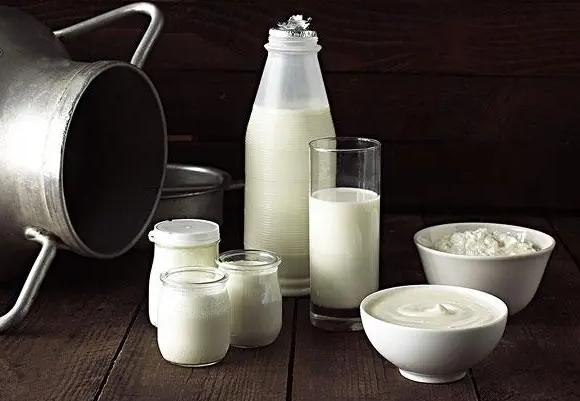
All types of dairy products such as cream, milk, yogurt and more, have different compositions which require testing to see how well they flow. Many different varieties of liquid milk, and especially yogurts, are very sensitive to the effects of fat and other types of composition, so they have many different viscosity properties.
Some liquid milk and some yogurt formulas can thin, then quickly regain some structure when sheared, while others do not regain any of their previous viscosity properties when sheared, so consistency must be carefully measured in each testing cycle.
Sauces and Condiments: Ketchup, Mayonnaise, and Salad Dressing
How condiment flowability affects its pour, squeeze, and spread is often what people care about first. For many condiments, most of them can be characterized as non-Newtonian fluids. Most types of ketchups are characterized as being shear thinning.
On the other hand, the structure of mayonnaises is highly dependent on initial structure and how many times the sample has been sheared. The same holds true with salad dressing, which usually has suspended particles, and of course oil/water ratios.
Using a rotational viscometer for food with fixed spindle and speed can effectively compare apparent viscosity across batches under identical shear conditions.
Honey, Syrup, and Jam
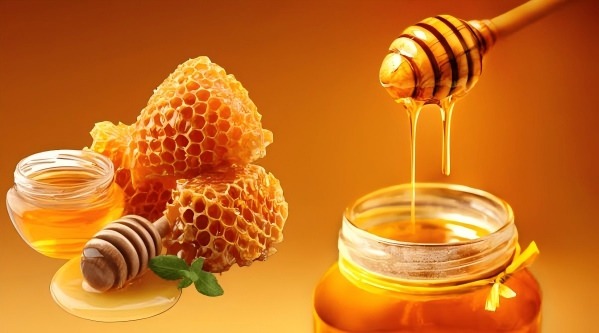
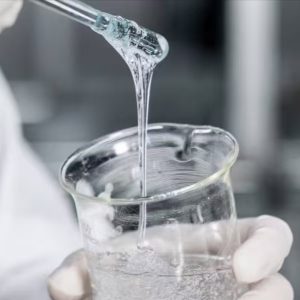
Like other foods of high viscosity, Honey, syrup, and jam should be scrutinized with packaging/filling in mind. Honey and syrup can lose their desired viscosity depending on the temperature, sugar, and moisture levels.
Fruit and pectin also play a role in viscometer results as they can get in the way of a spindle. Testing equipment must be evaluated carefully considering its viscosity measurement limits and the nature of the test. Do not choose equipment on the basis of food names alone.
Chocolate and Bakery Ingredients
Ingredients and foods such as chocolate, melted baking ingredients, and more, are extremely temperature dependent and are evaluated for filling and coating applications. Relative viscosity can be assessed through traditional rotational viscometers but results will not be representative of standard tests of rheology and chocolate plastic viscosity.
Viscosity measurements for things such as cake batter and fillings depend on ingredient ratios, presence of bubbles and ingredients with high densities. Ordinary rotational viscometers will be inadequate for evaluation of viscous systems that have complex solid-elastic-plastic behavior like most dough formulations.
What Types of Viscosity Meters Are Used in the Food Industry?
Type 1: Rotational Viscometers
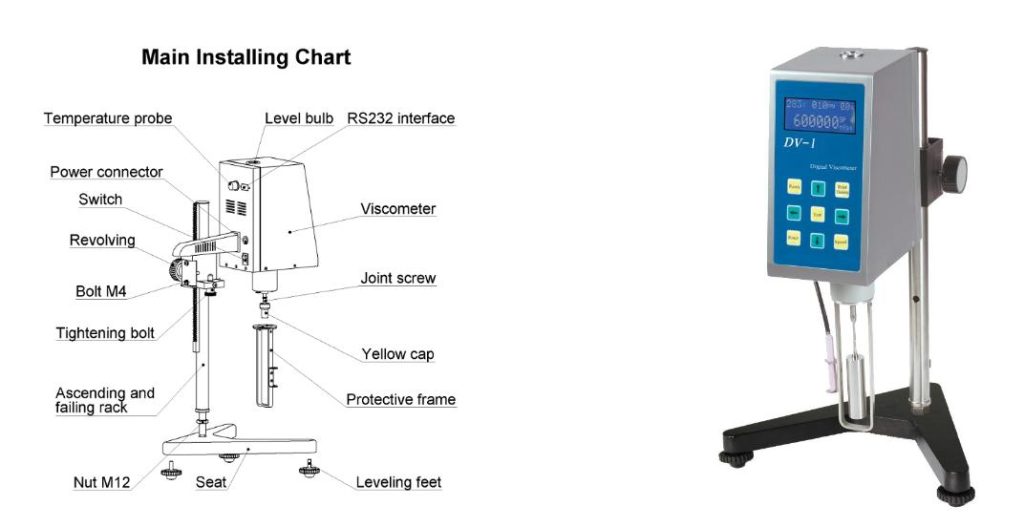
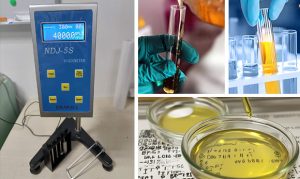
A viscometer is an instrument that determines viscosity and apparent viscosity of fluid foods based on a motor driving a spindle to rotate in a food sample. Because foods often exhibit non-Newtonian behavior, food research and quality control laboratories utilize apparent viscosity to characterize fluid food viscosity, and speed and measurement conditions must be specified during measurements. For more information, please see USP rotational viscosity methods。
Type 2: Consistometers and Flow-Based Testing Devices
Flow testing devices, represented by the Bostwick consistometer, are very useful when evaluating consistency and relative flowability of viscous materials such as ketchups, pastes, and puree samples. These flow measurements are accomplished by timing the flow of material along a specified distance of a graduated flow track, or timing the flow through a specific orifice. Flow distances and time can be related, but there is no direct translation to standard viscosity measures such as mPa·s.
Type 3: Inline and Process Viscometers
These viscometers are installed directly into production pipes or mixing tanks and are useful in process automation. Unlike lab instruments, inline viscometers are most often required to comply with food safety standards. These instruments find use in various industrial applications and their application scenarios are completely different from laboratory benchtop sampling.
Type 4: Capillary Viscometers and Flow Cups
Capillary viscometers, suitable for corresponding standard methods, provide the most traditional way of determining kinematic viscosity by measuring the time for liquid to flow through a specified capillary. Their flow cup equivalents offer an alternate measurement of relative flowability by measuring the time for liquid to flow out of a specified orifice.
Traditional capillary methods are usually for liquid samples meeting specific test method requirements; some methods have explicit requirements for Newtonian flow characteristics and uniformity. Therefore, for foods containing particles or with complex non-Newtonian behavior, confirm method applicability first, and results from these methods cannot be simply interchanged with rotational viscometer readings.
Overall, different viscometer for food industry equipment have different measurement principles and result forms. If a laboratory needs flexible sampling and batch comparison for multiple liquid and semi-fluid foods, a benchtop rotational viscometer is a more practical choice.
How to Measure Food Viscosity with a Rotational Viscometer?
- Prepare the Food Sample
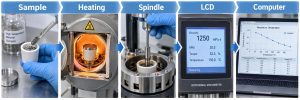
The first step in the measurement process is the sampling of foods. This includes the collection of food products for tests according to a sampling protocol. Food products such as sauces and some beverages that contain sediments must be homogenized.
However, as some foods may contain particulate material, and even some may be non-homogeneous, food homogenization must be performed carefully so as not to affect the structure of the foods or introduce air.
In cases where the foods to be tested contain particulate matter, the appropriateness of the gap between the food to be tested and the spindle must be determined, and the presence of such particulate matter must be recorded along with any signs of the separation of foods or the presence of bubbles.
- Control Sample Temperature
Foods generally show variations in their flow characteristics because of fluctuations in their temperature. This phenomenon is quite distinct for chocolate, cream, honey, and even syrup.
Prior to taking any measurements, the foods to be tested must have achieved their expected constant temperature and a record of the actual temperatures of the samples tested must be taken.
Any alteration of temperature also alters the food products’ viscosity; as a result, comparative food sample testing must always use the guidelines of temperature effects on viscosity measurement.
- Select the Spindle and Rotational Speed
For viscometer readings, it is best to use a rotational viscometer in combination with appropriate spindles and rotational speed in anticipation of the sample’s viscosity. Because of the behavior of non-Newtonian fluids, changing speeds will also result in changes to apparent viscosity readings.
Additionally, shear rates depend on measuring system and spindle geometry, therefore rotational speed cannot be equated to shear rate. Consistent testing of sample viscosity against similar shear rates must be recorded individually, because different spindle speed tests will result in a recorded change of viscosity readings.
| Food Sample | Testing Considerations |
| Fruit juice | Low viscosity range matching, temperature stability, sample uniformity |
| Milk and cream | Testing temperature, milk fat and solid composition, speed consistency |
| Ketchup and mayonnaise | Non-Newtonian flow characteristics, shear conditions, fixed reading time |
| Honey and syrup | Temperature sensitivity, high-viscosity range coverage |
| Jam and fruit puree | Particle distribution, sample structure, spindle and container gap |
- Perform the Measurement and Compare Results
Position the instrument on a steady level surface and insert the spindle carefully. Prepare your container and sample to ensure proper volume is attained, as per manual guidelines, and carefully lower the spindle. Once you start the measurement, note readings after a certain amount of time, and proceed to clean all components as soon as possible. Follow a consistent rotational viscometer measurement procedure.
If testing is for quality control purposes, samples being tested from different batches of the same product must have identical test conditions such as temperature, spindle, speed, etc. Ensure that all the details of your test have been logged so as to help build your internal Quality Control Database.
How to Choose a Viscosity Meter for Food Applications?
Measurement Range
Clarify the food type that will be analyzed as well as the expected viscosity range. Check if the food viscosity is compatible with the range that the instrument can measure. Think of a combination of more than one viscosity range or even different instrument models for those food samples that have very different viscosities.
Spindle and Speed Configuration
Examine the instrument’s technical specifications with regards to spindle type and speed. It is necessary to consider the most extreme expected measurement. Consider if multiple speeds and/or repeatability is necessary for viscosity measurements for Research and Development purposes.
Temperature Control
Check whether the main instrument is capable of accepting external temperature control accessories such as temperature control jackets.
Testing Frequency and Environment
Instruments should be selected on the basis of expected usage, whether the purpose is everyday sampling, formulation Research and Development, and Quality Control batch tests or production monitoring. Choose benchtop viscometers if there are lots of individual sample measurements, and choose inline viscometers if production pipe viscosity must be continuously monitored.
Drawell Digital Viscometers for Food Testing
If your laboratory performs viscosity testing of foods spanning a range of viscosities, Drawell’s digital viscometer series provides LVDV, RVDV, and HBDV configurations.
LVDV Series for Lower-Viscosity Samples
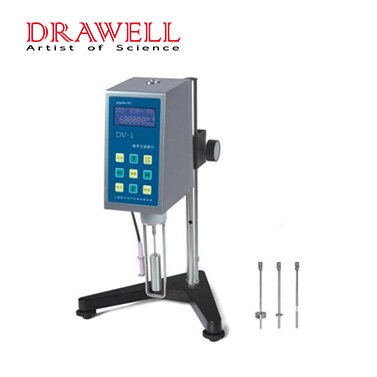
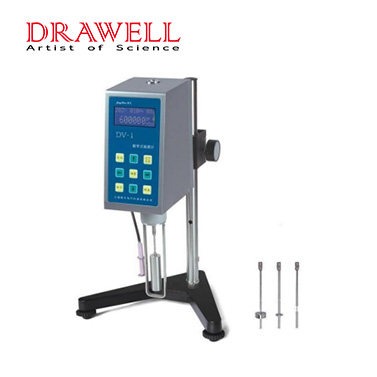
The LVDV Series consists of low-viscosity range configurations. These instruments can be used to evaluate some liquid foods, beverages, and some low-viscosity syrups. An example is the LVDV-1 . It is capable of measuring a range from 12-6,000,000 mPa·s. Actual applicability will depend on viscosity, test conditions and spindle choice.
RVDV Series for Medium-Viscosity Samples
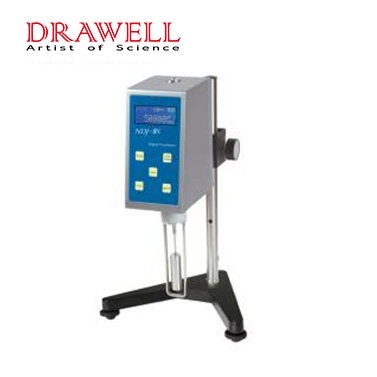
These viscometers utilize a medium-viscosity range, so they are designed to analyze certain foods, including condiments and dairy products. Let’s take the
RVDV-1 as an example. Its range spans from 80-40,000,000 mPa·s. Based on food sample qualities, different combinations of speeds and spindles will need to be selected for use in analyzing samples.
HBDV Series for High-Viscosity Samples
The HBDV series offers high-viscosity range configurations for evaluating thick food samples such as honey, jam, and heavy syrups. For example, the HBDV-2 high-viscosity viscometer has a range of 320-320,000,000 mPa·s; whether it meets specific food sample requirements needs confirmation based on actual test conditions.
Conclusion
A food’s viscosity allows us to gauge quality of texture and ensure uniformity among lots of production, but it also allows for optimized food processing techniques.
Laboratory rotational viscometers can measure liquid and semi-fluid food viscosity in certain conditions, however, for foods with non-Newtonian behavior, food preparation must be very well controlled before testing is undertaken and food must be thoroughly documented as to the sample characteristics, speed of test, and spindle of test during comparison.
Selection of instrument configuration must include a determination of viscosity, the spindles to be used, testing speed, and environmental test conditions. Drawell digital rotational viscometer series also can supply a variety of equipment options for viscosity ranges of lab tests.
Get Quote Here!
Latest Posts

What Next?
For more information, or to arrange an equipment demonstration, please visit our dedicated Product Homepage or contact one of our Product Managers.


