


So you’re looking at optical instruments for your lab. And you keep seeing two names: spectrometer vs spectrophotometer. They sound similar. They even look alike sometimes. But they are not the same thing. And picking the wrong one? That can cost you time, money, and a lot of frustration. Let’s cut through the noise.
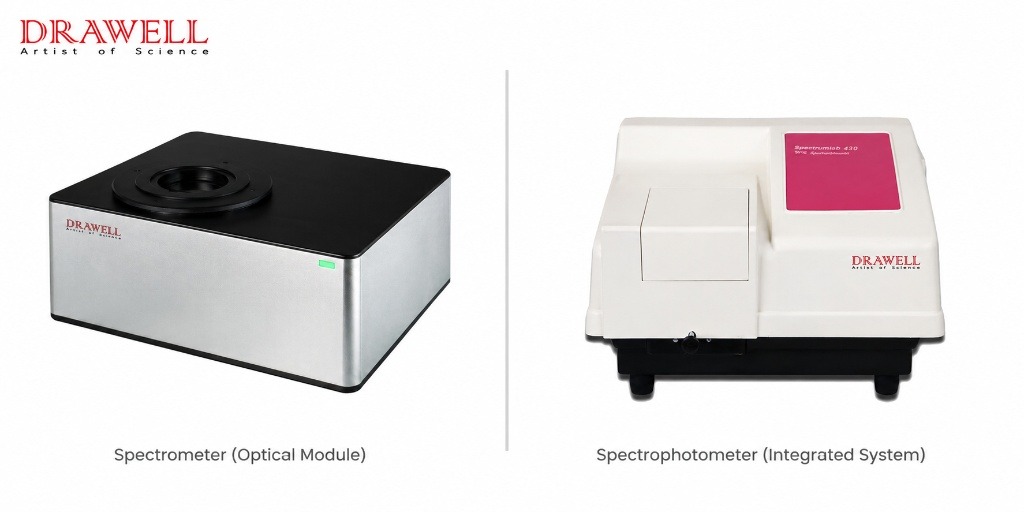
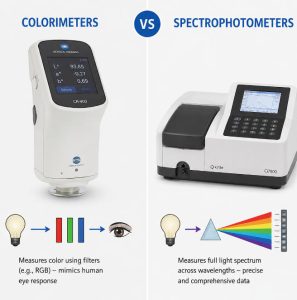
A spectrometer cares about light itself. Its job? To break light into wavelengths and show you its intensity profile. A spectrophotometer, on the other hand, is built for a different mission. It measures how a sample interacts with light. Specifically, how much light gets absorbed, how much passes through (transmission), or how much bounces off (reflectance). That’s the core distinction. Get that straight, and you’re already halfway to making the right call.
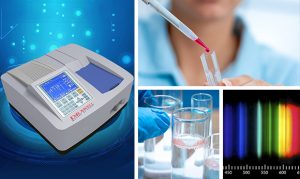
What is the Main Difference?
What is Spectroscopy, Spectrometry, and Spectrophotometry?
Think of these three as a staircase. Step one: Spectroscopy – that’s the science. The theory of how light and matter interact. Step two: Spectrometry – that’s the action. The actual measuring of wavelengths and intensities. Step three: Spectrophotometry – this is where it gets practical. It takes that measuring technique and points it at a specific problem: how much light does a sample absorb, transmit, or reflect? And from that, you can figure out concentration or color. Simple, right?
Defining Spectrometer and Spectrophotometer Accurately
Let’s be precise. A spectrometer is a light analyzer. Pure and simple. It takes incoming light, splits it into its individual wavelengths, and shows you the spectrum. That’s it.
A spectrophotometer is a whole system. It comes with its own light source. A way to pick a specific wavelength. A slot for your sample. And a detector that measures what comes out the other side. All in one box. Its whole reason for existing is to measure how much light your sample absorbs, lets through, or reflects back.
If you want to dig deeper into how these machines actually work, know the fundamental working principles and operating protocols of spectrophotometers. It’ll give you a solid grounding before you compare further.
Is a Spectrophotometer a Type of Spectrometer?
Yes and no. They share parts – both use gratings or monochromators to split light. But they’re built for different jobs. A spectrophotometer is optimized for quantitative measurements. Concentrations, absorbances, that kind of thing. A spectrometer is more about identifying spectral fingerprints. So while they’re cousins, they’re not twins.
Spectrometer vs Spectrophotometer: 5 Core Differences at a Glance
Here’s a quick cheat sheet. Five key angles to look at when you’re deciding:
| Feature | Spectrometer | Spectrophotometer |
| 1. Measurement Target | Looks at light sources, emissions, or reflections – the spectral profile itself. | Measures how much light a sample absorbs, transmits, or reflects. |
| 2. System Architecture | Usually just a module – needs an external light source to work. | A complete system: light source, wavelength selector, sample holder, and detector. |
| 3. Light Source | Depends on external light or the sample’s own glow. | Comes with built-in, calibrated lamps (deuterium, tungsten, xenon, or LED). |
| 4. Analysis Focus | All about spectral characterization and identification (some can do quant, but that’s not the main thing). | Tuned for absorbance, transmittance, concentration, and color difference – that’s its bread and butter. |
| 5. Best For | Material characterization, light source testing, emission spectra work. | Routine concentration checks, DNA/protein purity, water quality, color QC in manufacturing. |
Key Components and How They Work
Key Components: Spectrometer vs Spectrophotometer
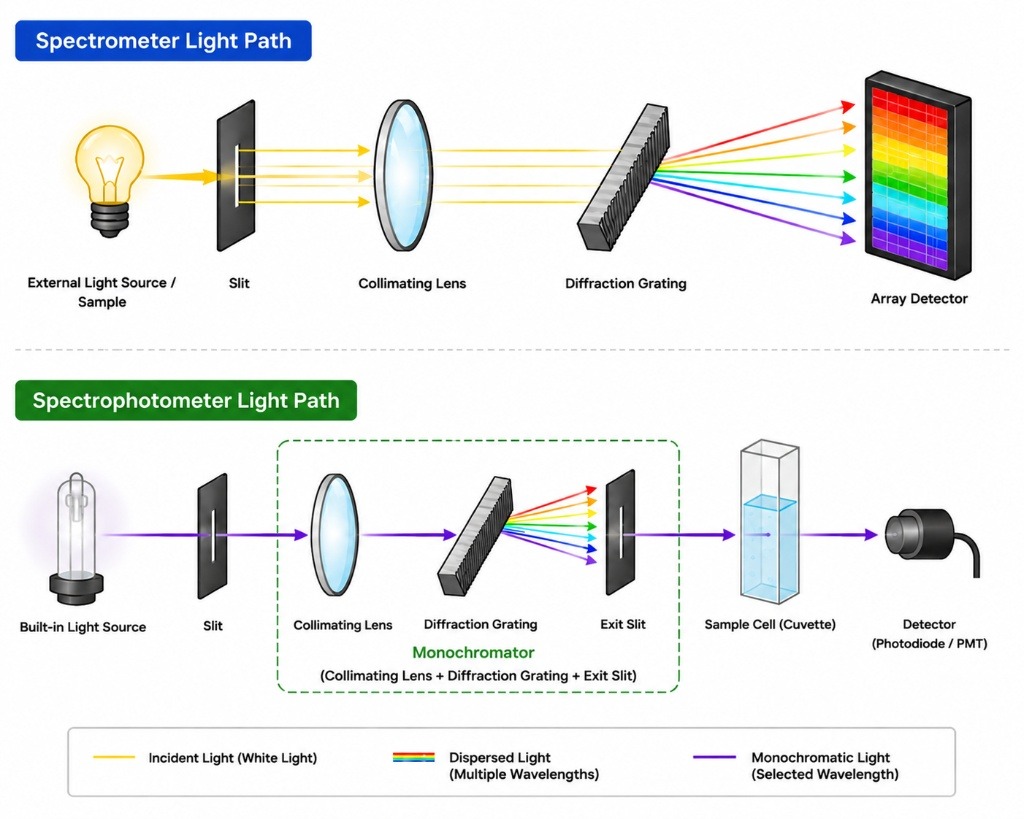
Spectrometer – small and focused. You’ve got an entrance slit (lets light in), a collimating mirror (makes rays parallel), a diffraction grating (splits the light), and a detector array that grabs the whole spectrum in one go.
Spectrophotometer – bigger, more complete. It needs a calibrated light source (deuterium and/or tungsten). A monochromator system (grating plus slits) to pick wavelengths. A sample compartment for your cuvette or solid sample. And a high-sensitivity photodetector. Every piece has a role. They work together as one closed loop.
Detector Differences: CCD Array vs Photodiode/PMT
Spectrometers often use CCD or CMOS arrays. Why? Speed. They capture every wavelength at the same instant. Great for getting a full spectrum fast.
Spectrophotometers go a different route. They use photodiodes or photomultiplier tubes (PMTs) . These are all about accuracy and low noise. They measure one wavelength at a time, but they do it with extreme precision. That’s what you need when you’re calculating concentrations.
Light Path: How Measurement Happens
Here’s how light moves through each:
Spectrometer path:
External light or sample emission → slit → collimator → grating (splits into wavelengths) → array detector → out comes a spectral graph.
Spectrophotometer path:
Built-in light source → monochromator selects a wavelength → light hits your sample (or passes through it) → detector measures the remaining intensity → software calculates absorbance, concentration, or color values based on what you’re testing.
Single Beam vs Double Beam Spectrophotometers
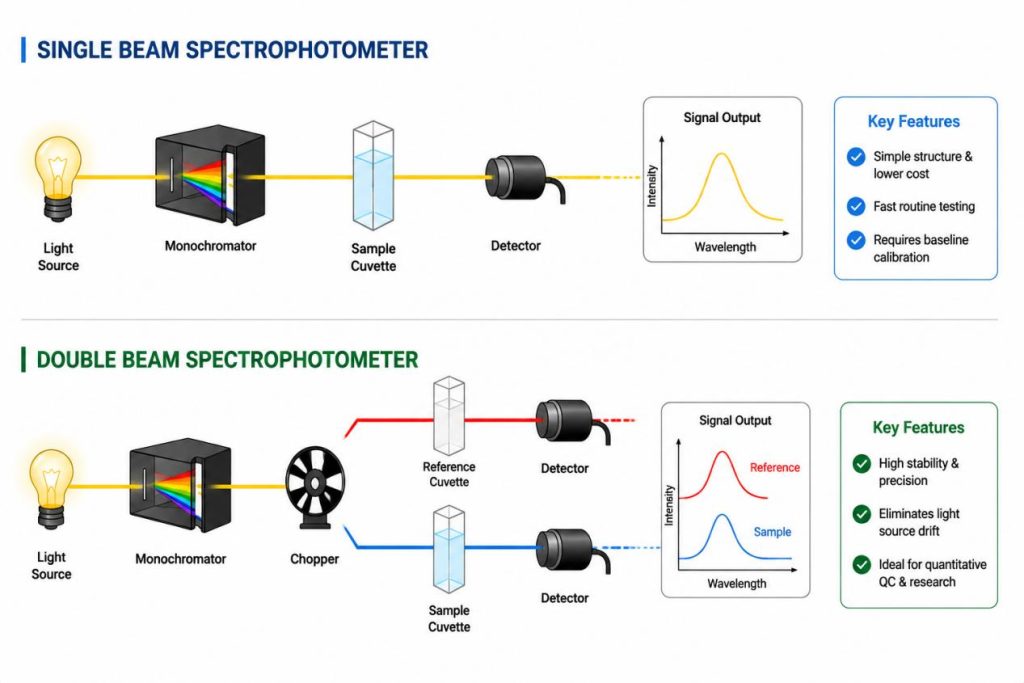
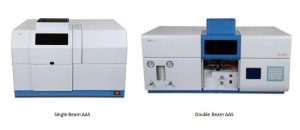
When you’re looking at spectrophotometers, you’ll see two main optical designs:
Single Beam – light goes through the blank, then through the sample. One after the other. Simple. Cheap. Works fine for routine work. But you have to zero it manually, and you need to do that often.
Double Beam – here, a beam splitter divides the light into two paths. One goes through the reference, the other through the sample. They’re measured at the same time. The instrument constantly compares them. That cancels out drift from the light source or any environmental wobble. Much more stable.
If stability is critical for you – say, research or pharma QC – you should really understand the differences between single beam and double beam optical configurations.
Qualitative vs Quantitative Analysis (Physics Simplified)
Spectrometers are mostly used for qualitative work – identifying materials by their spectral fingerprints. Some can do quant, but that’s not their primary strength.
Spectrophotometers? They’re built for quant. They rely on the Beer-Lambert Law. That’s the equation:
A = ε · b · c
Where:
A = Absorbance (how much light gets absorbed)
ε = Molar absorptivity (a constant for each substance)
b = Path length – how thick your cuvette is
c = Concentration of your solution
This law gives you a direct, linear relationship. That’s why spectrophotometers are so reliable for concentration measurements.
Common Types of Spectrometers and Spectrophotometers
Common Types of Optical Spectrometers
Optical Spectrometer – the basic model. Covers UV, visible, and infrared ranges. Does the core job of showing you spectral distributions.
UV-Vis Instruments – these come in both flavors. A UV-Vis spectrometer is used for spectral characterization. A UV-Vis spectrophotometer is specifically designed for quantitative absorbance work. Same wavelength range, different mission.
Raman Spectrometer – uses Raman scattering to pick up molecular vibrations. Great for non-destructive testing. Think gemstones, semiconductors, that kind of thing.
Infrared (FTIR) Spectrometer – identifies functional groups by measuring infrared absorption. A standard tool for organic chemistry – helps you figure out what’s in your compound.
Common Types of Spectrophotometers
UV-Vis Spectrophotometer – covers 190 to 1100 nm. The workhorse for chemistry, biology, and water testing labs.
Benchtop Spectrophotometer – big, heavy, but very accurate. Low stray light, high precision. Used in R&D and for building reference standards.
Portable Spectrophotometer – small, runs on batteries. Perfect for field work – water quality testing on-site, or color checks right on the factory floor.
Reflectance vs Transmittance Models – transmission models handle transparent liquids and thin films. Reflectance models come with an integrating sphere. They measure solid surfaces – plastics, textiles, paints. Anything where color and reflectance matter.
Industry Applications: Where is Each Instrument Used?
Key Applications for Spectrometers
Material Characterization – figuring out what unknown minerals or polymers are made of. Checking thin-film optical properties.
Elemental Analysis – in metallurgy and foundries, optical emission or XRF spectrometers measure trace elements in alloys. Percentages, even down to parts per million.
Optical Research – testing LED output, laser purity, fluorescence emission from new materials.
Key Applications for Spectrophotometers
Biochemistry & Life Sciences – measuring DNA, RNA, and protein concentrations. Checking purity using the 260/280 nm absorbance ratio.
Pharmaceutical QC – quantifying active ingredients in drugs. Making sure they meet pharmacopoeia standards.
Water & Food Testing – measuring nitrates, heavy metals, turbidity, pigment concentrations in beverages.
Spectrophotometers in Color Measurement
Colorimetry & Metamerism – this is where spectrophotometers really earn their keep. They measure reflectance across the entire visible spectrum. Then they convert that data into standard CIE L*a*b* coordinates. From there, you can calculate color differences (Delta E) between batches. They can also simulate different light sources. That helps you spot metamerism – when two colors match under one light but look totally different under another. And they handle optical brighteners too. That’s a big deal in textiles and paper.
Video:https://www.youtube.com/watch?v=ARH3ZF9e1Yw
How to Choose Between a Spectrometer and Spectrophotometer?
Quick Decision Checklist
Pick a Spectrometer if:
- You need to analyze a light source – its wavelength, laser properties, fluorescence pattern.
- You’re identifying materials – alloys, minerals, polymers – by their spectral signature.
- You’re building a custom optical setup for physics or photonics research.
Pick a Spectrophotometer if:
- You need precise concentrations – chemicals, DNA, proteins in solution.
- You’re following standard methods – absorbance, transmittance, color difference.
- You’re setting up a QC lab, a water testing station, or a pharma analysis unit.
Before you decide, get familiar with essential spectrophotometer features – wavelength range, bandwidth, sample compartment size. That’ll narrow your options fast.
Accuracy, Cost, and Technical Metrics
Accuracy Profile – spectrometers focus on spectral resolution and wavelength accuracy. Spectrophotometers care more about photometric accuracy and repeatability – how consistent your readings are.
Metrics to Watch – look at Spectral Range (e.g., 190–1100 nm). Spectral Bandwidth – 1 nm vs 2 nm makes a real difference. And Stray Light – that’s the unwanted light that can throw off your measurements. These specs tell you what each instrument can actually deliver.
Laboratory Instruments from Drawell
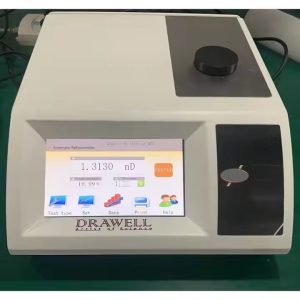
If you’re comparing models, Drawell has a bunch of options. UV-Vis spectrophotometers, atomic absorption, portable units – they cover a lot of ground.
UV-Vis Spectrophotometers (DU/DW Series) – single-beam and double-beam choices. Good for routine QC, and also for high-end research.
Atomic Absorption Spectrophotometers (AAS) – purpose-built for trace heavy metals in environmental water, soil, and food samples.
Portable Spectrophotometers – lightweight, battery-powered. Designed for field water testing and on-site color inspections in industrial settings.

Final Verdict: Choosing the Right Instrument for Your Lab
So here’s the takeaway. A spectrometer is your go-to for analyzing light itself – wavelengths, intensities, spectral fingerprints. A spectrophotometer is your system for measuring sample responses – absorption, transmission, reflection – and translating that into concentrations or color values.
For most labs doing chemistry, biology, water testing, or industrial QC, the spectrophotometer is the everyday workhorse. It’s practical, reliable, and built for quant.
Before you buy, think about your samples – liquid or solid? What wavelength range do you need? How precise does your measurement have to be? Answer those, and you’ll find the right fit without overspending.
For specs, pricing, or application advice, head over to Drawell – their product pages and technical team can help you nail down the perfect instrument for your workflow.
Get Quote Here!
Latest Posts

What Next?
For more information, or to arrange an equipment demonstration, please visit our dedicated Product Homepage or contact one of our Product Managers.


