


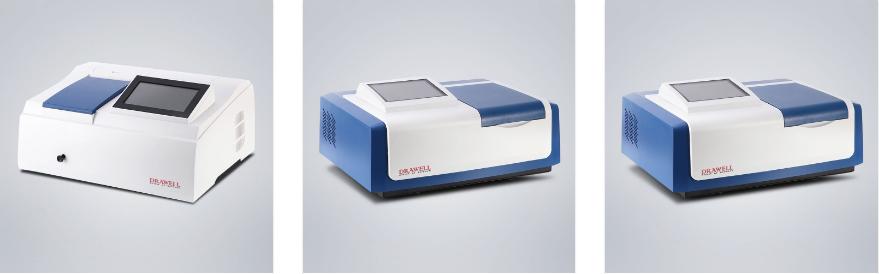
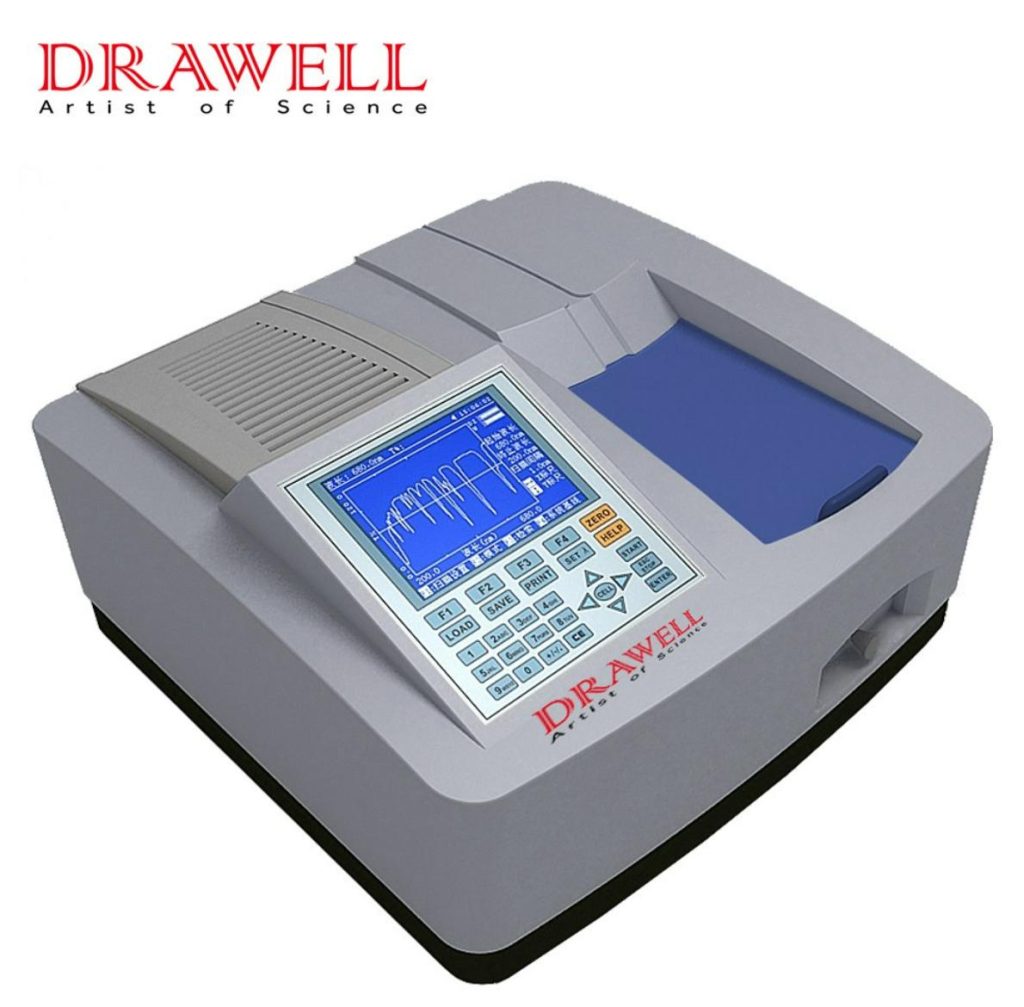
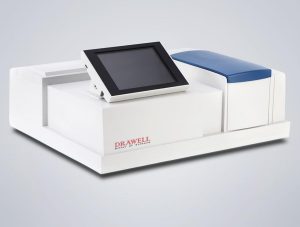
A UV-VIS spectrophotometer is an analytical instrument used to measure absorption or transmission of ultraviolet UV and visible VIS light by a substance. It is one of the most widely used laboratory instruments in chemistry, biology , pharmaceuticals , environmental science , food analysis, and material research because it gives fast accurate, and non-destructive analysis for samples.
The term “UV-VIS” refers to the ultraviolet and visible regions of the electromagnetic spectrum. Ultraviolet light usually covers about 190 to 400 nanometers, while visible light covers about 400 to 800 nanometers. A UV-VIS spectrophotometer basically checks how much light in these wavelength ranges gets absorbed by a sample, so scientists can figure out concentration and traits of various substances.
Basic Principle of UV-VIS Spectrophotometry
The working principle of a UV-VIS spectrophotometer is based on how light makes contact with matter. When light goes through a sample, some wavelengths are absorbed by the molecules inside it, while the rest of the light is allowed to pass on through, yes through it.
Different compounds take in light at particular wavelengths because their electrons accept energy and then move from lower energy states up to higher ones. By checking how much of the light was absorbed, the spectrophotometer can deliver useful details about the sample makeup, and also its concentration.
Main Components of a UV-VIS Spectrophotometer
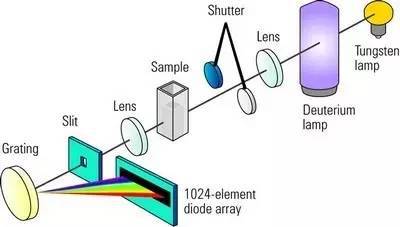
A UV-VIS spectrophotometer contains several important components that work together to produce accurate measurements.
| Component | Function | Description | Importance in UV-VIS Analysis |
| Light Source | Produces ultraviolet and visible light | Typically uses a deuterium lamp for UV light and a tungsten-halogen lamp for visible light | Provides stable radiation needed for accurate measurements |
| Monochromator | Selects specific wavelengths of light | Uses prisms or diffraction gratings to separate light into individual wavelengths | Ensures precise wavelength selection for analysis |
| Entrance and Exit Slits | Controls light beam width | Regulates the amount of light entering and leaving the monochromator | Improves spectral resolution and measurement accuracy |
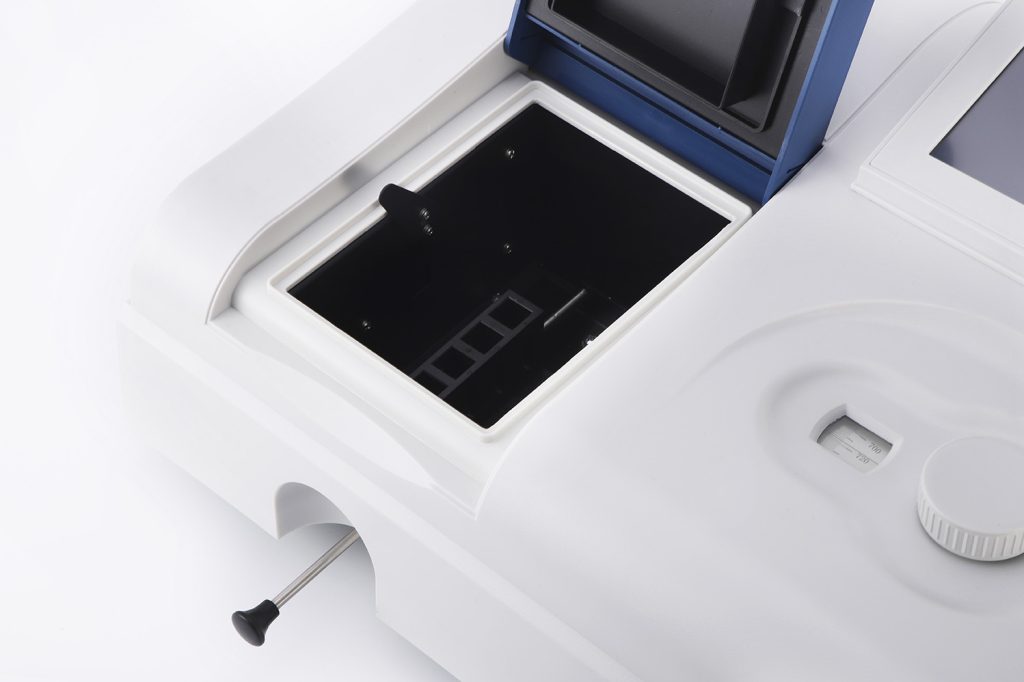
| Sample Holder (Cuvette Compartment) | Holds the sample during analysis | Contains cuvettes made of quartz, glass, or plastic depending on wavelength range | Allows consistent interaction between light and sample |
| Cuvette | Contains the liquid sample | Transparent sample cell with a fixed optical path length | Critical for accurate absorbance measurements |
| Detector | Measures transmitted light intensity | Converts light energy into electrical signals using photodiodes or photomultiplier tubes | Determines absorbance and transmittance values |
| Beam Splitter (Double Beam Systems) | Divides light into reference and sample beams | Used in double beam spectrophotometers | Improves measurement stability and compensates for lamp fluctuations |
| Amplifier | Strengthens detector signals | Enhances weak electrical signals from the detector | Improves sensitivity and signal accuracy |
| Data Processing System | Processes and displays analytical data | Includes software, microprocessors, and display systems | Enables spectrum analysis, calculations, and result storage |
| Display/Output System | Presents measurement results | Displays absorbance, transmittance, and spectral graphs | Allows users to interpret and record analytical data |
| Control System | Manages instrument operation | Controls wavelength scanning, calibration, and measurement settings | Ensures smooth and accurate instrument performance |
| Optical System | Directs and focuses light through the instrument | Includes mirrors, lenses, and optical pathways | Maintains efficient light transmission and measurement precision |
How a UV-VIS Spectrophotometer Works
So it starts when the light source throws out radiation that covers both UV and visible ranges. Then the monochromator , picks one wavelength at a time and directs that beam straight toward the sample, more or less.
While the light moves through the sample, a part of the wavelengths get absorbed. The rest just continue going through. After that, the detector catches the transmitted light intensity and it also compares it to the starting light intensity, like the original amount that came in.
From there the spectrophotometer works out absorbance or transmittance values and shows them as numbers, or sometimes as spectral graphs. That absorption spectrum, can be useful for compound identification and for figuring out their concentrations in a practical way.
Types of UV-VIS Spectrophotometers
UV-VIS spectrophotometers are available in several configurations depending on analytical requirements.
| Type | Working Principle | Main Features | Common Applications |
| Single Beam UV-VIS Spectrophotometer | Uses one light path for both blank and sample measurements | Measures reference and sample separately | Routine laboratory analysis and educational labs |
| Double Beam UV-VIS Spectrophotometer | Splits light into separate reference and sample beams | Simultaneously compares sample and reference signals | Pharmaceutical analysis and research laboratories |
| Split Beam UV-VIS Spectrophotometer | Divides light into two beams with partial simultaneous monitoring | Combines features of single and double beam systems | Quality control and industrial testing |
| Scanning UV-VIS Spectrophotometer | Continuously scans across a range of wavelengths | Generates full absorption spectra | Chemical identification and research applications |
| Diode Array UV-VIS Spectrophotometer | Uses multiple photodiodes to detect many wavelengths simultaneously | Captures entire spectrum rapidly | Kinetic studies and high-throughput laboratories |
| Portable UV-VIS Spectrophotometer | Compact instrument designed for field use | Lightweight and battery-powered | Environmental monitoring and field analysis |
| Microvolume UV-VIS Spectrophotometer | Measures extremely small sample volumes | Requires only microliters of sample | DNA, RNA, and protein analysis |
| UV-VIS-NIR Spectrophotometer | Extends measurement range into near-infrared region | Covers UV, visible, and NIR wavelengths | Material science and advanced spectroscopy |
| Benchtop UV-VIS Spectrophotometer | Standard laboratory instrument with full functionality | Larger size with advanced analytical features | Academic, industrial, and pharmaceutical laboratories |
| Fiber Optic UV-VIS Spectrophotometer | Uses fiber optics for remote or flexible measurements | Allows real-time monitoring in difficult locations | Process monitoring and industrial automation |

Advantages of UV-VIS Spectrophotometers
UV-VIS spectrophotometers they bring several advantages, and they are really useful analytical tools. One big plus is the rather fast analysis speed, most readings are finished in seconds or a few minutes. Then again the method is usually non-destructive, so after the measurement the sample can often be kept and reused.
Also, these instruments provide strong sensitivity and reliable accuracy when you need to measure concentration. They are relatively easy to use, especially compared with many advanced analytical setups. On top of that, UV-VIS spectrophotometers handle a wide range of sample materials, and they fit many analytical applications that are common in labs.
Limitations of UV-VIS Spectrophotometers
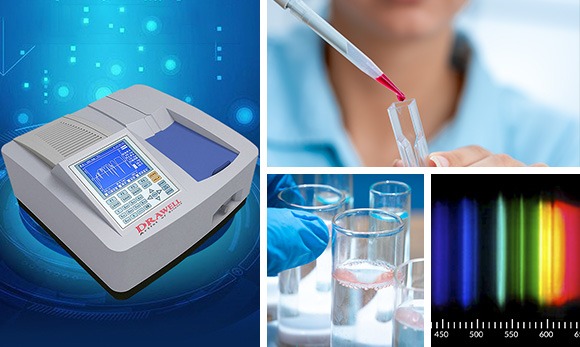
Even with their flexibility, UV-VIS spectrophotometers are not perfect in every case.
If a compound does not absorb ultraviolet or visible light, it cannot be tested directly with this approach. Accuracy can also suffer when impurities are present, or when absorption bands overlap and interfere with each other, which is something that happens more than people expect.
Sample preparation is sometimes needs to be done, to make sure the concentration and the clarity are right. Also when samples are very turbid or opaque, they can scatter the beam and that will bring down measurement reliability a lot.
Final Thoughts
A UV-VIS spectrophotometer is an essential analytical tool used for measuring how substances absorb ultraviolet and also visible light. By looking at absorbance and transmittance data, the instrument gives useful insight, into sample concentration, makeup, and chemical characteristics, all at once.
Since it is fast, precise, straightforward and has a broad spectrum of applications UV-VIS spectrophotometry still counts as one of the most important analytical methods in both scientific research and industrial settings. As technology keeps evolving, newer UV-VIS spectrophotometers are turning more “intelligent” and automated, plus they are more adaptable, which expands their role in advanced analytical science even more.
Get Quote Here!
Latest Posts

What Next?
For more information, or to arrange an equipment demonstration, please visit our dedicated Product Homepage or contact one of our Product Managers.


