

Digital Viscometer

Digital Viscometer
The viscometer refers to an instrument used to measure the viscosity of fluids (liquid and gas). NDJ and DV series digital viscometer has the advantages of high measurement accuracy, stable viscosity readings, convenient operation, and good anti-interference performance. They are widely used to determine the viscosity of various fluids such as grease, paint, food, medicine, adhesives, and cosmetics. It can also be used to measure the viscous resistance of liquids and the absolute viscosity of liquids.
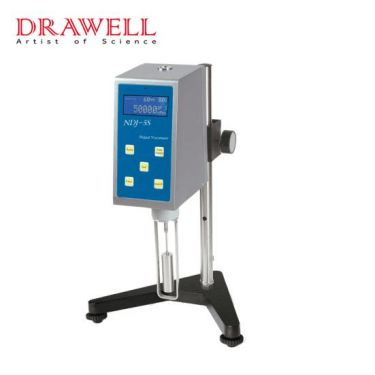
Features of Digital Viscometer
1. Stable speed.
2. It can be used as a stand-alone computer, or it can be connected to a micro printer and a computer to realize data collection.
3. The speed, rotor number, viscosity, torque, and temperature can be displayed simultaneously.
4. Different standard spindles can be selected according to needs.
Types of Drawell Viscometers:
Low Viscosity Viscometer:
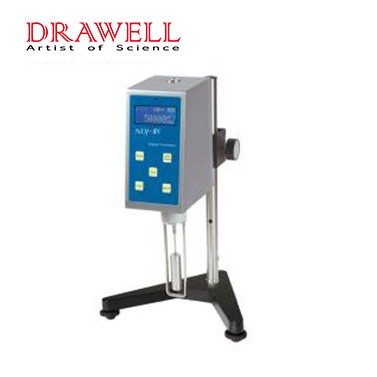
NDJ-5S 20-100000mPa·s Low Viscosity Viscometer
• Rotating Speed: 6/12/30/60
• Standard Spindles: Code L1,L2,L3,L4
NDJ-8S 20-2000000mPa·s Low Viscosity Viscometer
• Rotating Speed: 0.3/ 0.6/ 1.5/ 3/ 6/ 12/ 30/ 60
• Standard Spindles: Code L1, L2, L3, L4
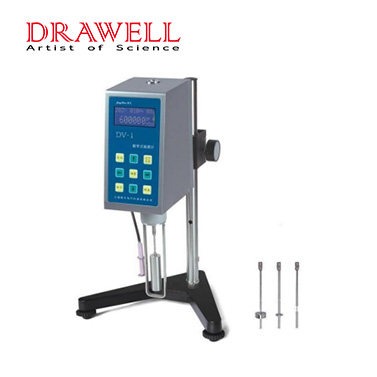
LVDV-2 6-6000000mPa·s Low Viscosity Viscometer
• Rotating Speed: 0.1~200(Stepless Gear)
• Standard Spindles: L1,L2,L3,L4
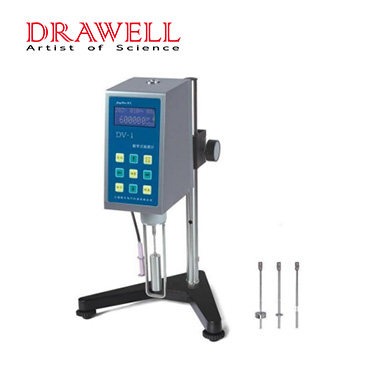
LVDV-1 12-6000000mPa·s Low Viscosity Viscometer
• Rotating Speed: 0.1~99.9 (Stepless Gear)
• Standard Spindles: L1,L2,L3,L4
Medium & High Viscosity Viscometer:
RVDV-1 80-40000000mPa·s Medium Viscosity Viscometer
• Rotating Speed: 0.1~99.9 (Stepless Gear)
• Standard Spindles: R2,R3,R4,R5,R6,R7
RVDV-2 40-40000000mPa·s Medium Viscosity Viscometer
• Rotating Speed: 0.1~200(Stepless Gear)
• Standard Spindles: R2,R3,R4,R5,R6,R7
HBDV-2 320-320000000mPa·s High Viscosity Viscometer
• Rotating Speed: 0.1 ~ 200 (Stepless Gear)
• Standard Spindles: Code R2, R3, R4, R5, R6, R7
HBDV-1 60-320000000mPa·s High Viscosity Viscometer
• Rotating Speed: 0.1~99.9 (Stepless Gear)
• Standard Spindles: R2,R3,R4,R5,R6,R7
High-Temperature Digital Viscometer:
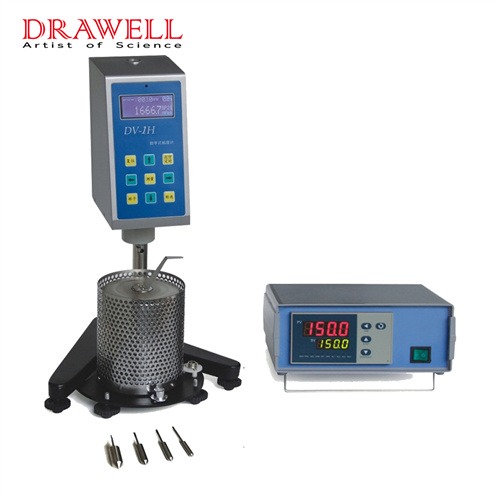
HBDV-1H High-Temperature Digital Viscometer
• Measuring Range: 800~80,000,000 mPa·s
• Rotating Speed: 0.1~99.9(Stepless Gear)
• Spindles: 21、27、28、29
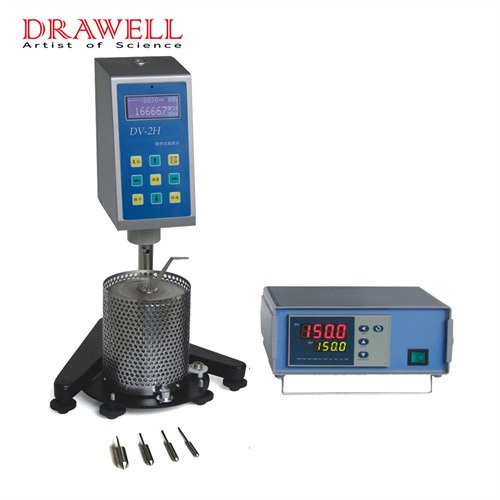
HBDV-2H High-Temperature Digital Viscometer
• Temp. Range: RT+10℃~300℃
• Measuring Range: 400~80,000,000 mPa·s
• Spindles: 21、27、28、29
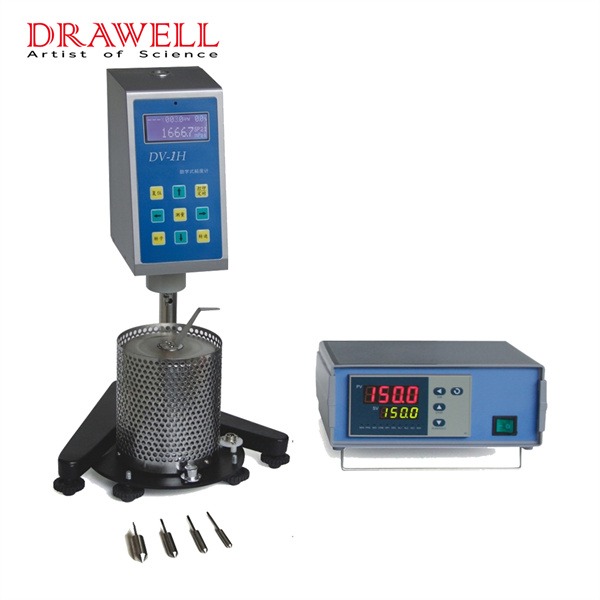
LVDV-1H High-Temperature Digital Viscometer
• Measuring Range: 10~1,000,000 mPa·s
• Rotating Speed: 0.1~99.9 (Stepless Gear)
• Spindles: 21、27、28、29
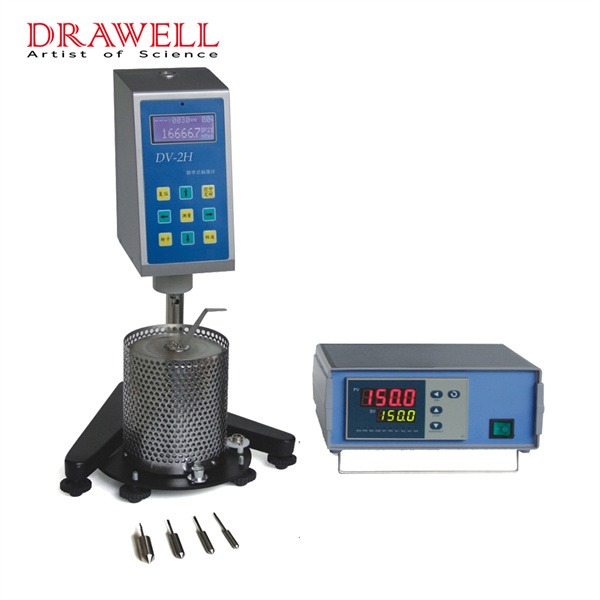
LVDV-2H High-Temperature Digital Viscometer
• Measuring Range: 5~1,000,000 mPa·s
• Rotating Speed: 0.1~200 (Stepless Gear)
• Spindles: 21、27、28、29
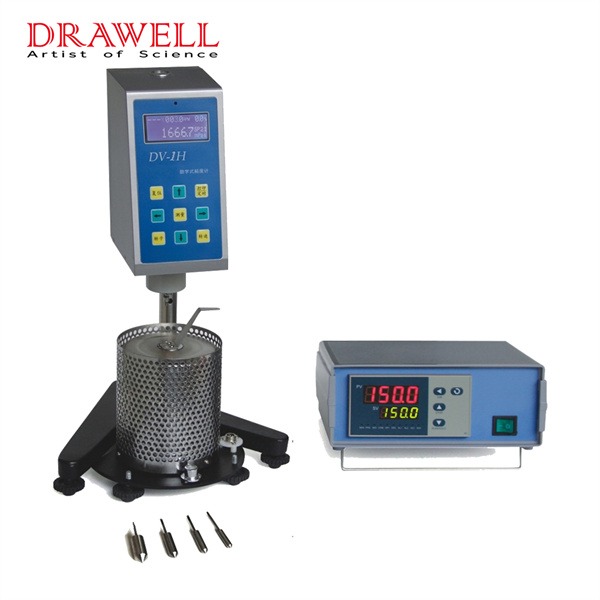
RVDV-1H High-Temperature Digital Viscometer
• Measuring Range: 100~10,000,000 mPa·s
• Rotating Speed: 0.1~99.9 (Stepless Gear)
• Spindles: 21、27、28、29
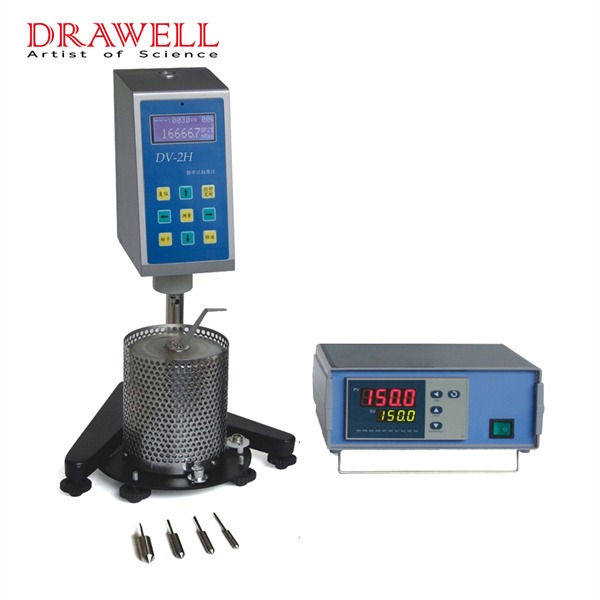
RVDV-2H High-Temperature Digital Viscometer
• Measuring Range: 50~10,000,000 mPa·s
• Rotating Speed: 0.1~200 (Stepless Gear)
• Spindles: 21、27、28、29
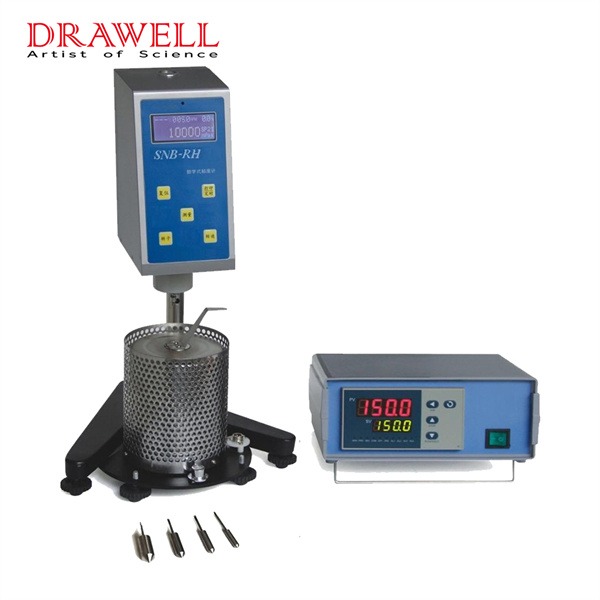
SNB-RH High-Temperature Digital Viscometer
• Measuring Range: 50~200,000 mPa·s
• Rotating Speed: 5,10,20,50,100
• Spindles: 21、27、28、29
How to Choose a Digital Viscometer
Start with the Expected Viscosity Range
Choose a model whose measurement range covers the expected viscosity of your sample. Do not select a model only by its maximum viscosity value; spindle and rotational speed also affect the available measurement range.
Low viscosity → NDJ / LVDV
Medium viscosity → RVDV
High viscosity → HBDV
Confirm the Test Temperature
For samples tested under normal laboratory conditions, select a standard digital viscometer. If the sample must be melted or maintained at elevated temperature during measurement, select an H-series high-temperature model.
Sample: asphalt / hot melt adhesive / polyethylene wax
Check the Required Rotational Speed
NDJ / SNB-RH: preset speeds
DV-1 Series: up to 99.9 RPM
DV-2 Series: up to 200 RPM
Select the Correct Spindle System
L-Series: L1 / L2 / L3 / L4
For LVDV and NDJ series.
R-Series: R2 / R3 / R4 / R5 / R6 / R7
For RVDV and HBDV standard models.
High-Temperature Series: 21 / 27 / 28 / 29
For dedicated high-temperature models.
Structure of Digital Rotational Viscometer
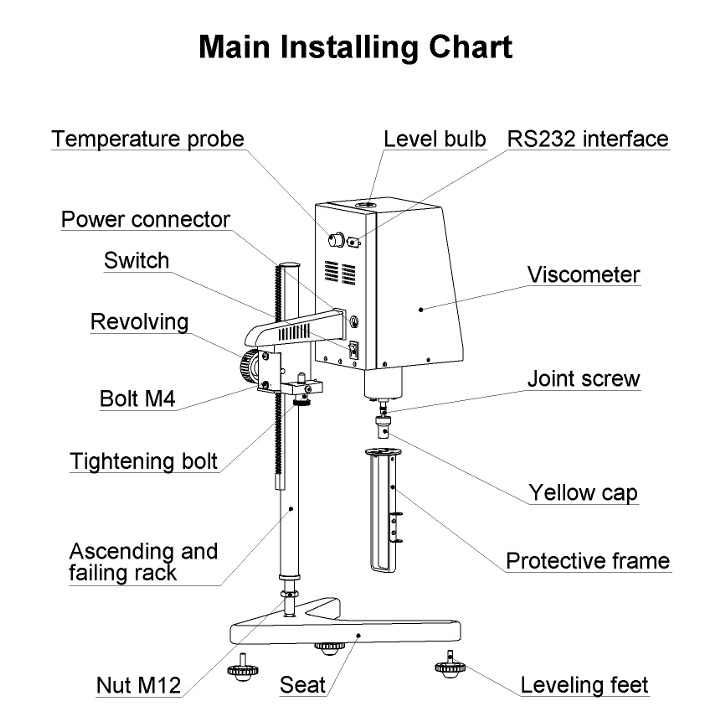
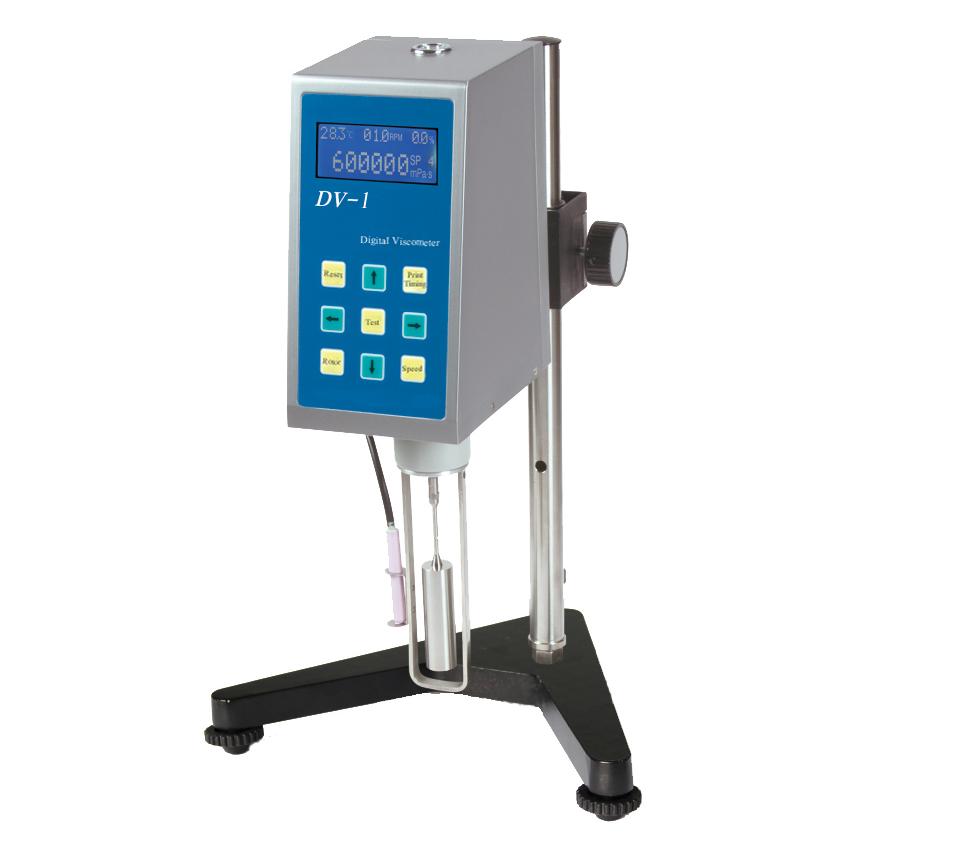
- It can be used to measure the absolute viscosity of Newtonian liquids and the apparent viscosity of non-Newtonian liquids.
- It is widely used to test the viscosity of oils, paints, plastics, coatings, detergents, medicines and other items.
Advantages of Digital Rotational Viscometer
- It can be used to describe shear thinning and time-dependent behavior and can measure the viscosity of opaque, settling or non-Newtonian fluids.
- The speed of the rotating part can be simply adjusted for easy operation.
- Connect to a computer via RS232 interface to facilitate automatic measurements.
Applications of Digital Viscometer
- Paints, Coatings & Inks
Viscosity checks for liquid coatings, printing inks and related formulations.
- Oils & Petrochemical Samples
Lubricating oils, mineral oils and related fluid products.
- Adhesives & Chemical Formulations
Adhesives, polymer solutions, detergents and liquid chemical formulations.
- Food & Daily Chemical Products
Syrups, sauces, lotions, creams and other flowable samples.
- High-Temperature Materials
Selected high-temperature models are designed for materials such as asphalt, hot melt adhesive and polyethylene wax.
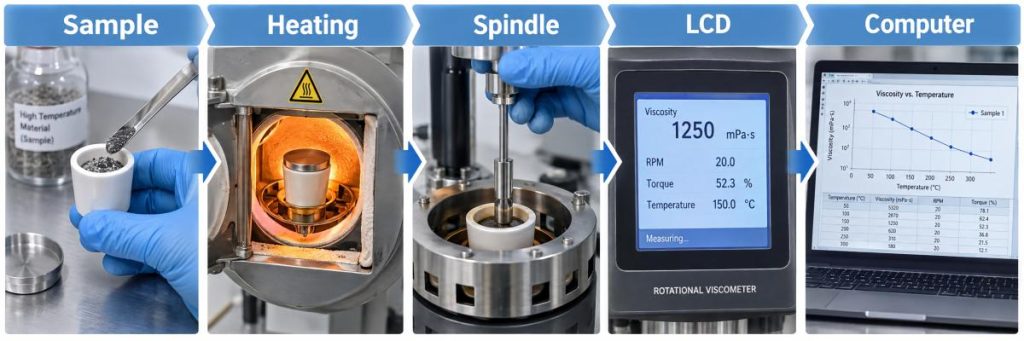
Digital Viscometer Measurement Workflow
- Prepare the Sample: Place approximately 10–20 mL of sample into the high-temperature sample container.
- Set the Test Temperature: Heat the sample to the required temperature within the available range.
- Select Spindle & Speed: Install the appropriate supplied spindle and select 5, 10, 20, 50 or 100 RPM.
- Run the Measurement: Monitor viscosity, torque and temperature directly from the display.
- Record or Analyze Data: Read the result directly or use optional VSoft for data collection and viscosity–temperature analysis.
How to Calibrate a Viscometer?
The calibration process is a precise measurement process. If the data obtained is inaccurate, the more you calibrate, the worse the test results will be. The use of standard fluids has very high temperature requirements. It can’t be guaranteed that all customers have this condition or can operate the viscometer in a standardized manner, so viscometer manufacturers will not let customers calibrate themselves.
If customers insist on calibrating themselves, they can buy standard fluids for measurement. While trying to ensure the temperature conditions, if the measurement results are very different after comparison, the equipment needs to be returned to the factory for repair, otherwise it can continue to be used.
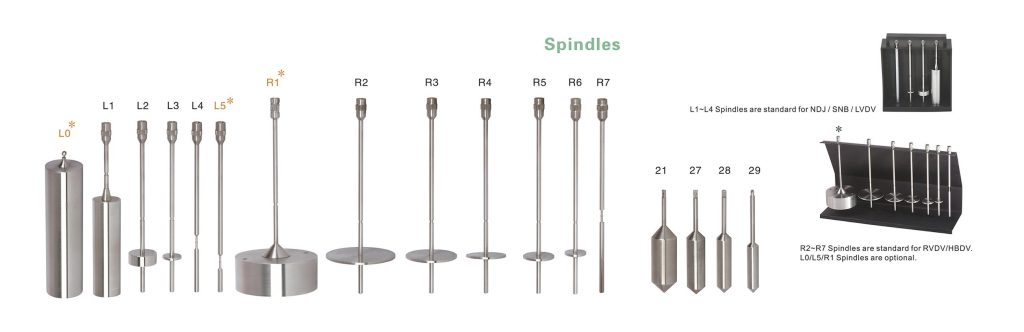
How to Select Digital Viscometer Spindle
- Spindles with mark * are optional.
- The NO. 21, 27, 28 and 29 spindles are equipped with small sample adaptor which is optional; temperature-controlled heaters are standard.
- K=1000, M=1000000.
Digital Rotational Viscometer Optional Accessories
- Extreme low viscometer adapter (with one spindle L0)
- Small sample adapter (with spindle 21, 27, 28 and 29 each)
- RTD temperature probe
- Temperature-controlled heater
- Printer
- Data acquisition analysis and plotting software
- DV programmable download software
Customer Feedback

M* H***

Germany

A* K***

Poland
S* P***

Indonesia
A* E***

Egypt
L* C***

Chile
R* A***

UAE
C* M***

Brazil
N* T***

Vietnam
J* V***

South Africa
D* R***

Mexico
E* Y***

Turkey
Why Choose Us?
“Multiple suppliers” have always been an issue in the procurement process. Drawell as a one-stop laboratory equipment and scientific instruments supplier, can perfectly solve this problem. In addition to manufacturing our own equipment, we also represent other laboratory equipment. Our product lines are rich and diverse at competitive prices. Provide one-stop service to customers.
User Training – Training by Drawell skilled engineers about installation, debug tests, technical services, etc. It can happen in our factory in China, or at the site in the customers’ country. Cost depends on where and when the training happens.
To discuss the problem and get it resolved, online chats, real-time video calls, and remote guidance. For the after-sales stage, our online technical guidance is free and ready forever.
1 year free official warranty, including repairing quality-damaged parts, and offering replacements of selected parts (shipping cost is extra). 5% of the product price is charged for extending the warranty before the end of the official warranty.
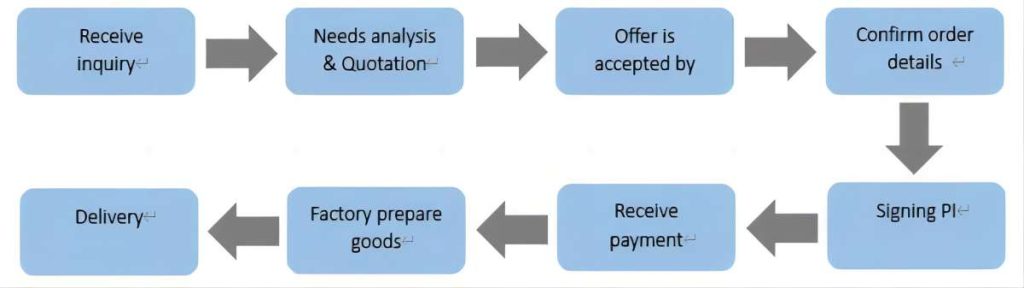
Order Process