


You’ve run the centrifuge, waited through the entire spin cycle, and expected a clean separation. Instead, the sample is still hazy. It’s one of those lab moments that is as annoying as it is confounding, especially when you’ve followed the protocol to the letter.
Poor sample separation is not only an annoyance. This can impact downstream analysis, delay results and leave you wondering whether the problem is with the sample, the technique or the equipment. In this guide, we’ll look at the most common reasons for a cloudy sample after centrifugation and go through practical approaches to resolve it.

What Should the Sample Look Like After Centrifugation?
Before we start troubleshooting, let’s establish what a successful result looks like. You would normally have a little pellet at the bottom of the tube and a clear or much clearer supernatant above it.
But “clear” is relative. In ideal settings, there may always be some degree of haze in samples that are rich in protein, lipids or fine cellular debris. The essential question is whether the separation is better than the beginning material. If the pellet is defined and the cloudiness has dropped sufficiently then the centrifuge probably performed its work. If the sample appears just about the same way as it did before the spin, something has to change.
Why Is the Sample Still Cloudy?
In many cases, sample properties and centrifugation conditions are the first things to check, but equipment and handling issues can also affect separation.
- Particle size too small: Centrifugation separates particles based on their size, density, and behavior in the surrounding medium. Submicron colloids or tiny cell detritus are very fine particles, which require significantly larger forces to sediment efficiently. A standard protocol may simply not generate enough RCF to bring them down.
- High sample viscosity: Thick or viscous samples slow particle movement through the medium. Standard spin speeds and times that work for water-like samples may be completely insufficient here.
- High particle concentration: Too many particles compete to sediment at the same time, and they can interfere with each other. This phenomenon is frequently called impeded settling. Diluting the sample before spinning can assist a lot.
The first step is always to know what is in the sample. If the particles are tough to sediment intrinsically then the next logical step is to change the centrifuge settings.

Are the Centrifugation Settings Right?
If the problem is not with the sample itself, it could be worth looking at your centrifugation parameters.
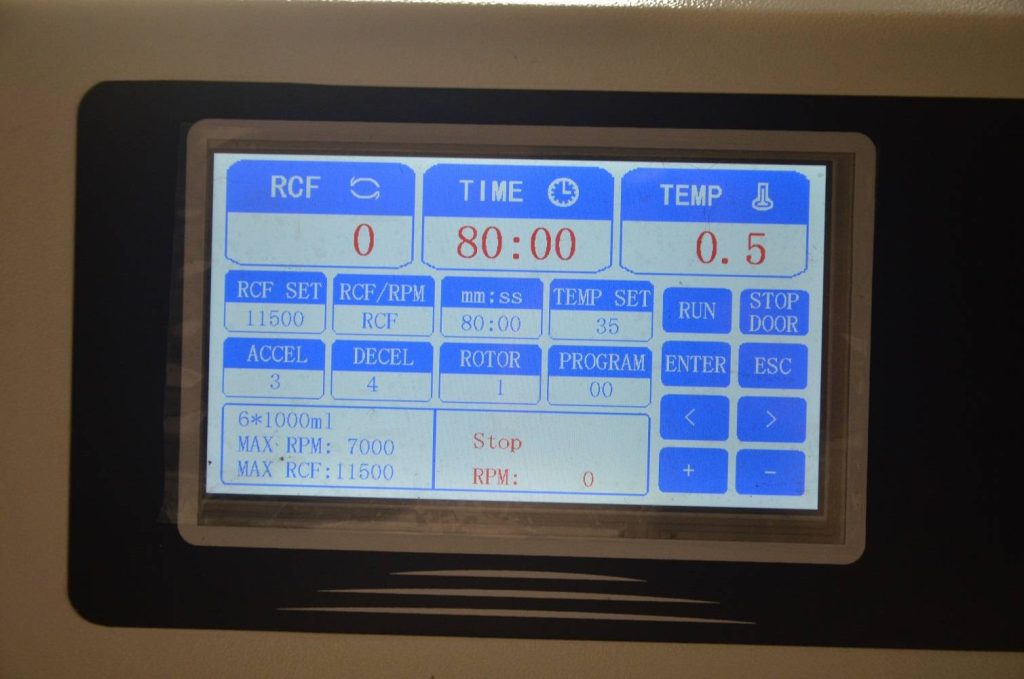
RCF (relative centrifugal force) is more important than RPM. Two centrifuges at the same RPM can produce drastically different forces based on rotor radius. Always check the RCF your protocol requires and check your device is actually delivering it. The RCF depends on the radius of the rotor and the speed of rotation. Therefore, citing RPM without rotor information is generally meaningless.
- RCF too low: If the RCF is below the recommended range for your sample, increasing it within the limits of the protocol may improve sedimentation.
- Spin time too short: Extending the centrifugation time can also improve separation, especially when the current conditions are close to the required range.
- Temperature effects: Samples that are cold generally have higher viscosity, which can slow sedimentation. If your protocol requires 4°C, make sure the centrifugation time and RCF are appropriate for that temperature and sample type.
Check the Rotor, Tubes, and Sample Handling
Hardware and technique contribute to poor sample separation more often than people expect.
- Rotor type: Fixed-angle and swinging bucket rotors are not identical. The quality of your separation can be greatly affected by using the wrong type of rotor for your application, especially with density gradients.
- Tube condition: Check tubes for cracks, deformation, or incompatibility with the rotor. Damaged or unsuitable tubes can cause leakage, imbalance, or other problems during centrifugation.
- Sample balance: Unbalanced loads put tension on the rotor and can cause unequal spacing between tubes. Opposing tubes should be balanced according to the centrifuge and rotor manufacturer’s specifications.
- Loading volume: Overloading does not allow enough room for a good pellet to develop. Ensure your samples are filled to the proper fill level for your tube type.
Cloudy Sample Troubleshooting: What to Check First
If your supernatant is hazy after centrifugation and you don’t know where to start, the table below translates typical observations to their probable explanations.
| What You See | Possible Cause | What to Check |
| No visible pellet | Target particles may be too small, too dilute, or insufficiently sedimented | RCF, time, particle properties |
| Small or loose pellet | Insufficient sedimentation or low particle concentration | RCF and centrifugation time |
| Pellet visible but supernatant still cloudy | Fine particles remain suspended | Particle size, viscosity, longer spin |
| Results vary between runs | Inconsistent sample preparation | Sample volume, concentration, rotor loading |
| Supernatant becomes cloudy during transfer | Pellet disturbance | Pipetting or decanting technique |
If you suspect a cause, check the following in sequence:
1. Check the sample first.
2. Confirm RCF and centrifugation time.
3. Check rotor and tube compatibility.
4. Review sample loading and balance.
5. Improve supernatant transfer technique.
Change one condition at a time to find out what really enhances separation.

Final Thoughts
A hazy sample after centrifugation is usually related to the sample itself, the centrifugation conditions, or sample handling after the run. The easiest way to solve the problem is to go over each factor and see what works. This is faster and more dependable than trying things out.
If you’re running into separation issues regularly and want to make sure your equipment is part of the solution, Drawell offers a full range of centrifuges designed for consistent, reliable lab performance. Browse our centrifuge selection or contact us for a recommendation suited to your application.
Get Quote Here!
Latest Posts



What Next?
For more information, or to arrange an equipment demonstration, please visit our dedicated Product Homepage or contact one of our Product Managers.


