


FTIR vs Raman. The comparison centers on detection. Each technique reads molecular vibrations in its own way. Fit to the sample and analytical goal varies. FTIR measures infrared absorption. Raman measures inelastic scattering. Two spectroscopic techniques. Different physical mechanisms. They probe molecular structure from complementary angles. Not replacements.
In practical analytical work, the choice depends on sample physical state. Water content. Potential fluorescence interference. Sample preparation requirements. No single spectroscopic technique handles every sample. Selecting the right method takes a comprehensive judgment. It combines sample properties with the specific detection goal.
What Is the Difference Between FTIR and Raman?
How FTIR Works
FTIR. Fourier Transform Infrared Spectroscopy. It obtains spectra by measuring how much infrared radiation a sample absorbs at different wavelengths. Incident infrared light interacts with molecular bonds.
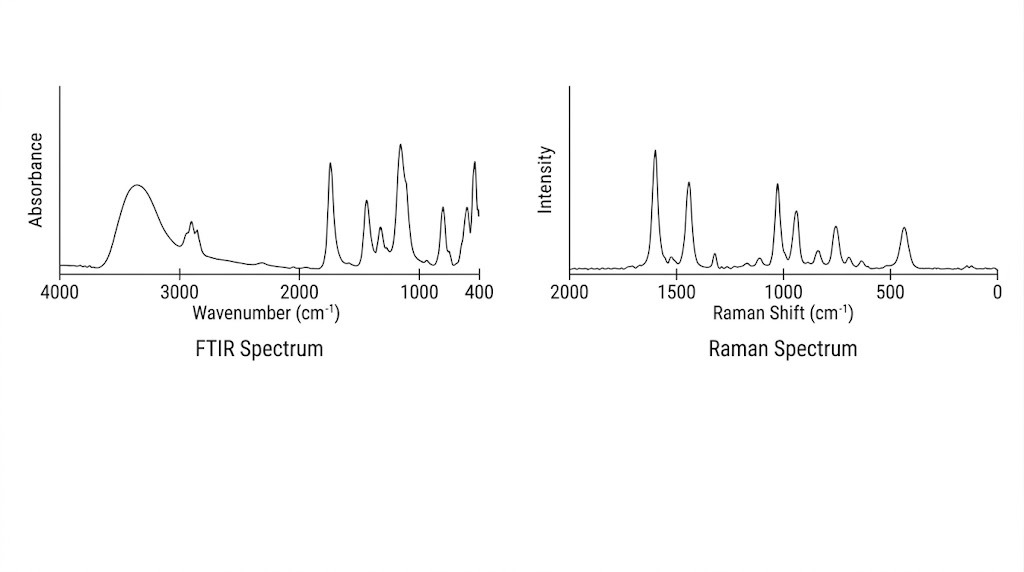
When the infrared frequency matches a molecular vibrational frequency and the vibration changes the molecular dipole moment, the molecule can absorb the light energy. That dipole-moment response drives FTIR. It identifies characteristic functional groups in organic compounds. It also provides important information for material identification and chemical composition analysis.
How Raman Works
Raman. It relies on inelastic scattering. Monochromatic laser light irradiates a sample. Incident photons interact with molecules. Most scatter elastically. A very small number exchange energy with molecular vibrations. That exchange shifts the energy of the scattered light. The Raman shift. When the molecular vibration changes polarizability, the Raman shift provides information about the molecule’s vibrational energy levels.
Why FTIR and Raman Give Different Information
Although both techniques probe molecular vibrations, they follow completely different vibrational selection rules. When a molecular vibration is accompanied by a change in dipole moment, it is usually easier to observe in FTIR. Raman, by contrast, specifically detects molecular vibrations related to changes in polarizability.
Because different molecular structures and symmetries respond very differently to these two sets of rules, some chemical bonds show strong responses in FTIR but weak or inactive signals in Raman, and vice versa. This difference in physical mechanism allows the two techniques to provide complementary information for molecular structure elucidation.
FTIR vs Raman: 7 Key Differences
1. Absorption vs Scattering
FTIR is an absorption spectroscopy technique, obtaining information by measuring changes in infrared light intensity after the sample absorbs it.
Raman is a scattering spectroscopy technique, obtaining information by detecting the frequency shift of inelastic scattered light after laser irradiation of the sample. This difference in signal generation is also an important reason why the two techniques produce different spectral responses and data characteristics.
2. Molecular Bonds and Vibrations
FTIR is more sensitive to molecular vibrations accompanied by dipole moment changes. That makes it useful for identifying functional groups. O-H, C=O, N-H, C-N. Raman is more sensitive to vibrations involving polarizability changes.
It provides information on symmetric vibrations, molecular skeletons, crystallinity, and inorganic lattice vibrations. In practical materials analysis, FTIR often handles organic materials and functional group identification. Raman supplements information on carbon materials, crystal structures, and inorganic materials.
3. Water and Aqueous Samples
The main limitation of FTIR in aqueous solution analysis comes from water’s strong absorption of mid-infrared light, which makes traditional transmission FTIR susceptible to background interference. Using ATR-FTIR can mitigate this problem by shortening the effective pathlength, making some liquid and aqueous samples still suitable for FTIR analysis.
In contrast, water usually produces relatively weak signals in Raman, so many aqueous samples can be analyzed by Raman. For high-water-content samples, Raman may therefore provide a more direct measurement path.
4. Fluorescence Interference
FTIR usually does not encounter the laser-induced fluorescence interference common in Raman. Raman uses a laser as the excitation source. Some samples contain chromophores, impurities, or organic pigments. Those can produce a fluorescence background. That background masks weaker Raman signals. When fluorescence severely affects Raman spectral interpretation, FTIR can serve as an alternative analytical method. The sample must meet FTIR sampling requirements.
5. Sample Preparation
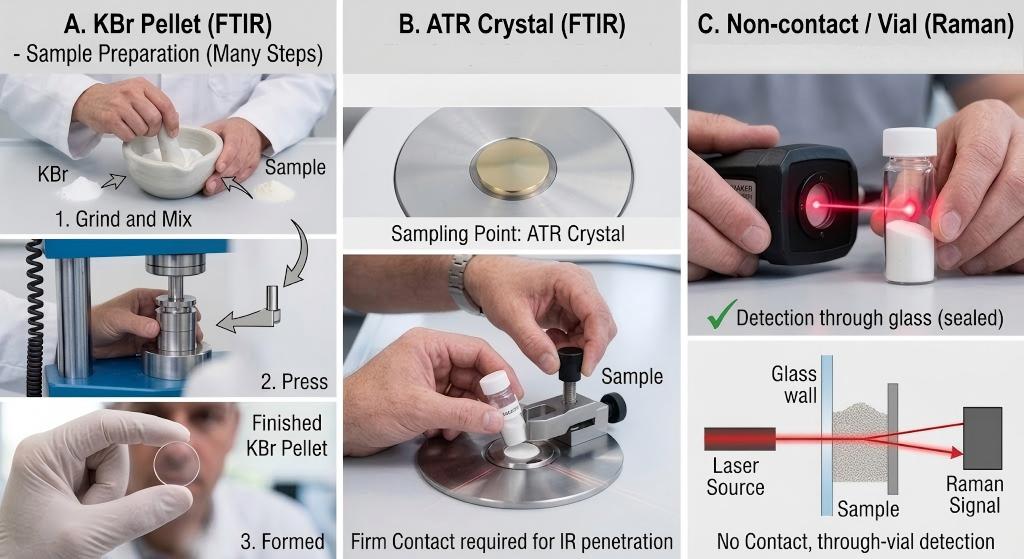
FTIR sample preparation requirements depend on the sampling mode. The specific FTIR sample preparation method depends on the sample type and the sampling mode used. Traditional transmission methods may require preparing KBr pellets or liquid films, while ATR can significantly simplify sample handling but still requires good contact between the sample and the crystal surface.
In contrast, Raman generally requires less sample preparation. Many solid powders, bulk materials, and liquids can be measured directly; with a suitable configuration, detection through appropriate transparent containers is also possible.
6. Applications and Sample Types
FTIR is commonly used for organic compound identification, polymer and plastics analysis, raw material inspection, and contaminant screening. In industrial production and materials analysis, polymer identification is one of the common applications of FTIR; liquid samples can be analyzed using corresponding FTIR liquid analysis methods according to the sampling mode.
Raman is commonly used for aqueous solutions, polymorphs, inorganic materials, and carbon materials analysis, and can also be used for pharmaceutical structure characterization and in-situ monitoring of certain reaction processes. Combined with Raman microscopy, Raman can also be used for local analysis of small areas, foreign particles, or material surfaces.
7. Complementary Information
FTIR provides vibrational information from the perspective of dipole moment changes, while Raman provides another set of vibrational information from the perspective of polarizability changes. Because the two techniques follow different vibrational selection rules, the same sample may exhibit different but complementary features in the two spectra.
When a single technique cannot provide sufficient identification information, combining FTIR and Raman can deliver more complete material characterization information.
How to Choose Between FTIR and Raman
Choose FTIR When
The primary goal is functional group identification of organic compounds, polymers, or resins.
The sample is suitable for ATR or other FTIR sampling methods.
Raman is affected by obvious fluorescence background interference.
Material comparison through established FTIR reference spectral libraries is needed.
Choose Raman When
The sample is an aqueous solution or a material with high water content.
Crystals, polymorphs, inorganic materials, or carbon-based materials need to be studied.
Reduced sample preparation is desired, or non-contact/micro-area analysis is required.
Consider Both When
The sample is a complex mixture or multi-component material. Information from a single technique is insufficient for reliable identification. Both functional group information and complementary information on molecular skeleton/crystal structure are needed.
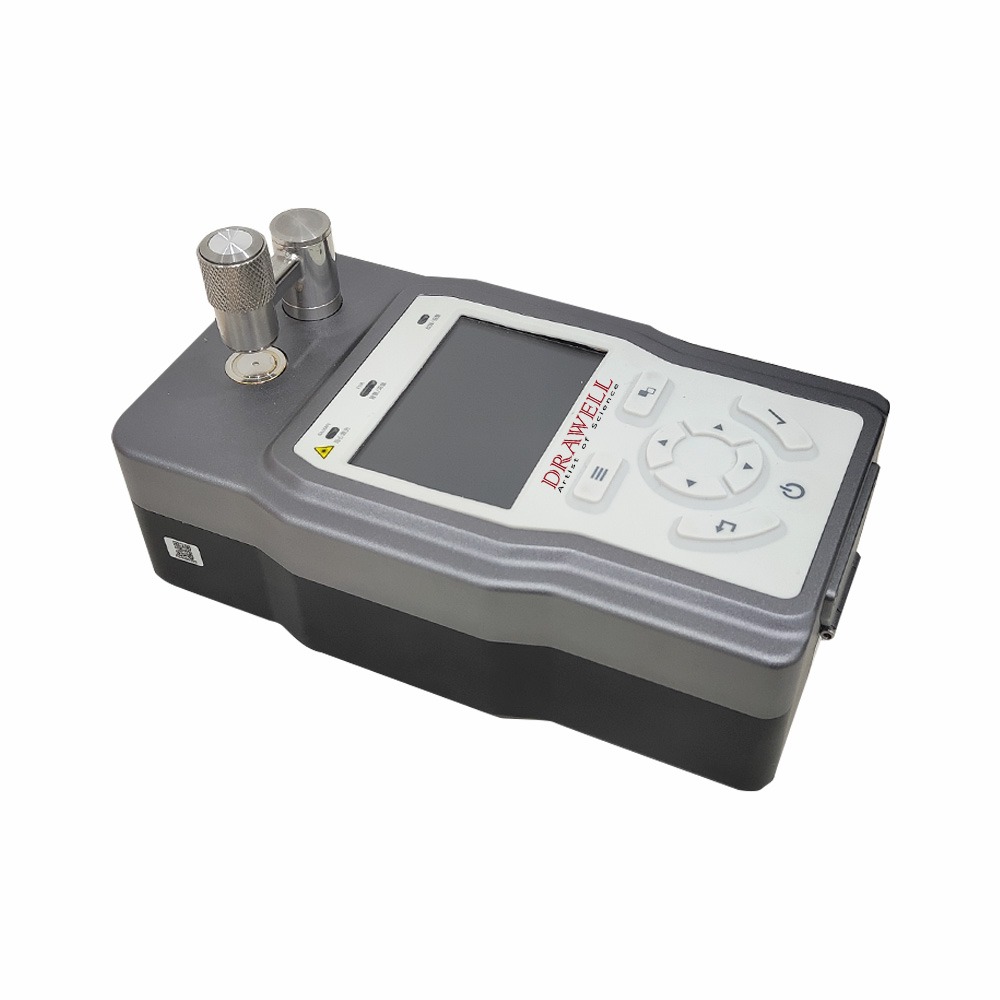
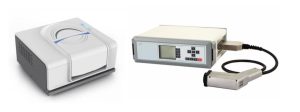
For scenarios requiring both FTIR and Raman information, integrated dual-spectroscopy equipment can reduce the need to switch between different standalone instruments. Drawell’s Portable FTIR and Raman Spectrometer DW-FR10 provides a solution that integrates both spectroscopic techniques into a portable device.
Conclusion
The choice of FTIR vs Raman ultimately depends on sample properties, the required structural information, and actual testing conditions. FTIR is generally suitable for functional group identification and organic material analysis, while Raman can be used for aqueous solutions, crystals and inorganic materials, and non-contact analysis requiring less sample preparation. When a single technique cannot provide sufficient information, the two methods can also be combined to obtain complementary material characterization data.
Get Quote Here!
Latest Posts


What Next?
For more information, or to arrange an equipment demonstration, please visit our dedicated Product Homepage or contact one of our Product Managers.


