


Let’s be honest. Few things are more frustrating in the lab than watching your HPLC baseline drift slowly upward, downward, or bounce around like it’s got a mind of its own. You know what that means. Integration gets thrown off. Quantitative results become questionable. And an entire batch of samples might end up needing reinjection.
This guide walks you through exactly what causes HPLC baseline drift and annoying hplc baseline noise, plus step-by-step ways to fix them. We’ll cover the difference between drift and noise, dive into the seven most common culprits, and give you practical troubleshooting steps that actually work. No fluff. Just actionable advice that helps you get back to running samples with confidence.
What Is HPLC Baseline Drift and Noise?
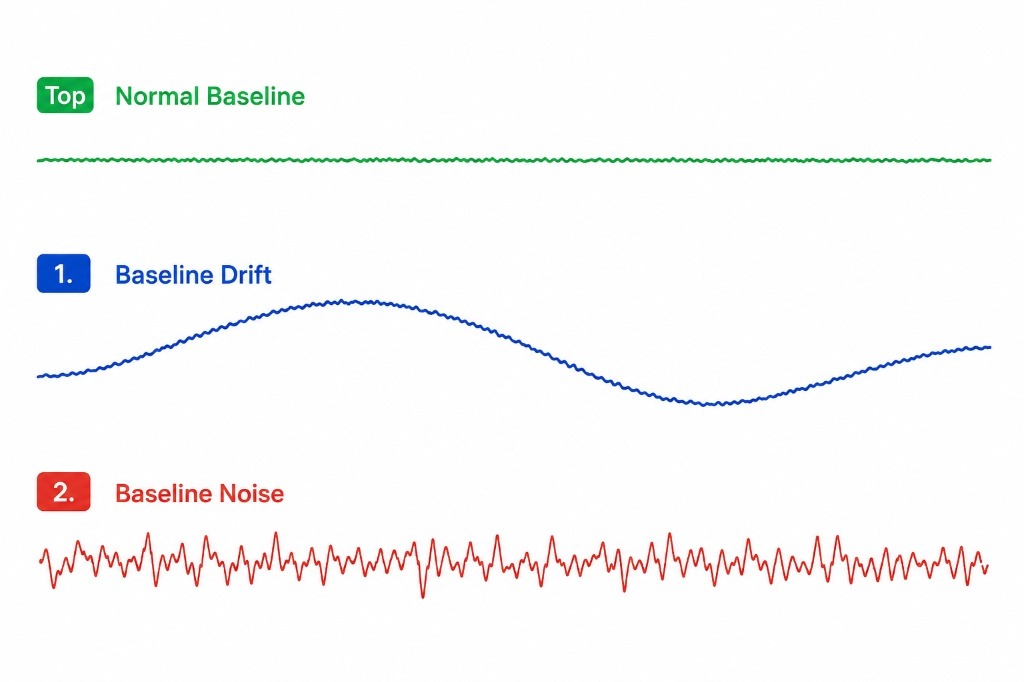
Baseline Drift vs. Baseline Noise
Let’s start with the basics so we’re on the same page.
Baseline drift shows up as a slow, continuous movement in one direction. The line creeps up or down over time. It might look gradual, almost like the baseline is taking a lazy walk. This usually ties back to changes in mobile phase composition during gradient elution, temperature shifts in the lab, or something in the system slowly washing out.
Baseline noise is different. It’s faster, more erratic. You see rapid, jagged up-and-down movements that make your chromatogram look messy. Think bubbles, pump pulsations, or a detector that’s not quite happy. Noise messes with your signal-to-noise ratio and makes it tough to integrate small peaks accurately.
Spikes are those random, sharp needle-like jumps that appear out of nowhere. A bubble passing through the flow cell, a valve switching, or even electrical interference can cause them.
Ripple is that rhythmic, wave-like pattern you sometimes see. It usually traces back to pump check valves or worn seals causing periodic flow fluctuations.
Here’s a quick reference table to help you differentiate what you’re seeing:
| Problem | What You See | Primary Causes |
| Baseline drift | Slow upward or downward trend over time | Gradient composition changes, temperature fluctuations, column contamination eluting slowly |
| Baseline noise | Fast, irregular up-and-down movement | Micro-bubbles, lamp energy loss, dirty flow cell, electronic interference |
| Spikes | Random sharp jumps | Bubbles passing through, injection valve switching, particles, external interference |
| Ripple | Regular wave-like pattern | Dirty check valves, leaking plunger seals causing periodic flow variation |
A lot of analysts panic when they see any movement at all. But here’s the thing: not every tiny wiggle means your system is broken.
When Is a Baseline Actually Abnormal?
You have to judge the baseline against your specific setup. If you’re running a UV or DAD detector at low wavelengths, say below 220 nm, you’re already operating in a region where mobile phase absorbance is naturally higher. A little bit of baseline movement at those wavelengths might be completely normal. The real question is whether the drift or noise exceeds your method’s signal-to-noise requirements or interferes with accurate peak integration. If it doesn’t affect your results, maybe just let it be.
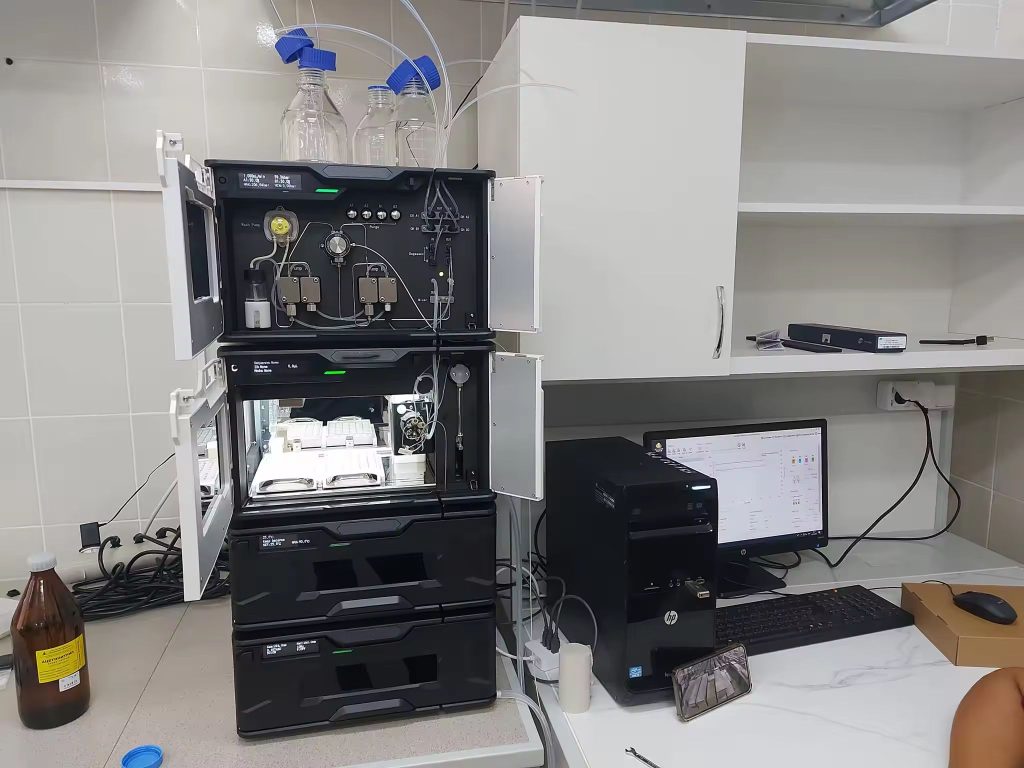
Understanding the how HPLC works and its key principles helps you see exactly which component – pump, detector, or flow path – is most likely responsible when things go wrong. That clarity saves hours of guesswork.
7 Main Causes of HPLC Baseline Drift and Noise
Let’s dig into the seven most common reasons your baseline looks off. Understanding the root cause makes troubleshooting a whole lot easier.
1. Mobile Phase Absorbance and Gradient Shift
This one’s really common in gradient methods. When your mobile phase composition changes over time, and the organic and aqueous phases absorb UV light differently, the baseline naturally shifts up or down. It’s basic physics. For instance, if your aqueous phase contains an additive like TFA that absorbs strongly at low wavelengths, and your organic phase doesn’t, the background signal changes as the proportion of organic increases. Sometimes you just have to accept a certain amount of drift. The key is making sure it’s within acceptable limits for your method.
2. Dissolved Air Bubbles in the System
Bubbles are the enemy of stable baselines. When dissolved gas comes out of solution and forms tiny bubbles, they scatter light and cause all kinds of noise. These bubbles can form anywhere: in the pump inlet, inside the pump head, in the mixer, or right in the flow cell. Whether bubbles appear depends on pressure changes, temperature, mobile phase composition, and how much gas was dissolved to begin with. Degassing your mobile phase properly is your first line of defense.
3. Pump Pulsation and Delivery Instability
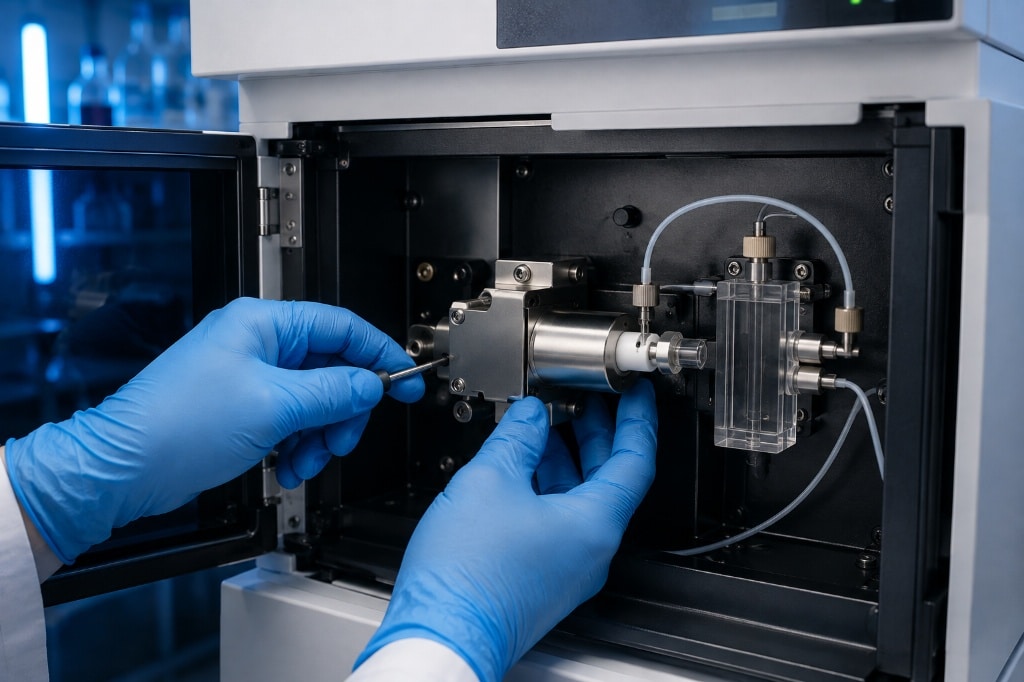
Your pump relies on check valves and plunger seals working together smoothly. If those components get dirty or worn, flow becomes uneven. That uneven flow translates directly into baseline ripple. You’ll often see a wave that matches the pump stroke frequency. It’s a dead giveaway that your pump needs attention.
4. Column Washing and Matrix Contamination
Columns degrade over time, especially if you push them beyond their recommended pH range or temperature limits. Stationary phase breakdown leads to a slowly rising baseline. On top of that, samples often contain strongly retained compounds like lipids, proteins, or pigments. These stick to the column head and gradually wash out during the run, causing background to creep up. Performing proper sample preparation for HPLC before injection can effectively remove most of that heavy matrix contamination and save your column from premature aging.
5. Ambient and System Temperature Fluctuations
Temperature changes affect solvent refractive index and even chemical equilibria. If your lab has an air conditioner blowing directly onto the instrument, or if your column oven isn’t holding temperature well, you’ll see baseline drift. Refractive index detectors are the most sensitive to this, but UV detectors aren’t completely immune either.
6. Detector Lamp Aging and Optics Drift
Deuterium lamps have a finite lifetime. As they age, light intensity drops and stability suffers. That leads to more noise and poorer signal-to-noise ratios. Dirty flow cell windows also scatter light and cause problems. Regular checks of lamp energy and flow cell cleanliness go a long way.
7. Injection and Electrical Interference
If your sample solvent doesn’t match the mobile phase composition, you can get a big disturbance right at the start of the chromatogram. Plus, if your HPLC is plugged into the same circuit as large equipment with poor grounding, you might pick up electrical noise that shows up as random baseline spikes.
How to Troubleshoot HPLC Baseline Drift Step by Step
Now let’s get practical. Here’s a structured way to figure out what’s causing your baseline issues. The time-point analysis described below is the core starting point for any systematic HPLC troubleshooting guide – you start by asking “when did it first appear?”
Step 1: Check When the Problem Starts
Take a moment to notice exactly when the baseline goes wrong. Is it there from the moment you start equilibrating? Does it only appear during the gradient? Does it happen right after injection? Or does it show up randomly after an hour of running samples? This timing gives you huge clues about where to focus your attention.
Step 2: Run a Blank Gradient
Inject nothing. Just run your gradient program with no sample. If the baseline still drifts or shows noise, you know the problem is in the system itself. It could be mobile phase, flow path, pump, temperature, or detector. If the blank run looks clean but your sample injections cause trouble, then you need to look at sample preparation, injection solvent, or matrix effects.
Step 3: Check System Pressure and Pump
Pull up the pressure trace in your software. Compare the current pressure ripple against what’s normal for your system. If you see big pressure drops with each pump stroke, that points straight to check valves or seals needing maintenance.
Step 4: Bypass the Column with a Union
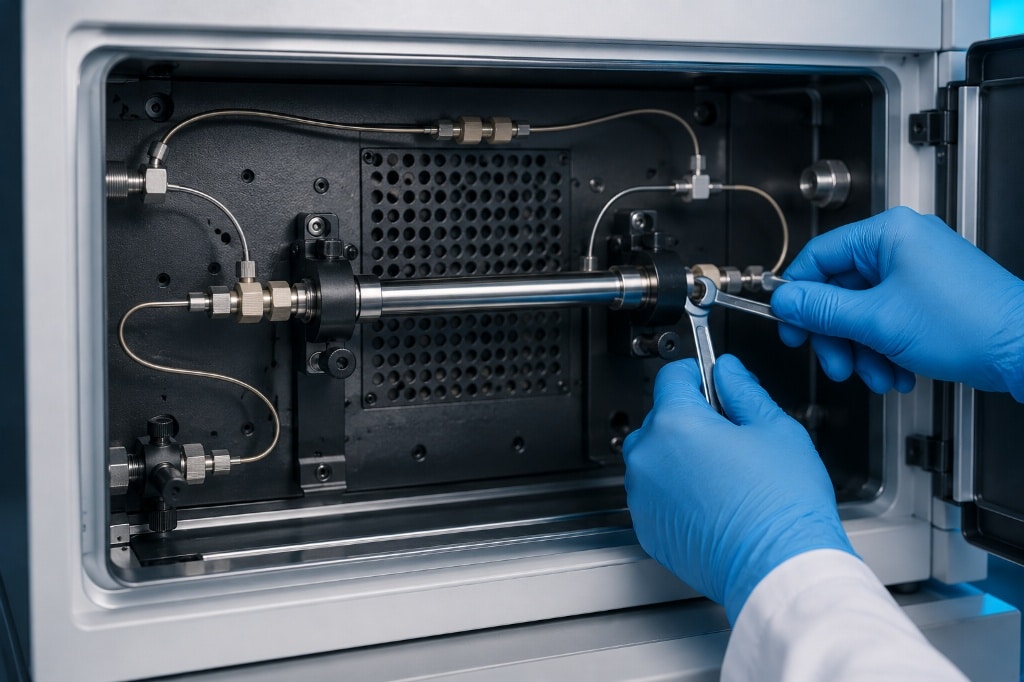
Remove the column and connect the inlet and outlet lines directly with a zero-dead-volume union. Run your mobile phase and watch the baseline. If it smooths out, you’ve identified the column as the source of your trouble. If the noise and drift persist, look elsewhere: bubbles, solvents, or the detector itself.
Step 5: Inspect Solvents and Detector Settings
Check that your solvents are fresh and properly degassed. Make sure the degasser is working. Verify lamp energy in the diagnostic software. For DAD systems, double-check your reference wavelength setting.
Step 6: Change One Variable at a Time
This is critical. Resist the urge to change everything at once. Swap solvents, clean the flow cell, and replace the column all at the same time, and you’ll never know which step actually fixed the problem. Change one thing, test, record the result, then move on.
Easy Action Steps to Fix Baseline Issues
Once you’ve identified the likely culprit, here’s what to do about it.
If the Problem Is Mobile Phase
Make sure your aqueous buffers are fresh. If there’s any sign of microbial growth or degradation, toss them and prepare new ones.
Degas your mobile phase properly. Online vacuum degassing is great, but sonicating and sparging with helium also work.
Filter all mobile phases through compatible membranes before use.
When working below 220 nm, choose high-purity solvents and additives specifically designed for HPLC to keep UV background low.
If the Problem Is Bubbles or Pump
Purge and prime the pump lines according to your instrument manual to push out trapped air.
If pressure ripple is excessive, clean or replace check valves. Check plunger seals for wear.
Consider adding backpressure. A piece of narrow-bore tubing after the detector can help keep bubbles from forming in the flow cell.
If the Problem Is Column or Detector
Flush the column in the direction recommended by the manufacturer. Reverse flushing is only allowed if the column supplier explicitly says it’s okay.
Change the guard column or inline filter if they’ve been in use for a while.
Clean the flow cell using solvents that are compatible with its materials.
Use the instrument’s diagnostic software to check lamp energy. Replace lamps that are nearing their recommended lifetime.
If the Problem Is Temperature or Electrical Noise
Turn on the column oven and set it to a stable temperature. Keep the instrument away from air vents, open windows, or direct sunlight.
Make sure the HPLC is plugged into a properly grounded outlet. Try to avoid sharing a power circuit with large motors or other noisy equipment.
Why Does HPLC Baseline Drift Down or Show Negative Peaks?
Negative Baseline Slope During Gradient Elution
Sometimes you see the baseline sloping downward during a gradient. That usually happens when the aqueous phase absorbs more UV light than the organic phase. For example, if your A phase contains 0.1% TFA and your B phase is pure acetonitrile, the TFA absorbs strongly at low wavelengths. As the proportion of B increases, overall absorbance drops, and the baseline slopes down. You can address this by matching the absorbance of your mobile phases during method development – and that’s something you’ll often refine during HPLC method development and optimization. But be careful not to change validated QC methods without proper approval.
Negative Peaks Caused by DAD Reference Wavelength
DAD detectors measure signal at your target wavelength minus signal at a reference wavelength. If the reference wavelength happens to fall on an area where the sample or mobile phase absorbs, the reference signal can be stronger than the target signal. That gives you a negative peak. To fix it, check your compound’s spectrum and move the reference wavelength to a region with no absorbance.
How to Prevent HPLC Baseline Problems
Before Each Run
Check solvent levels and clarity. Keep your pump from sucking air.
Make sure lines are purged and connections are leak-free.
Give your lamp enough warm-up time. Wait for the system to equilibrate thermally.
Run a blank injection first. Confirm that the baseline is flat and pressure is stable.
Routine Maintenance
Replace pump seals and clean check valves on a regular schedule.
Clean the flow cell periodically based on sample load and contamination risk.
Store columns in their recommended storage solvent. Never leave buffers sitting in the column.
Keep a Maintenance Log
Write down system pressure, ripple, and baseline noise at the start of each day.
Track column usage, mobile phase preparation dates, and lamp replacement dates. This historical data is gold when you’re troubleshooting later.
How Drawell Supports Reliable HPLC Analysis

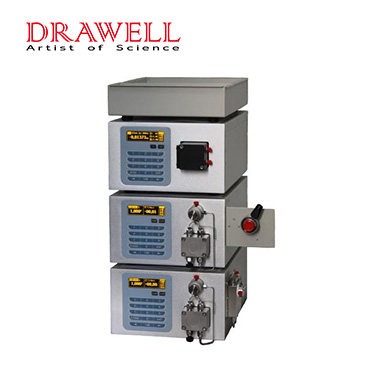
Stable Flow and Temperature Control
Consistent flow and stable temperature are the foundation of a flat baseline. Pressure ripple and temperature swings are major physical drivers of baseline instability. Drawell designs its HPLC systems to minimize these through robust hydraulic design and column temperature control, helping you get reproducible results run after run.
Detector and Degassing Options
Good detection and proper degassing reduce signal interference. Drawell systems can be configured with online degassers to control bubbles and lower baseline noise. Combined with efficient UV or DAD detectors, they provide reliable optical response even at low concentrations.
HPLC Solutions for Different Applications
Different applications have different demands. Pharmaceutical QC, environmental monitoring, and food safety testing each require specific configurations. Whether you’re doing drug purity analysis, trace environmental monitoring, or food additive testing – all these different applications of HPLC place varying emphasis on baseline flatness and anti-interference capability. Drawell offers tailored HPLC solutions, consumables, and technical support to help labs handle these diverse challenges effectively.
Final Thoughts
Chasing baseline drift and noise can be exhausting, but it’s usually solvable. Most cases trace back to one of these seven causes. The key is staying systematic: observe, test one variable at a time, and document everything. Over time, you’ll get faster at recognizing the warning signs and knowing exactly what to do. A stable baseline means better data, fewer reinjections, and a whole lot less frustration in the lab.
If you’re still stuck, don’t hesitate to reach out to your instrument supplier or check their maintenance resources. Sometimes an outside perspective makes all the difference.
Get Quote Here!
Latest Posts




What Next?
For more information, or to arrange an equipment demonstration, please visit our dedicated Product Homepage or contact one of our Product Managers.


