


Selecting between GC-FID and GC-MS systems for gas chromatography analysis is an essential decision for any lab’s daily workflow, but there is no universal “best” choice; ultimately it depends on your laboratory. In terms of routine quantitative work, GC-FID tends to be superior. Since it provides reliable results with excellent linearity when you know exactly what to look for, industrial quality control makes extensive use of this approach. GC-MS, in contrast, is essential for identification; providing both chromatographic separation and full mass spectra.
As such, this technology makes an invaluable asset when trying to identify unfamiliar compounds or confirm structures. For laboratories conducting high-volume, standard purity checks on known organic solvents, GC-FID provides optimal value. If screening environmental, food or forensic samples for unknowns that need structural proofing purposes GC-MS provides defensible evidence.
This guide covers five key areas: working principles, identification power, sensitivity costs and practical application fit so as to maximize ROI and achieve maximum return on investment (ROI).
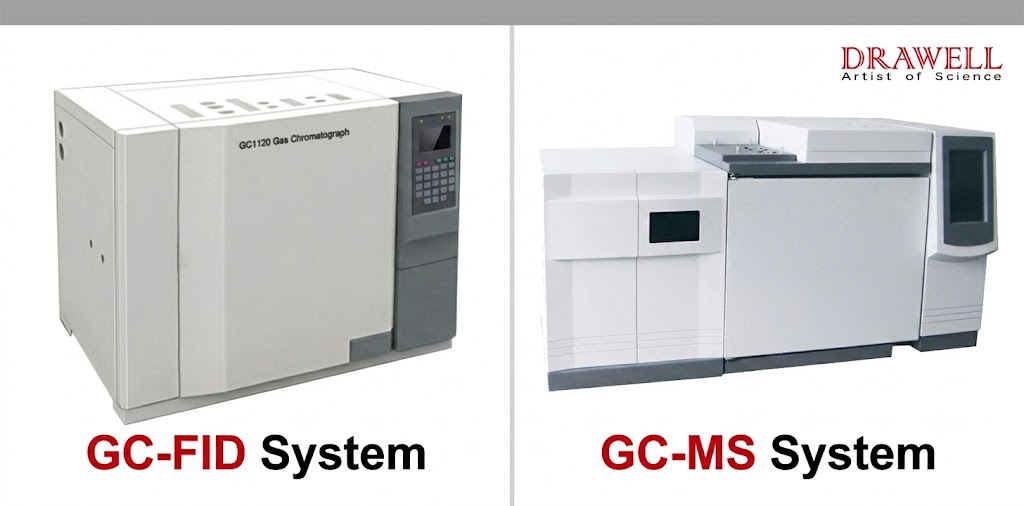
GC-FID vs GC-MS: What Is the Difference?
The Simple Guide to GC-FID (Why It Is Popular for Quantitative Analysis)
GC–FID is one of the most widely used detectors in gas chromatography for routine organic compound analysis.
Here is the thing about FID. For most organic compounds, the response you get is roughly proportional to the mass of carbon entering the detector. That makes life pretty simple. As long as you have a standard curve and reference materials for the components you care about, FID gives you rock–solid stability, great reproducibility, and low day–to–day maintenance costs. It just keeps running.
That said, it is not perfect for everything. FID responses drop significantly for certain structures like carbonyls, halogenated hydrocarbons, or highly oxidized organics. And if there is no carbon in the molecule? You get basically no response at all.
Full name and role: Gas Chromatography with Flame Ionization Detector. It is the foundation of volatile organic compound analysis.
Wide linear dynamic range: This is a big plus. FID handles both high and low concentrations without making you do endless dilutions. That saves time and cuts down on errors.
Quantitative stability: The physical design is not easily thrown off by changes in temperature or humidity. Baseline drift is minimal, which is why industrial labs and routine contract testing facilities rely on it as their go–to quantitative reference.
The Simple Guide to GC-MS (Why It Is Better for Identifying Unknown Compounds)
GC–MS takes the separation power of gas chromatography and pairs it with the advanced identification capabilities of mass spectrometry. For complex unknowns, this system really shines.
Once compounds elute from the column, they hit the ion source and get fragmented into characteristic ion patterns. That spectrum is like a molecular fingerprint. To help figure out what you have got, the system can match those patterns against standard reference libraries like NIST. If you want to get the most out of your GC–MS, understanding key operational aspects of GC–MS is essential for maintaining ion source performance and getting accurate library search results.
Hardware integration: Gas Chromatography–Mass Spectrometry combines chromatographic separation with structural confirmation.
Characteristic mass spectra: Using techniques like electron impact (EI) ionization, molecules are fragmented. The system records the mass–to–charge ratios (*m/z*) and relative abundances of those fragments, so you can distinguish compounds at the molecular level.
Qualitative confirmation advantage: In research, food safety screening, and multi residue analysis, GC–MS gives you solid qualitative backing. It cuts down on false positives that can happen when you rely only on retention times.
Are GC-FID and GC-MS Different Instruments?
From a hardware perspective, these two are not entirely separate instruments. They actually share the same front–end gas chromatography system. The real difference is what you put at the end.
For lab managers or procurement folks who do not live and breathe chromatography every day, here is the key takeaway. The GC itself handles the physical separation. That includes the inlet, carrier gas controls, oven, and column. Without a detector, those separated compounds just go out into the air and you never see them. FID and MS are simply two different types of “sensing systems” that you attach at the finish line.
Shared separation front end: Whether you are setting up FID or MS, the GC portion is essentially the same. The separation logic, the capillary columns, the injector, and the electronic pneumatic control (EPC) system are all common. Both systems rely on the same core components, which are driven by the core components of a gas chromatography system including carrier gas flow controls, inlet, and column oven.
Where they split at the back end:
GC–FID systems: The column outlet connects to a hydrogen flame ionization jet that runs at atmospheric pressure. The whole setup is relatively simple and does not demand much from your lab environment.
GC–MS systems: The column outlet connects through a heated transfer line to a precision mass detector that operates under high vacuum. You are talking about things like single quadrupole mass analyzers. The manufacturing tolerances and control requirements are significantly tighter.
How Do GC-FID and GC-MS Work?
Both systems follow the same separation process at the front end. But once the compounds come off the column, the signal conversion and output take completely different paths due to the different physics of each detector.
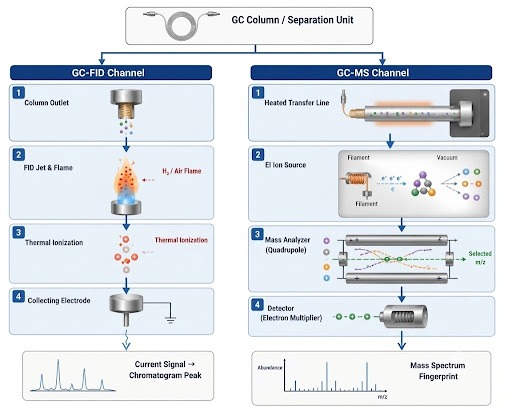
To keep things precise, we can break the core operation of both systems into three standard stages:
GC Separation Process: Your sample gets vaporized instantly in the inlet and carried into the column by high–purity carrier gas. As the molecules move through, they partition back and forth between the stationary phase and the mobile phase. Since each compound has different boiling points and affinities for the stationary phase, they exit the column at different times. Before those compounds ever reach the detector, a lot depends on whether you have chosen the right gas chromatography column based on polarity and boiling point of your samples.
GC-FID Detection Process: As the separated compounds exit the column, they flow into the detector and enter a hydrogen–air flame. They get pyrolyzed and ionized. The resulting carbon ions move under an applied voltage, creating a small current. That current gets amplified and turned into a chromatographic peak area in your software.
GC-MS Detection Process: The separated compounds exit the column and pass through a vacuum interface into the ion source of the mass spectrometer. Under electron impact (EI) ionization, high–energy electrons shatter the molecules into characteristic ionic fragments. Those charged fragments are accelerated into the mass analyzer, typically a quadrupole. The quadrupole uses RF and DC voltages to filter ions by their mass–to–charge ratio, letting only specific *m/z* values reach the electron multiplier detector. The system then plots the abundance of each fragment to give you a full mass spectrum.
The 1-Minute Core Comparison Table
If you are in a hurry and just need the highlights, here is a quick reference table. We have pulled together the core technical and practical considerations for these two detectors.
| Technical Feature | GC-FID System | GC-MS System |
| Detection & Signal Principle | Flame Ionization (hydrogen flame, current from carbon ions) | Mass–to–Charge Ratio (*m/z* filtering and structural analysis) |
| Qualitative & Structural Identification | Limited: mostly relies on retention time matching with known standards | Excellent: supports spectral library searching and unknown structure elucidation |
| Quantitative Stability & Accuracy | Outstanding: very wide linear range and excellent repeatability | Good: accurate but demands more careful calibration and standard curve maintenance |
| Best Suited Sample Types | Simple, Known Mixtures: routine industrial samples, pure solvents with expected components | Complex, Unknown Matrices: unknowns in complex backgrounds, trace target screening |
| Analytical Focus & Strength | Linearity & Repeatability (high precision quantitation of routine organics) | Selectivity & Identification (qualitative and selective analysis in complex matrices) |
| Hardware Complexity & Maintenance | Low. Rugged, resists contamination, easy for non specialists to maintain | High. Requires regular vacuum system upkeep, filament changes, and ion source cleaning |
GC-FID vs GC-MS Sensitivity: Which Detector Meets Your Limits?
When you are comparing detection limits, GC–MS usually wins on selectivity in complex matrices. GC–FID gives you a wider linear range for high concentration work in cleaner samples.
Here is the nuance that often gets missed. You cannot really talk about “sensitivity” in isolation. You have to consider the sample background. In a clean solvent, FID gives you excellent and stable response for hydrocarbons. But when your trace analyte is buried in soil extracts, food matrix, or biological fluids, a conventional detector often struggles.
GC–MS provides superior selectivity for trace analysis because it can distinguish compounds based on their mass spectral features. This lets the system filter out a lot of background interference and pull out the target signal even at very low concentrations.
GC-FID response and linearity characteristics:
It is great for major components at moderate to high concentrations. For most volatile organic chemicals, the response is predictable with low drift.
It has a very wide linear dynamic range. That means if your target compound concentrations vary quite a bit across samples, FID still gives you reliable quantitation. Mass spectrometers, on the other hand, are more prone to signal saturation or overload when you hit high concentrations.
GC-MS selectivity and trace advantage:
With its precision ion filtering and amplification, GC–MS delivers high value in trace analysis.
Data published in the PubMed National Library of Medicine on toxicology and clinical detection limits shows that in selected ion monitoring (SIM) mode, the mass spectrometer can lock onto characteristic fragment ions of your target. Even when the overall matrix background is high, it effectively excludes noise and gives you confident trace level tracking.
GC-FID vs GC-MS Cost: Which One Fits Your Budget?
When you are looking at instrument budgets, you need to look beyond the sticker price. Total cost of ownership (TCO) and long–term return on investment matter just as much.
There are two common traps in this decision. One, labs sometimes buy a flagship MS system because it sounds impressive, but they do not really need that capability. Then the instrument sits idle because of high gas costs and the lack of skilled operators. Two, labs go with a basic FID to save money upfront, but later they face unknown compound disputes from clients or regulators. Then they end up sending samples out to a third party lab for MS confirmation, which drives up long–term costs.
Total Cost of Ownership (TCO) includes these factors:
Initial hardware investment: MS systems are significantly more expensive due to the precision vacuum components, turbo molecular pumps, and sophisticated electronics. FID is much simpler and cheaper.
Daily carrier gas and consumables: GC–MS typically runs on high–purity helium, though some users are switching to hydrogen given recent helium supply issues. That switch brings extra costs for hardware adjustments and safety considerations. GC–FID can usually run on more economical hydrogen and air generators right out of the box.
Staff expertise and maintenance: MS requires trained operators who understand spectral interpretation and high–vacuum maintenance. FID is rugged and forgiving, so training costs are lower, and the risk of costly downtime from operator mistakes is reduced.
Real Examples: Choosing GC-FID or GC-MS in Different Tests
How do you actually choose between the two GC detection methods in real world applications? Here are three typical scenarios that show the logic behind the decision.
Example 1: Purity Control of Fatty Acid Methyl Esters (FAMEs) in Biodiesel
Recommended setup: GC-FID
Why: Methods like EN 14103 involve well–defined samples where you already know which fatty acid components to expect. The bottleneck is throughput and reproducibility. FID gives you a wide linear range and the quantitative durability you need for high volume batch release. It also stands up well to high–boiling impurities without constant downtime.
Example 2: Industrial Compliance Screening and Emergency Unknown Environmental Contaminants
Recommended setup: GC-MS
Why: When you are dealing with environmental regulations, illegal dumping, or unknown waste chemicals, you are in a non–targeted scenario. FID will just show you peaks with no identity. You have no standards to match retention times against. GC–MS lets you search against spectral libraries and provides defensible identification for regulatory or forensic investigations.
Example 3: Composition Analysis and Routine Quality Control of Natural Plant Essential Oils
Recommended setup: Combined approach (GC-FID and GC-MS together)
Why: Natural flavors and fragrances can contain hundreds of volatile components. Established labs often use a two–step strategy. First, they run full–scan GC–MS on a new batch to identify all those complex aroma compounds and establish a reference. Then, for daily production quality control, they switch to GC–FID for routine concentration monitoring to save on operating costs while keeping quantitation reliable.
Do GC-FID and GC-MS Require Different Sample Preparation?
Sample cleanliness and volatility directly affect how long your detector lasts. These two systems have quite different tolerance levels for sample prep quality.
GC-FID sample prep characteristics: The workflow is generally more straightforward. You mainly need to remove particulates and water. FID is more tolerant of contamination compared to MS. Even if some non–volatile residue builds up on the jet or collector, cleaning is relatively simple and you can get the hardware back online quickly.
GC-MS sample prep characteristics: To protect the ion source and quadrupole, which operate under high vacuum, samples need rigorous extraction and cleanup. Some applications may require derivatization to improve volatility or detection performance, particularly for sugars or certain amino acids. As discussed in ScienceDirect Elsevier Analytical Research, derivatization helps adjust polarity and thermal stability, so you get cleaner, more informative mass fragments.
How to Choose Between GC-FID and GC-MS: 3 Practical Steps
To make sure your lab gets the right system without overspending, we recommend walking through these three steps before you submit that purchase order.
Step 1: Define Your Analysis Goal: Start by figuring out your primary mission. Are you doing routine quantitative analysis of known compounds? Then GC FID should be your first look. Are you identifying unknowns, doing R&D, or reverse–engineering complex mixtures? Then GC MS is probably the way to go. This is the core decision point when choosing between standard GC and GC–MS.
Step 2: Assess Sample Complexity and Baseline Noise: Take a hard look at your sample matrix. If you are working with relatively pure industrial raw materials or defined petrochemical fractions, FID gives you excellent linearity at low cost. If you are dealing with messy biological extracts or soil samples with pesticide residues, you need the ion filtering capabilities of MS to avoid false positives and false negatives.
Step 3: Evaluate Technical Upgrades and Future Capacity: Think about where your lab might be in three to five years. Platforms that support modular detector configurations, like those from Drawell, let you start with FID for today’s needs and add MS capability later without replacing the whole system. That keeps your upfront investment manageable while leaving the door open for future expansion.
Conclusion
So, where does that leave you? Choosing between GC-FID vs GC-MS really depends on whether your lab prioritizes cost-efficient routine quantitation or advanced unknown identification.
Maybe you just need a rugged, reliable workhorse for production quality control. Or maybe you need a high-end MS platform for cutting-edge research and selective trace analysis. Either way, a good applications engineer can walk you through the specifics based on your compound types, regulatory requirements, and total budget.
The right choice is the one that fits your samples, your team, and your long-term goals. And now you have the framework to make that call with confidence.
Get Quote Here!
Latest Posts
What Next?
For more information, or to arrange an equipment demonstration, please visit our dedicated Product Homepage or contact one of our Product Managers.


