


If you work in pharmaceutical or biopharmaceutical manufacturing, you already know that cleaning validation isn’t just a box to check. It’s a critical safeguard against cross-contamination. And when it comes to organic residue detection, TOC cleaning validation has become one of the most practical, widely adopted approaches out there.
But here’s the thing. TOC—or Total Organic Carbon—doesn’t look for a specific drug compound. Instead, it measures the total amount of oxidizable organic carbon present in a rinse sample or on a swab taken from equipment surfaces. This gives you a broad picture of whether your cleaning process actually removed organic soils. No, it won’t tell you exactly what is there. But it will tell you how much organic stuff remains. And for routine monitoring, that is often more than enough.
This guide covers the whole workflow. Sampling strategies. Analytical considerations. Recovery studies. Acceptance criteria that actually make sense. And an honest look at the method’s limitations. The end goal is a testing process that is scientifically sound and ready for an inspection.
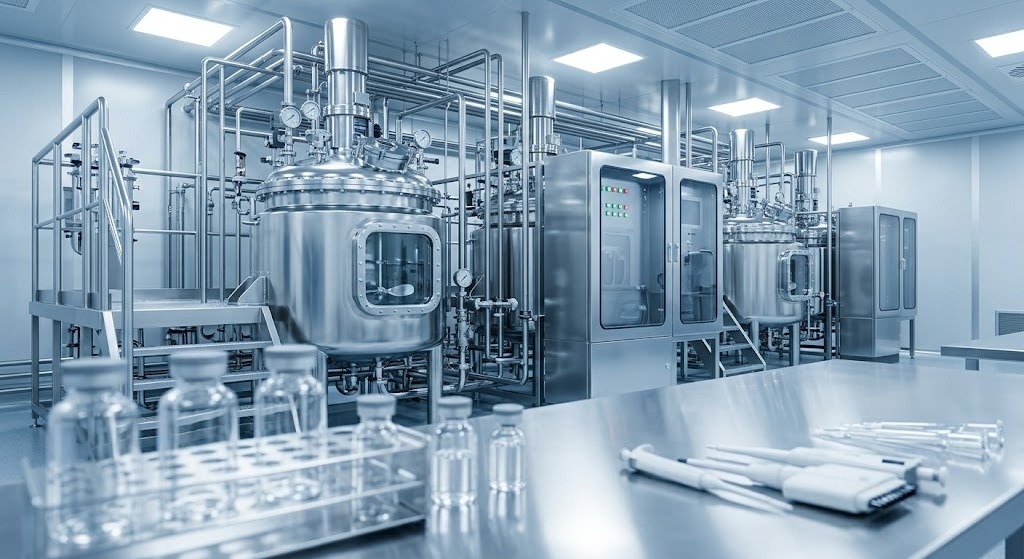
What Is TOC Cleaning Validation?
Equipment gets reused across different batches in pharmaceutical production. That means you need hard proof that cleaning reduces residues to safe levels. Without that proof, you risk contaminating the next batch. No shortcuts here.
TOC cleaning validation is simply the use of a TOC analyzer to measure organic carbon extracted from equipment surfaces—either via a rinse sample or a surface swab. The result gives you a quantitative handle on organic cleanliness.
TOC detects a wide range of organics. Active pharmaceutical ingredients. Degradation products. Excipients. Even leftover cleaning agents. But TOC is non-specific. It cannot tell whether the carbon came from Compound A or Compound B. It simply measures the total organic carbon that gets oxidized to CO₂ during the analysis.
This non-specific nature is both a strength and a limitation. We’ll get into that more later.
Take the USP <643> standard as a reference. It defines TOC as an indirect measurement of organic molecules based on carbon mass. That same principle underpins its use in pharmaceutical water systems. And by extension, it applies directly to cleaning validation.
Why Use TOC for Cleaning Validation?
So why go with TOC instead of something more specific like HPLC? The short answer: efficiency.
Developing a separate, targeted analytical method for every single API, excipient, or degrader is expensive and time consuming. Most of these compounds contain carbon. So TOC gives you a single, broad assay that can catch organic residues across the board. That makes it a very attractive tool for routine monitoring.
Think about a typical equipment surface after cleaning. You might have residual API, some leftover surfactant from the detergent, and maybe a degradation byproduct. Setting up individual methods for each would be a regulatory and logistical nightmare. With TOC, you just need to show that your residues can be extracted and oxidized under the conditions used. Once that is confirmed, you are essentially good to go.
But—and this is important—because TOC is non-specific, it cannot tell you the chemical identity of the residue. If your TOC result spikes, you might not know if that came from an API, a cleaning agent, or even environmental contamination. So TOC works best as a broad screening tool. It should not be the sole method for highly toxic or potent compounds, where specific identification is critical.
How Does TOC Cleaning Validation Work?
Running a proper TOC cleaning validation study isn’t just about sticking a sample into an analyzer and reading a number. There is a logical, stepwise process that ensures your data is accurate, defensible, and actually meaningful.
Here are the 7 essential steps.
Step 1 — Set the Residue and Acceptance Limit
First, you need to know what you are looking for. Identify the target residues that could remain on equipment after cleaning. Then, based on toxicological data (like ADE or PDE values), calculate the maximum allowable carryover (MACO) for the next product.
But here is the key. You can’t just use the TOC limit for purified water. That would be way too simplistic. You have to convert the MACO into a TOC-based acceptance criterion. That conversion takes into account:
- The carbon fraction of your target residue
- The surface area of the equipment
- The volume of rinse or extraction solvent used
- The validated recovery rate
So it is a calculation, not a guess. Get this wrong, and your entire validation is built on sand.
Step 2 — Check Solubility and Oxidizability
Before you go any further, verify that your target residues can actually be extracted by your chosen solvent. And just as important, confirm they can be fully oxidized under the conditions inside your TOC analyzer.
This is a laboratory exercise. Your residue might not dissolve well in water or your extraction solvent. That makes swab results unreliable. Some molecules also resist oxidation. A highly refractory compound. Then the TOC reading comes out lower than the real residue level. Inspectors pay close attention here. Do not skip this verification.
Step 3 — Choose Rinse or Swab Sampling
Now, how are you going to collect the sample? Two main approaches exist: rinse sampling and swab sampling.
Rinse sampling is simpler. You flush the equipment surface with a known volume of solvent and collect the effluent. It works well for pipes, hoses, and areas that are hard to disassemble. However, it might not fully capture residues that are tightly adhered to surfaces.
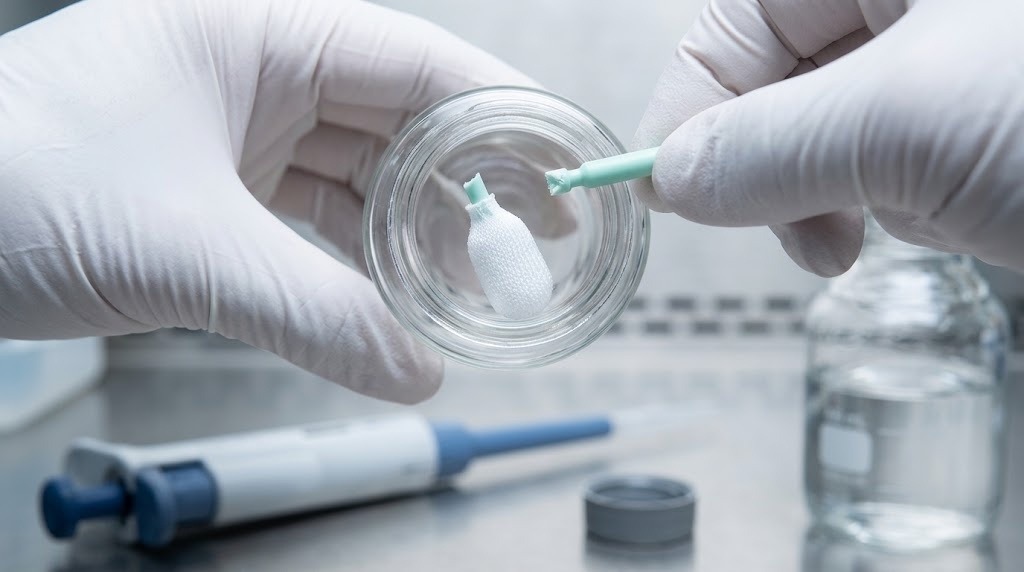
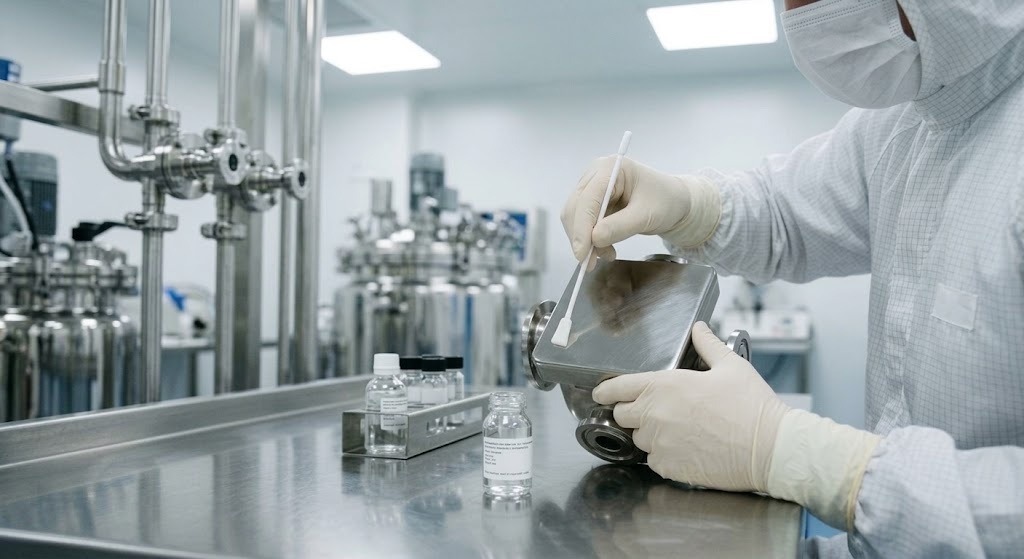
Swab sampling is more targeted. You use a low-TOC swab to physically wipe a specific area, usually the worst-case spots like valves, seals, or corners. The swab is then placed into extraction solvent. This method gives you a more precise picture of the hardest-to-clean locations.
In practice, many companies use both. Rinse for general coverage, swabs for the critical zones. After the swab is extracted, the liquid sample is then analyzed using the standard process for analyzing liquid samples on the instrument.
Step 4 — Prepare Samples and Blanks
This step is all about controlling background carbon. If your blanks are dirty, your sample results are meaningless.
You need multiple types of blanks: solvent blanks, vial blanks, and swab extraction blanks. These help you account for any carbon contributed by the sampling materials themselves. Also, pay attention to sample holding time. If you leave samples sitting around too long, CO₂ from the air can dissolve in, or volatile organics can escape. Either way, your numbers drift. Validate that holding time before you start generating data.
Step 5 — Run the TOC Analysis
This is the part people usually think about first. Load your prepared samples into the TOC analyzer. Depending on the chemical characteristics of the residue, the system will adopt a matching TOC analysis method to oxidize the organic carbon. The instrument then measures the resulting CO₂, either by conductivity or NDIR, and calculates the TOC concentration.
Make sure the analyzer is calibrated and that your system suitability checks are current. Different analyzers use different oxidation principles; some are better suited for certain compound classes.
Step 6 — Compare the Result With the Limit
Here is a common pitfall. Many people take the raw TOC result and directly compare it to the acceptance limit. That is not correct. You need to factor in the recovery rate determined during method validation.
For example, if your validated recovery is 80%, you would adjust the measured value accordingly before making a pass/fail decision. The exact correction procedure should be predefined and documented in your validation protocol. Do not make up corrections on the fly.
Check your LOQ. It must be low enough. If the LOQ sits above your acceptance limit, the method cannot measure reliably at the level you need. That is a basic flaw.
Step 7 — Document and Trend the Results
Document every detail. Sampling points. Sample IDs. Blank values. Recovery corrections. Final results. The pass/fail decision. But do not stop at one batch. Look at data across batches. A slow upward creep over time, even below the limit, is a warning. Could be SOP drift. Equipment wear. A subtle change in cleaning agent performance. Trending catches problems early. Do not wait for an audit to find out.What Should You Check Before Accepting a TOC Result?
Before you sign off on TOC data and present it to regulators, run through this checklist. The quality department should examine these key elements based on the core considerations outlined in the FDA cGMP equipment guidance.
- Method suitability: prove that the residue dissolves and oxidizes completely under your conditions.
- Recovery study: run recovery experiments on actual equipment materials, like 316L stainless steel or PTFE.
- Background carbon: blank TOC levels should stay low and stable.
- LOQ adequacy: the method must quantify below your acceptance limit. Worst-case sampling: swab the toughest spots, like dead legs, valves, and connections.
- Sample holding time: analyze within the validated time window. If you cannot confirm any of these, you have a gap to fix.
TOC vs HPLC for Cleaning Validation
When you are building a cleaning validation strategy, the TOC versus HPLC question almost always comes up. Both have their place. The table below highlights the core differences.
| Aspect | TOC | HPLC |
| Detection target | Total oxidizable organic carbon | Specific target compound(s) or impurities |
| Specificity | Non-specific, broad screen | Highly specific, qualitative and quantitative |
| Method development complexity | Focus on dissolution and oxidation | Requires unique mobile phase, column, and separation conditions |
| Multi-residue mixtures | Fast, total carbon reading | Individual peak analysis and quantitation |
| Molecular identification | Cannot identify chemical structure | Can identify predefined compounds with appropriate detectors |
| Typical use cases | General organic monitoring, routine cleaning validation | High potency / high toxicity residue confirmation |
So, the bottom line is this. TOC is a powerful, efficient tool when your residues are soluble and oxidizable. But it is not a universal replacement for HPLC. For highly toxic or sensitizing compounds, you still need specific, targeted methods.
What Are the Limits of TOC Cleaning Validation?
Let’s be realistic. TOC is useful, but it is not magic. Understanding its limitations is essential to using it correctly.
First, the non-specificity again. If TOC is high, you do not know what is causing it. API residue? Cleaning agent leftover? Maybe even a contaminated swab? You need additional investigation to determine the root cause.
Second, not all organic compounds respond equally. Some are difficult to oxidize. Some are nearly insoluble. These can give you artificially low recoveries, leading to a false pass. If your residue falls into that category, TOC might not be the right method.
Third, background carbon is a constant nuisance. CO₂ from room air can dissolve into samples. Vial caps can leach trace organics. Even the ambient environment in your lab can contribute. At trace levels, these interferences can skew your results significantly.
And finally, just because your TOC analyzer is qualified for pharmaceutical water testing does not mean it is automatically validated for your cleaning study. Method validation is specific to the residue, the surface material, and the sampling procedure. You have to do that work separately.
Which TOC Analyzer Fits This Application?
Choosing the right analyzer depends on what you are testing. Laboratory samples and online water monitoring have different requirements. Here are two common configurations.
DW-DI1500 for Laboratory TOC Testing
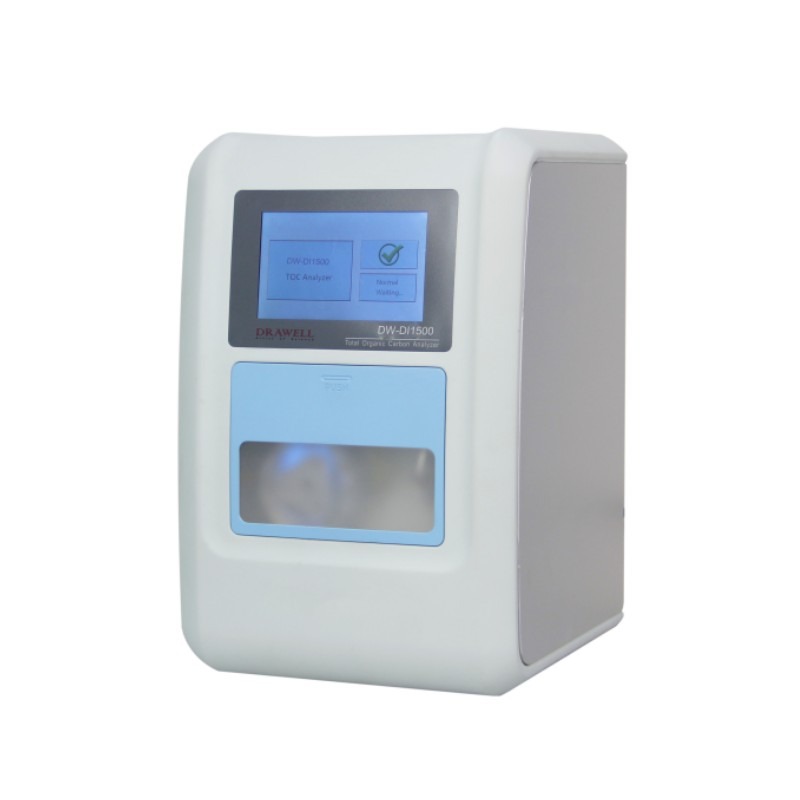
The DW-DI1500 is a benchtop laboratory analyzer. It is designed primarily for high purity water applications like purified water and WFI. But it also works well for cleaning validation samples, after you have completed proper sample preparation and method confirmation.
This unit uses UV oxidation combined with conductivity detection. The measuring range covers 0 to 1500 µg/L. Each run takes about 3 minutes. In a lab environment, it delivers stable, reproducible results at very low carbon levels.
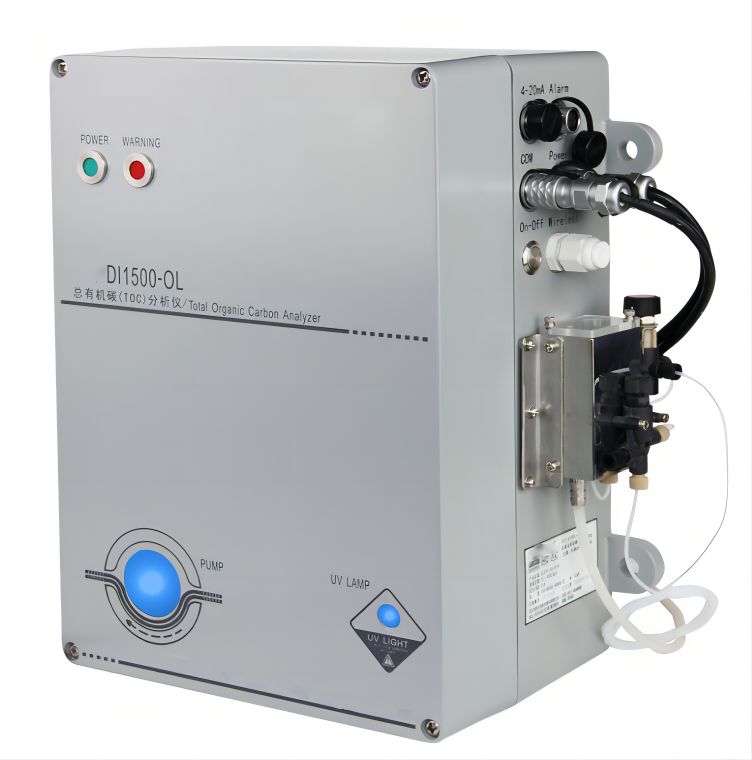
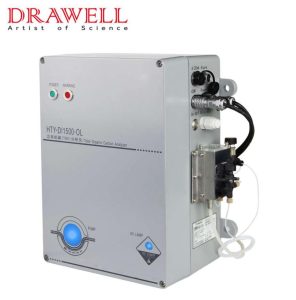
DW-DI1500-OL for Online Water Monitoring
The DW-DI1500-OL is built for continuous online monitoring. It integrates directly into pharmaceutical water loops to track WFI and purified water quality in real time.
That said, remember that online TOC is great for water quality. But for cleaning validation swab samples, you still need to bring those into the lab for analysis. The online unit complements, rather than replaces, your lab-based testing.
Many pharmaceutical sites combine surface swab testing with regular pharmaceutical grade water analysis. The right TOC analyzer depends on your sample type and how many tests you run each day.
Conclusion
TOC cleaning validation can be an effective approach for evaluating organic residues when the target residue and analytical method are suitable for TOC measurement. For highly toxic or poorly soluble compounds, pair TOC with a specific method like HPLC. That gives you a broad screen and a targeted confirmation. Choose the right instrument for your application. The result is a cleaning validation program that stands up to scientific scrutiny and regulatory inspection.
Get Quote Here!
Latest Posts
What Next?
For more information, or to arrange an equipment demonstration, please visit our dedicated Product Homepage or contact one of our Product Managers.


