


Pressure is the heart of every high pressure homogenizer. Whether you are producing nanoemulsions for pharmaceuticals, dispersing pigments for cosmetics, processing dairy beverages, or breaking microbial cells for biotechnology research, the level of pressure applied during homogenization determines how efficiently particles are reduced, how stable your formulation becomes, and how successful your scale-up will be.
Yet many users—even experienced laboratory professionals—still ask:
- How much pressure do I actually need?
- Does higher pressure always produce smaller particles?
- Why does the sample heat up during homogenization?
- Which pressures are suitable for large-scale production?
- What pressure should I choose for nano-formulation?
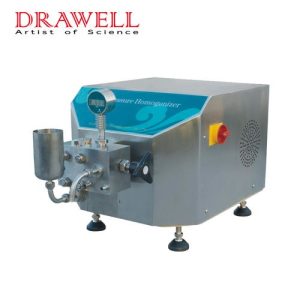
As a global supplier of high-quality homogenization solutions, Drawell provides laboratory-scale, pilot-scale, and ultra high pressure homogenizer systems that help customers achieve consistent nanoscale results. Our high pressure homogenizers, such as the DW-150 series, DW-150A, and D207A Ultra High Pressure Homogenizer, are widely used in pharmaceuticals, food science, materials science, nanotechnology, and biotechnology.
Here we focus on how pressure impacts homogenization performance—including efficiency, particle size, temperature, and optimization strategies—so you can choose the right equipment and operating conditions for your application.

The Role of Pressure in High Pressure Homogenization
High pressure homogenization is fundamentally based on forcing a fluid through a narrow, precisely designed homogenizing valve at extremely high pressure. As the fluid accelerates, it undergoes several mechanical forces simultaneously, such as Shear force, Turbulence, Impact and collision, and Cavitation.
These forces break down particles, reduce droplet size, create stable emulsions, and disperse solids.
Why Pressure Matters?
Pressure determines the energy density supplied to the material. Higher pressure results in:
- More intense cavitation
- Greater shear forces
- Increased kinetic energy
- Finer particle and droplet breakdown
- Faster homogenization (fewer passes)
In simple terms:
Higher pressure → Higher energy → Stronger particle disruption → Smaller particle size
This is why advanced applications—such as nanoemulsions, liposomes, nanocrystals, and cell lysis—often require pressures of 150–300 MPa, or even 400 MPa in some ultra high pressure homogenizer systems.
Pressure and the Homogenization Valve
Different valve geometries respond differently to pressure. Drawell uses optimized valve structures in the DW-150 High Pressure Homogenizer and D207A Ultra High Pressure Homogenizer to ensure strong cavitation and consistent nanoscale particle reduction.

How Pressure Influences Homogenization Efficiency?
Pressure does not just affect particle size—it also significantly affects processing speed, pass efficiency, and overall production throughput.
Higher Pressure = Fewer Passes
At higher pressures, each cycle through the homogenizer performs more work on the sample, meaning:
- Faster reduction in particle size
- Less time spent processing
- Lower total energy cost per batch (even though instantaneous pressure is high)
- Improved scalability from lab to pilot to industrial production
Efficiency Differences by Pressure Level
| Pressure Range | Typical Uses | Expected Efficiency |
| 40–80 MPa | Dairy, beverages, simple emulsions | Moderate |
| 80–150 MPa | Cosmetics, general nanoemulsions | High |
| 150–300 MPa | Pharmaceuticals, nanocrystals, liposomes | Very high |
| 300–400+ MPa | Ultra-fine nanomaterial dispersion, advanced pharma | Maximum |
Why Higher Efficiency Matters for Users?
For laboratories and manufacturers, higher efficiency means:
- Reduced processing time
- Lower production cost
- Less wear on mechanical components
- Greater batch-to-batch consistency
This is especially important for large-scale high pressure homogenizer applications, where small differences in efficiency can translate into significant cost savings.

Pressure and Particle Size Reduction: What the Data Shows?
Particle size is arguably the most important performance indicator in homogenization. Pressurized flow disrupts particles more effectively than any low-shear mixing or ultrasonic method.
How Pressure Reduces Particle Size?
When pressure increases:
- Cavitation bubbles collapse more violently
- Shear and turbulence intensify
- Droplets and particles are divided more finely
- Aggregates disperse more completely
- Final particle size decreases
- Particle size distribution (PSD) becomes narrower
But Does Higher Pressure Always Produce Smaller Particles?
Not always.
Many materials exhibit a diminishing returns effect:
- From 50 → 100 MPa: Large reduction
- From 100 → 150 MPa: Significant reduction
- From 150 → 200 MPa: Moderate reduction
- Beyond 200 MPa: Small improvements
This is why optimization experiments are essential.
Typical Particle Size Outcomes by Pressure Range
| Pressure Level | Expected Particle Size | Notes |
| <60 MPa | 800–300 nm | Coarse emulsions |
| 60–120 MPa | 300–150 nm | Cosmetics, beverages |
| 120–180 MPa | 150–80 nm | General nanoemulsions |
| 180–300 MPa | 80–30 nm | Pharmaceutical-grade nanosystems |
| 300–400+ MPa | <30 nm | Ultra-fine dispersion, nanomaterials |
Drawell’s D207A Ultra High Pressure Homogenizer can reach extremely high pressures suitable for nanotechnology and advanced drug delivery formulations.

Pressure Requirements for Different Applications
Different materials require different pressure levels. Below is a reference guide.
Pharmaceutical Applications (150–300 MPa)
- Liposomes
- Nanocrystals
- Nanoemulsions
- Vaccines
- Drug suspension optimization
These require tight PSD control, meaning high pressure homogenizers are essential.
Cosmetic Formulations (100–200 MPa)
- Lotions
- Creams
- Serums
- Pigment dispersions
Here, pressure determines texture, stability, and skin feel.
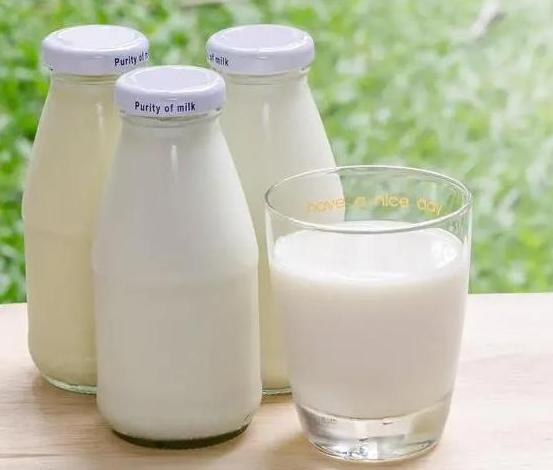
Food and Beverage (40–120 MPa)
- Milk
- Protein drinks
- Juice emulsions
- Flavor encapsulation
Lower pressures are sufficient thanks to lower viscosity and simpler matrices.
Biotechnology (80–150 MPa)
- Bacterial cell disruption
- Yeast and fungal lysis
- Protein extraction
Drawell’s DW-150A is commonly used in microbiology labs for efficient cell rupture.
Nanomaterials (200–400+ MPa)
- Graphene dispersion
- CNT dispersion
- Nanoparticle stabilization
Ultra high pressure is required to break agglomerates.
Relationship Between Pressure and Temperature Rise
A natural consequence of high pressure is increased temperature. Users often search for:
“high pressure homogenizer temperature rise”
“why does my sample heat up”
“temperature control in high pressure homogenization”
Why Temperature Increases?
As material passes through the homogenizing valve:
- Energy is converted into heat
- Temperature can rise by 2–10°C per cycle, depending on pressure
Higher pressure = faster and larger temperature increase.
Temperature Concerns
High temperature can:
- Denature proteins
- Impact sensitive drug molecules
- Reduce stability of nanoemulsions
- Alter viscosity and disrupt PSD
How Drawell Manages Temperature Control?
Drawell homogenizers offer:
- External cooling coils
- Heat exchangers
- Multi-stage pressure reduction
- Temperature monitoring systems
For heat-sensitive materials, Drawell’s DW-150A Medium-Sized High Pressure Homogenizer provides excellent thermal control during continuous operation.

Choosing the Right Pressure Settings for Your Process
Choosing the right homogenization pressure is not a one-size-fits-all decision. It directly affects particle size reduction, homogenization efficiency, temperature rise, and even overall product stability. When optimizing your process, consider the following key factors:
1. Material Properties
Different materials respond differently under high pressure.
- Viscosity: High-viscosity samples may require higher pressure for sufficient shear.
- Hardness / toughness: Fibrous or crystalline materials often need ultra-high pressure.
- Heat sensitivity: Sensitive formulations may require moderated pressure to reduce temperature spikes.
2. Desired Final Particle Size
Your target particle size distribution determines whether you need standard high pressure (100–150 MPa) or ultra-high pressure (>200 MPa). Smaller nano-scale goals typically require higher pressure and more passes.
3. Application Requirements
Pharmaceutical emulsions, food suspensions, and cosmetic nano-creams each require different shear intensities. Consider industry-specific standards such as:
- Pharma: high reproducibility and narrow particle size distribution
- Food: texture control and microbial reduction
- Chemical: stable dispersions and long-term formulation compatibility
4. Temperature Tolerance
Higher pressure increases temperature rise inside the homogenizer. If your formulation is heat-sensitive, you must:
- reduce pressure
- reduce number of passes
- or integrate cooling modules
5. Equipment Capabilities
Every high-pressure homogenizer has a safe operating range. Check your model’s maximum pressure, flow rate, and cooling system.
For example:
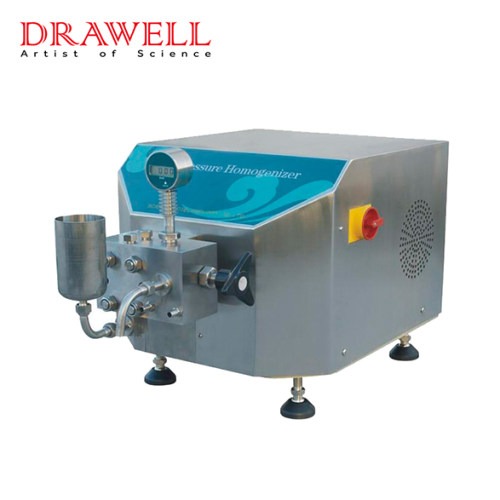
- Drawell DW-150 → ideal for routine high-pressure tasks
- Drawell D207A Ultra-High Pressure Homogenizer → supports ultra-fine nano emulsions requiring higher pressure
6. Scale and Throughput Needs
Small R&D batches can tolerate multiple passes at high pressure. Large-scale production must balance pressure with throughput and energy consumption.
7. Number of Required Passes
Higher pressure typically reduces the number of passes needed — but not always. Some formulations achieve optimal particle size through moderate pressure with multiple cycles.
General Pressure Recommendations
| Application | Recommended Pressure |
| Dairy / Food | 40–120 MPa |
| Cell rupture | 80–150 MPa |
| Cosmetics | 100–200 MPa |
| Pharmaceutical nanoemulsion | 150–250 MPa |
| Nanomaterials | 250–400 MPa |

Equipment Factors: How Valve Design Affects Pressure Performance?
When it comes to achieving consistent particle size reduction and optimal homogenization efficiency, valve design is one of the most critical—but often overlooked—equipment factors. The homogenizing valve is the core component that converts mechanical pressure into the intense shear, turbulence, and cavitation forces needed for emulsification and dispersion. Even with identical pressure settings, different valve structures can produce dramatically different results.
Types of Homogenizing Valves and How They Influence Performance
Different valve designs directly affect how the pressurized fluid accelerates, collides, and decompresses—ultimately determining the quality and efficiency of homogenization. Below is a clear overview of the most common valve types used in high pressure homogenizers.
1. Standard / Flat-Seat Valve
Best for: General emulsification, dairy applications, routine lab use
Performance Characteristics:
- Offers balanced shear and turbulence
- Delivers predictable homogenization efficiency
- Cost-effective and easy to maintain
Impact on Pressure:
Flat-seat valves deliver good performance at moderate to high pressures but may struggle with ultra-fine particle reduction in nano-emulsions.
2. Impact Ring Valve
Best for: Applications requiring stronger shear forces, submicron emulsions
Performance Characteristics:
- Fluid is forced against a hardened impact ring
- Generates intense collision zones
- Produces smaller particle sizes compared to flat-seat valves
Impact on Pressure:
More efficient at converting high pressure into shear energy, improving particle size reduction without needing maximum pressure settings.
3. Microfluidization / Interaction Chamber (for Ultra-High Pressure Systems)
Best for: Nano-emulsions, cell disruption, pharmaceutical formulations
Performance Characteristics:
- Creates highly focused microchannels
- Provides extreme shear and cavitation forces
- Delivers very narrow particle size distributions
Impact on Pressure:
Excels under ultra-high pressure (>200 MPa), maximizing pressure utilization and significantly enhancing homogenization efficiency.
This type of chamber is used in advanced systems like Drawell’s Ultra-High Pressure Homogenizer (e.g., D207A), enabling nano-scale results.
4. Spherical or Corrugated Valves
Best for: High-viscosity materials, suspensions with coarse particles
Performance Characteristics:
- Larger flow channels minimize clogging
- Stable pressure drop across the valve
- Durable and suitable for industrial applications
Impact on Pressure:
Helps maintain smooth flow at high pressure, preventing pressure surges and ensuring consistent homogenization in viscous or particle-rich formulations.
5. Adjustable Valve Designs
Best for: R&D labs, multi-formulation processing
Performance Characteristics:
- Operators can fine-tune impact distance and flow path
- Greater control over shear forces
- Allows quick optimization for different materials
Impact on Pressure:
Improves flexibility—important when testing varying pressure settings or processing multiple sample types with the same equipment.
Why Valve Design Matters for Your Application?
Different formulations demand different mechanical forces. A homogenizer equipped with the right valve design can:
- Achieve smaller particle sizes at lower pressures
- Reduce energy consumption and operational costs
- Improve temperature stability
- Enhance batch-to-batch consistency
- Extend equipment lifespan
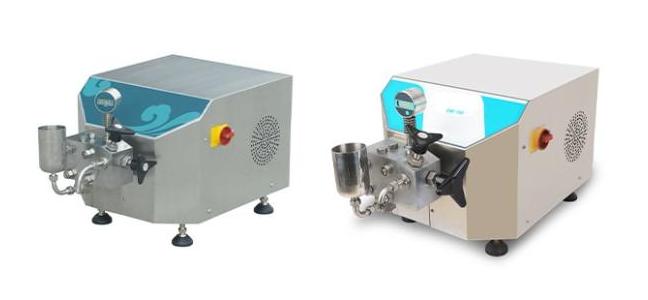
This is why Drawell’s high pressure homogenizers—such as the DW-150 and D207A Ultra-High Pressure Homogenizer—use precision-engineered valves optimized for stability, efficiency, and long-term reliability.
Final Words
Pressure is the core driving force behind homogenization. It determines how efficiently particles break, how small they become, and how stable your final formulation will be. By understanding the role of pressure—and choosing the right operating conditions—you can dramatically improve your homogenization performance, reduce processing time, and achieve consistent nanoscale results.
As a trusted high pressure homogenizer manufacturer, Drawell offers you high pressure homogenizer solutions for the laboratory. Whether you need a standard high pressure system like the DW-150, a more advanced nano-focused model like the DW-150A, or an ultra high pressure homogenizer such as the D207A, Drawell provides reliable engineering, expert support, and consistent performance for your homogenization needs.
If you want to optimize particle size, improve process efficiency, or select the ideal pressure range for your application, Drawell’s technical team is ready to assist you at here.
Related Products Recommendation


Get Quote Here!
Latest Posts

What Next?
For more information, or to arrange an equipment demonstration, please visit our dedicated Product Homepage or contact one of our Product Managers.


