





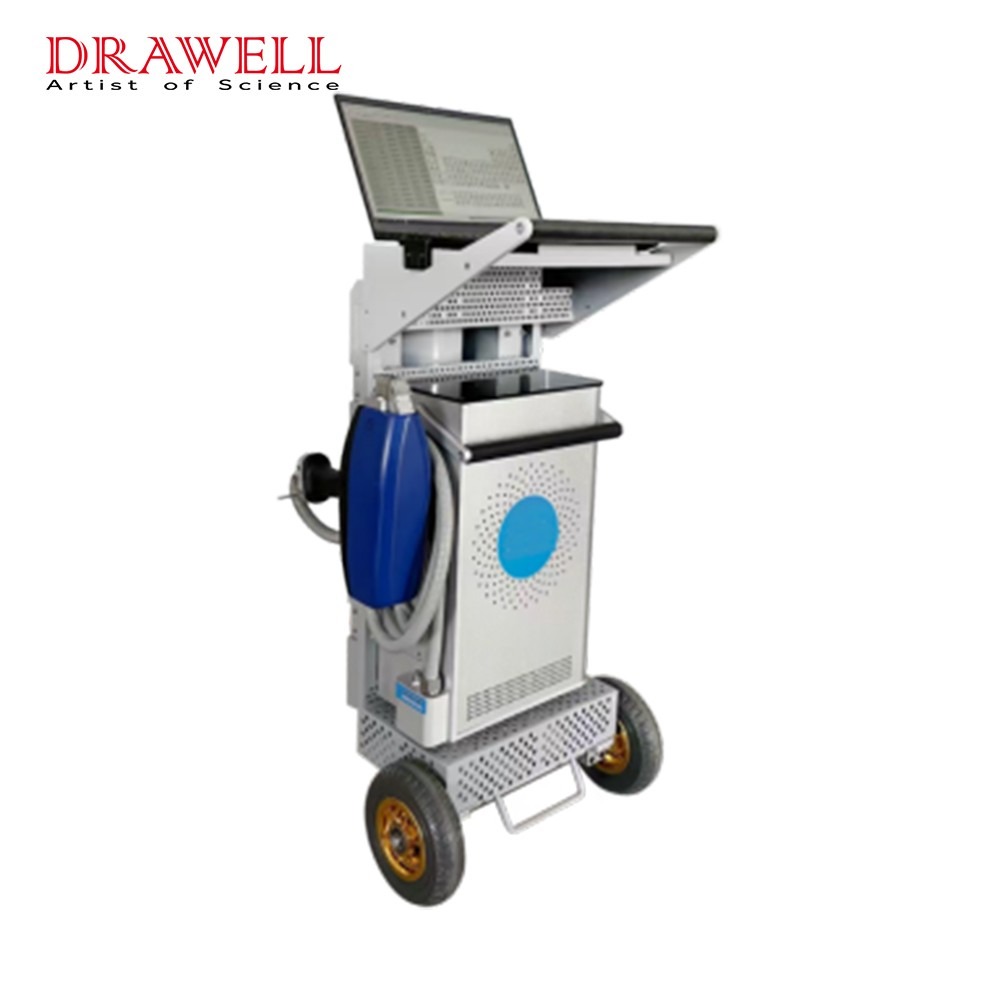
Sprite SP6 Mobile Metal Analyzer
Fast and Reliable On-Site Metal Analyzer
Sprite SP6 mobile metal analyzer is a portable optical emission spectrometer that can be used in many applications like the metal producing, processing, and recycling industries. Sprite SP6 mobile metal analyzer has the advantages of high analysis accuracy, good analysis stability, convenient operation, wide application, small size, light weight, etc. The use of widely used and trusted optical emission spectrometry (OES) technology to make SP6 mobile metal analyzer results more reliable.
SP6 mobile spectrometer is your choice to analyze the contents of nonmetallic elements such As C, P, S, B, Sn, As and other metals when it is inconvenient to cut large metal parts. It can analyze various forms of metal materials, such as pipes, bars, valves, welds, tanks, castings, etc. SP6 Mobile spectrometer can meet your analysis requirements, whether in or out of the factory, on the high ladder in the waste yard, underwater diving tank or chemical plant.
Scope of supply
1. Supply list
| No. | Item | Specifications | QTY | Unit | Remarks |
| 1 | Mobile Optical Emission Spectrometer | SP6 | 1 | Set | Include in quotation. |
| 2 | Laptop computer | 1 | Set | ||
| 3 | Tungsten electrode | 1 | Pc | ||
| 4 | Electrode brush | Φ6 | 2 | Pcs | |
| 5 | Optical lens | Φ10×2.65 | 2 | Pcs | |
| 6 | Degreasing cotton | 15 | Gram | ||
| 7 | M4 Internal hexagonal wrench | 1 | Set | ||
| 8 | Spark stand screw | M4 | 2 | Pcs | |
| 9 | Argon gas pressure reducing valve | 1 | Pc | ||
| 10 | Argon gas pipeline | 2 | M | ||
| 11 | Spectrum calibration samples | 1 | Group | ||
| 12 | Manual | 1 | Set |
Notes: The Buyer knows and agrees that the Seller may adjust the supply when the production of the above-mentioned instruments, spare parts and other suppliers change due to technological progress, product upgrading, market changes, etc.
2. Optical items
| Optional item | Qty | Note |
| Argon purifier | 1 set | When argon gas is not as pure as 99.999%. |
| Type samples | pieces | Essential for foundry |
Analytical Program
| No | Elements | Cr/Ni Stainless Steel |
| 1 | C | 0.0052-1.04 |
| 2 | Si | 0.02-4.8 |
| 3 | Mn | 0.021-19.6 |
| 4 | P | 0.0049-0.051 |
| 5 | S | 0.0008-0.056 |
| 6 | Cr | 7.4-29.5 |
| 7 | Ni | 0.063-23.11 |
| 8 | Mo | 0.0058-4.91 |
| 9 | Al | 0.005-1.8 |
| 10 | Cu | 0.05-4.5 |
| 11 | Co | 0.008-0.62 |
| 12 | Ti | 0.005-1.1 |
| 13 | Nb | 0.02-2.0 |
| 14 | V | 0.02-0.58 |
| 15 | B | 0.007-0.02 |
| 16 | Fe | Reference |
Note:
Note:
- (1) This form is filled out according to the actual contract demand of the customer.
- (2) *C, P, S, As, B only available on UV Touch probe.
- (3) If the special material exceeds the detected elements and measurement range, both the supplier and the buyer can formulate internal control standard samples.
- (4) Due to the hysteresis of national standard materials, the original standard elements shall be implemented before some grades of materials have new standard materials.
- (5) The final interpretation right of this element table and measurement range belongs to the supplier.
Technical Parameter
Optical System:
- Detector system: high-performance CMOS detector display
- Wavelength range: 165-585 nm
Spark Unit
- Argon Sparge Electrode
- The standard configuration length of optical fiber is 3.5m (it can be lengthened according to user’s requirements).
- Equipped with HPC fiber
- Probe is exquisitely designed and easy to clean
UV-Touch Probe
- Used to detect typical ultraviolet elements (C, P, S, B, Sn, As, etc.)
- Configure the network information connected to the mobile phone.
- Cloud platform operation
Spark Source
- High energy spark light source
- Built-in energy electronic regulation and steady-state device
- Unidirectional discharge
- Computer control of light source parameters
- Frequency: 100-1000 Hz, 250-300V, Maximum pulse current 80A,
Computer and Readout System
Built-in industrial control host
Battery powered
– LAN, USB port open
– Built-in HD LCD display
– Rugged and durable screen, no keyboard required, built-in mouse, easy to operate
Spectral Analysis Software
- Windows 10 operating system
- Dedicated spectrometer software for multitasking operation:
- Raw Material Sorting
- Automatic calibration control is carried out according to the given deviation and excitation times.
- Electrode cleaning according to set data
- Display and corresponding deviation
- Detecting element results storage and printing
- Freely editable reports
- Display light intensity value, intensity ratio, recalibration and corrected intensity ratio
- Analysis result percentage content display
- Additive or Multiplicative Interference Correction
- Matrix correction
- Automatically select spectral lines
- Sample identification input
- Analysis data can be transferred to an external computer
- Connecting external printers and monitors
- Analysis data is stored in standard formats such as Excel, ASCII, etc.
Technical Data
Cart dimensions:
- Length: 780mm, Width: 610mm, Height: 1050mm
- Weight: about 20kg (including excitation tip and box. Argon cylinder and mobile cart are not included)
Power requirements:
Configure 220V power charger
Argon gas requirement:
- Argon purity 99.999%
- Inlet pressure 0.3Mpa
Technical Futures
1. Multi-matrix, All-Element Analysis Technology
Designed for rapid identification and accurate analysis of metal materials in industrial field, it can accurately determine C, P, S and As in steel. The matrix of Fe, Cu, Al, Ni, Ti, Sn and Co can be analyzed. It can be comparable to the high-precision analysis of laboratory spectrometers and can also be used for quick material sorting with analysis time of only a few seconds. It can analyze metal materials and products such as pipes, bars, valves, welds, oil tanks and large castings. The compact design makes the equipment multifunctional and can meet different application requirements.
2. Unique Optical Design Technology
The optical system of the equipment is integrated with CMOS detector technology, and all the spectral lines can be read. The compact and lightweight design can truly realize the “portable” and firm mechanical structure, and can adapt to various vibration environments. Very wide spectral line range and very high resolution can be reflected from the number and precision of elements in the test results.
3. Intelligent Calibration Function
Eliminate the spectral drift caused by the change of temperature and pressure; Full-spectrum technology automatically and quickly addresses, which avoids laborious manual operation and human error.
4. Full-Spectrum Direct Reading Technology
The equipment can easily increase spectral lines and matrix. Multi-matrix analysis can be realized without adding hardware facilities.
Customers can increase the types of analytical matrix and elements on the equipment according to the actual needs in the use process, which can be conveniently completed at the user’s site.
5. High-Performance Special Optical Fiber Technology
Since the spectrometer is in a high-energy and high-temperature state during the excitation process, the performance of ordinary silica fiber will be drastically reduced due to overexposure under such working conditions. The breakthrough high-performance special fiber technology solves this problem, ensuring that the fiber can work in the best condition for a long time and stably.
Since the optical fiber can maintain long-term stable work during the signal transmission process, the equipment has a good effect in testing the application of ultra-low carbon and other trace elements, and it is convenient to complete the sorting and identification of steel on site without resorting to laboratory equipment.
6. Unique Jet Electrode Technology
In the excited state, a jet of argon gas is formed around the electrodes. The argon gas flow around the excitation point ensures that the excitation process is not disturbed by the outside world, saves the use of argon gas, and reduces the use cost of customers.
7. Multifunctional Adapter
Wire (with a universal adapter, the smallest wire can be analyzed 1mm) Pipe, bar, valve, weld, etc.
8. Intelligent Spark Design
The design of the spark tip is ingenious, fully considering the needs of practical applications. It can detect low content of C, P, S, B, As and Sn in medium and low alloy steel and stainless steel. The test results can be displayed by configuring the mobile phone on the spark gun, and the main functions of the equipment can also be directly controlled.
9. Direct Power Supply from Lithium Battery
Fully consider the actual application situation in the industrial field, and ensure that customers can maximize the working efficiency of the equipment. It is powered by a new lithium-ion battery, with sufficient power, convenient use, safety and reliability. The new lithium-ion battery can stand by for up to 10 hours and can analyze hundreds of samples.
10. Operating Software Based on Win10 System
The operating software is easy to learn, with both Chinese and English versions. Operators without any knowledge of spectroscopic equipment can use the equipment with only simple training.
11. It Embodies the Combination of Humanization and Modern Scientific and Technological Concepts.
The design of the equipment includes the latest CMOS and readout system technology, as well as the Win 10 operating system, so that the subsequent maintenance cost of the equipment is low, and the equipment also retains a good expandability. The equipment has a built-in display screen and a mobile phone display of the excitation gun head, which can operate the software directly on the excitation gun, and visually display the analysis results during the excitation process.
12. The First New Design
It is light in weight and small in size, easy to carry, analysis and measurement is not limited by the site, and can be installed in a matching suitcase and can be brought to the site for material testing anytime, anywhere. At the same time, it can also be easily brought on a high platform to perform inspection work at high altitude and complete outdoor operations.
Operating Requirements
1 Environmental Requirements
The instrument must be placed in an area free from harmful, flammable and corrosive gases.
Note: It is forbidden to place this instrument in a chemical analysis laboratory.
Storage temperature: 0℃~45℃
2 Power Requirements
1) Power supply: 24V/10A.
2) Charging power supply: single-phase 220±20V power supply.
3 Argon Requirement
1) The purity of argon gas is greater than or equal to 99.999%, the oxygen content is less than or equal to 2ppm, and the content of H2O is less than or equal to 5ppm. If high-purity argon is not available, an argon purifier is recommended.
2) Argon flow rate: maintain the flow rate of about (0.2-0.3) L/min, and stimulate the flow rate of about 3L/min.
3) Argon control pressure: 0.4Mpa.
4 Argon Connecting Pipe
Must use the special argon tube connection provided.
5 Sample Preparation
An angle grinder is used to grind the surface of the tested sample.
The sample to be analyzed must be uniform, free of pores and casting defects, and the preparation must achieve a smooth surface, no oxide layer, no oil stains, and no burrs on the edge of the sample.
6 Standard Sample Requirements
A spectral calibration standard sample will be randomly attached when it leaves the factory to correct the overall spectral drift of the instrument. In addition, users need to prepare standard samples or internal control samples suitable for their own product types for calibration of instrument analysis curves.
Installation and Acceptance
1 Arrival Inspection and Storage
After the buyer receives the goods, they should check whether the outer packaging is in good condition. If the outer package is damaged or the direct reading spectrometer is damaged, the user should keep relevant evidence and notify the seller in time, and cooperate with the seller to make a claim to the responsible party. Otherwise, the buyer is responsible for damage to the goods.
After the instrument is delivered to the buyer, the buyer should store the instrument in an indoor environment with a temperature of 0°C to 45°C and a humidity of 20% to 80%. Before the installation engineer arrives, the buyer cannot open the box without authorization, otherwise, the goods will be deemed as qualified.
2 Installation and Commissioning
Within one month of the arrival of the instrument, the buyer should meet the installation conditions and notify the seller to install it in time.
After the installation engineer arrives, the packing list will be inspected and received by both parties together, and the representatives of both parties will fill in the acceptance items in the packing list in duplicate according to the inspection results and sign them. If there are any missing parts, the installation engineer shall indicate them on the installation acceptance sheet, and immediately notify the seller to make up the mail.
If the buyer still does not have the installation conditions within two months of the arrival of the instrument, or if the instrument is damaged during storage, the seller has the right to ask the buyer to pay additional installation costs, and all costs caused by the damage to the instrument during storage shall be borne by the buyer.
During the installation and commissioning of the instrument, the Buyer shall provide the installation engineer with convenient working conditions. If the installation engineer can’t work and stay at the site for more than 2 days (inclusive) because the buyer doesn’t have the installation conditions, the installation engineer can directly return, and the buyer shall bear all the expenses of the installation engineer during his stay, including round-trip transportation, accommodation, subsidies, etc.
Installation Step:
1) Engineers go to the site to install and debug according to the instrument installation procedure.
2) Selection of test standard sample:
According to the content and grade of the samples analyzed by the buyer, the buyer and the seller shall negotiate to determine a set of standard samples that meet the daily analysis requirements of the user (the set of standard samples shall be provided by the buyer or entrusted by the seller to purchase through negotiation) as the standard sample for instrument acceptance. The principle of standard sample selection should be based on the principle of meeting the content range required by the buyer’s daily production.
After-Sales and Others
1 Random Technical Data and Software
l User Manual
l Daily Maintenance Manual
2 Training
During the on-site installation and commissioning of the installation engineer, the buyer shall organize relevant users and maintenance personnel to receive on-site training, and the training time generally does not exceed 3 days. Through the training, the relevant personnel can have a deeper understanding of the relevant technologies of spectral analysis and be proficient in the operation and maintenance of the instrument.
The seller will hold free or paid technical training courses from time to time. Training notices will be sent to users in a timely manner, and users can decide whether to send personnel to participate according to their own circumstances.
3 After-Sales Service
1. Calculation of Warranty Period:
1) The warranty period of the instrument is subject to the contract;
2) Unless otherwise specified in the contract, the warranty shall be implemented in accordance with the following periods:
The warranty period is 12 months after the acceptance of the goods or 12 months after the buyer receives the goods, whichever comes first.
The warranty period of general wearing parts is three months from the date of shipment;
The repair warranty period is three months;
Consumables (standard samples, electrode brushes, tungsten electrodes, etc.) are not guaranteed.
3) If there is a quality problem with the instrument that affects its use, the warranty period will be extended accordingly.
2. During the warranty period, the failure under the normal use of the instrument will be repaired free of charge; However, due to the damage to the instrument hardware caused by the operation or improper use of the buyer’s operation or maintenance personnel, as well as force majeure factors (war, earthquake, lightning strike, flood, etc.), the seller will charge the cost fee and maintenance fee.
3. After the instrument is reported for repair, the seller shall first confirm the fault phenomenon by telephone and solve the problem. If it is necessary to solve the problem on site, it can rush to the site within 48 hours.
4. Out of Warranty Maintenance:
After the warranty period expires, the seller will continue to provide maintenance service and use consultation. If it is necessary to provide on-site service to users, the seller will properly charge the spare parts fee, service fee and other fees.
5. Supply of Spare Parts and Consumables:
The seller will supply spare parts and consumables to the buyer at preferential prices.


