


If you work in a modern analytical laboratory, you already know that spotting trace elements down to parts-per-trillion (ppt) levels can feel like finding a needle in a haystack. That is where icp ms (Inductively Coupled Plasma Mass Spectrometry) comes in. Over the years, it has transformed from a high-end research novelty into the gold standard for elemental analysis. Whether you are tracking heavy metals in groundwater or checking purity levels in drug formulations, understanding what is icp-ms used for and how it functions is crucial for any modern testing facility.
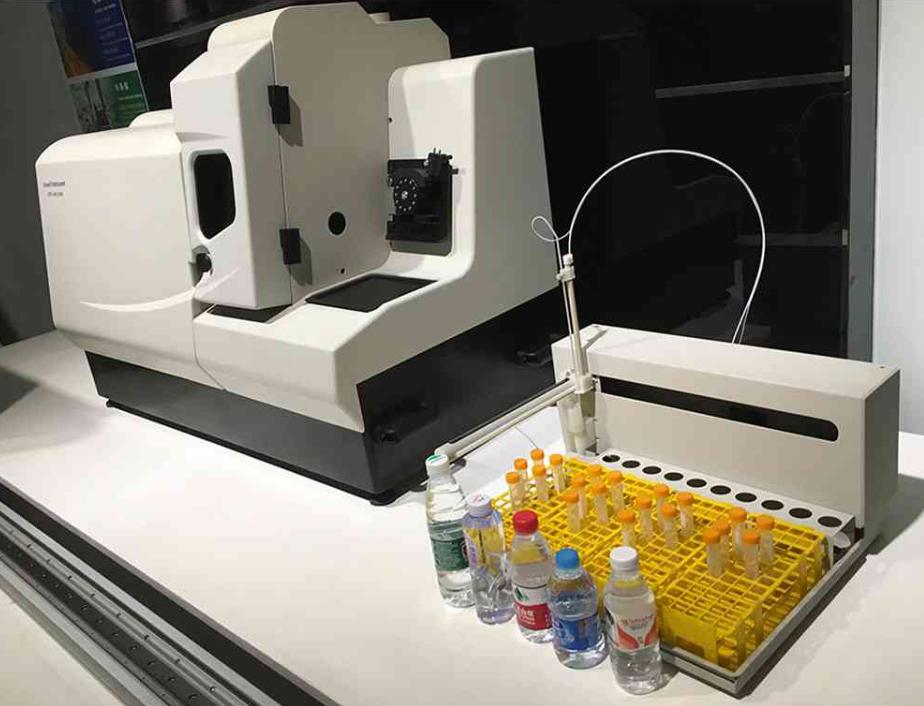
What Is the Working Principle of ICP-MS?
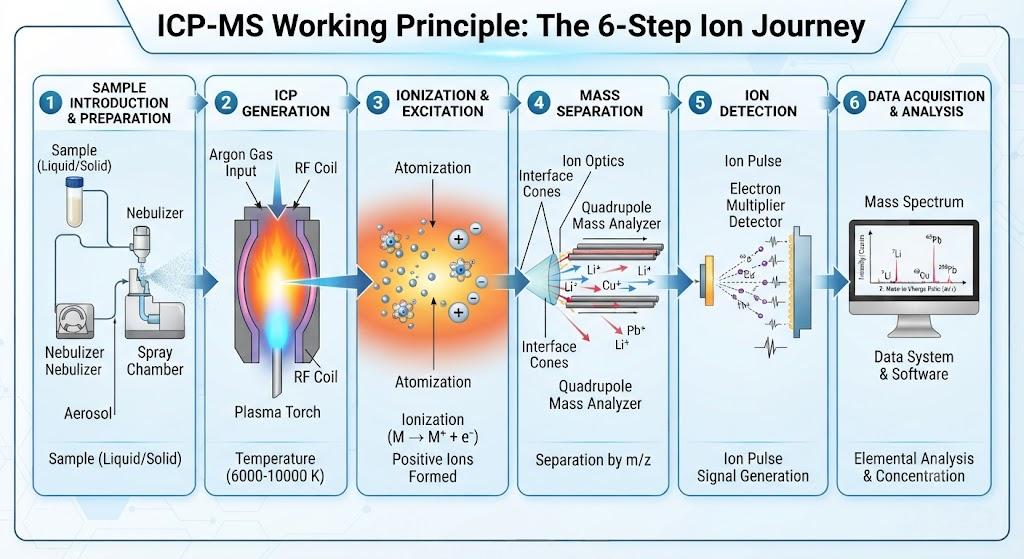
Ever wondered how does an icp-ms work under the hood? The icp ms working principle relies on converting solid or liquid samples into ions and then sorting them by their mass-to-charge ratio (m/z). Here is a step-by-step breakdown of how a standard icp-ms instrument processes samples:
| Step | Process Stage | What Happens in the Lab |
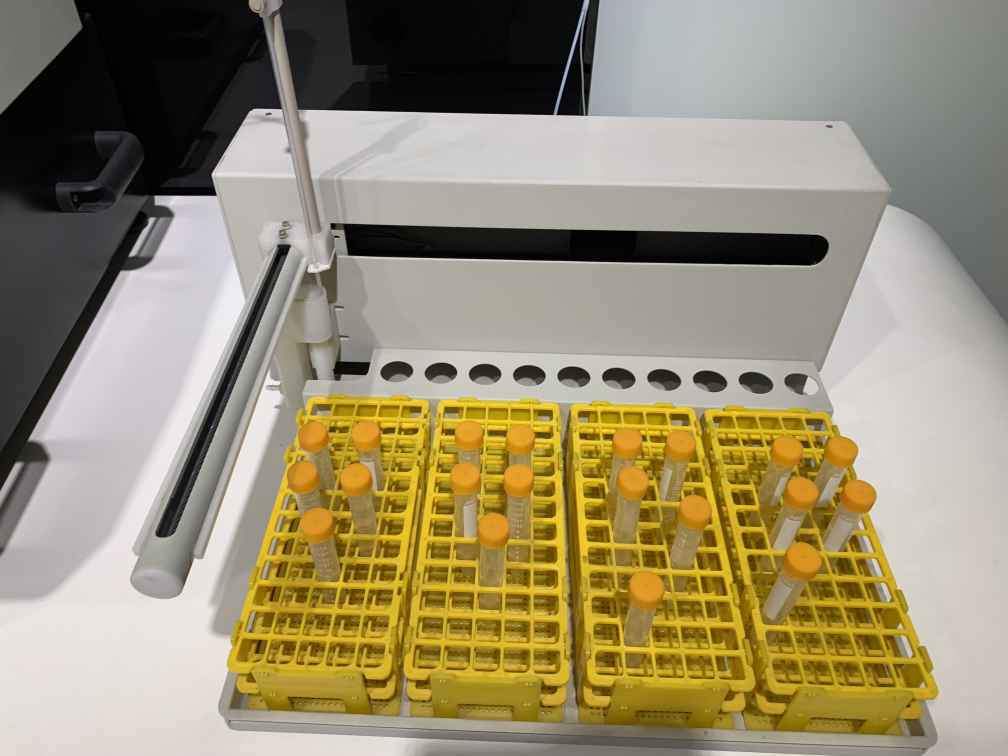
| 1 | Sample Introduction & Preparation | Samples undergo digestion, dilution, or filtration before being pumped into the system as a fine aerosol. |
| 2 | ICP Generation | The aerosol enters an argon plasma torch driven by radio frequency (RF) energy, reaching scorching temperatures of around 6,000 to 10,000 Kelvin—like a mini-sun on your benchtop. |
| 3 | Ionization & Excitation | The extreme heat strips outer-shell electrons from the sample atoms, turning them into positively charged ions ready for sorting. |
| 4 | Mass Separation | Ions are guided into a mass analyzer (such as a quadrupole or time-of-flight analyzer) that filters them using electric and magnetic fields based on their m/z ratio. |
| 5 | Ion Detection | Separated ions hit an ion detector (such as a discrete dynode electron multiplier) to measure their abundance and generate electronic signals. |
| 6 | Data Acquisition | Software translates the signals into a clean mass spectrum, revealing the exact elemental makeup and concentration of your sample. |
Throughout any routine icp ms analysis, analysts must watch out for isobaric interference, polyatomic ions (like ArCl⁺ interfering with arsenic), and matrix effects. Overcoming these hurdles often relies on collision/reaction cells (CRC) and proper calibration standards.
What Are the Applications of ICP-MS?
The true value of an icp ms application lies in its ability to combine ultra-heightened sensitivity with simultaneous multi-element detection. However, an environmental testing facility evaluates an instrument through a very different technical lens than a pharmaceutical quality control manager or a geochemical explorer. Each field involves distinct matrix challenges, regulatory benchmarks, and analytical parameters.
1. Environmental Analysis
For municipal water authorities and environmental testing laboratories, tracking hazardous pollutants down to stringent regulatory thresholds like EPA Method 200.8 requires reliable and high-throughput elemental screening.
What contaminants are typically screened? It is primarily used to screen and quantify trace levels of toxic heavy metals (such as lead, arsenic, mercury, and cadmium) alongside essential mineral nutrients across diverse matrices, including drinking water, surface water, industrial wastewater, digested soil samples, and air filter extracts.
How do high-matrix samples affect daily operations? Environmental samples vary wildly—from clean drinking water to high-salinity seawater or muddy soil digests. High Total Dissolved Solids (TDS) can rapidly deposit salts onto the instrument interface cones, causing signal drift or clogging if sample introduction and dilution workflows are not properly managed.
What matters most when selecting an environmental ICP-MS?
- Robust Plasma Stability: The system must handle fluctuating salt loads and high-matrix samples smoothly without extinguishing the plasma or suffering premature cone degradation.
- Automated Dilution & Workflow Efficiency: Environmental labs process heavy daily batch volumes, making automated sample preparation and dilution features critical to minimize manual handling errors.
- Effective Interference Management: The instrument needs reliable collision cell capabilities to resolve stubborn polyatomic interferences common in complex water and soil digests, ensuring compliance results hold up to regulatory audits.
2. Pharmaceutical and Clinical Applications
In pharmaceutical manufacturing and clinical research, maintaining absolute product purity and safety requires precise tracking of elemental impurities. When applied to pharmaceutical and clinical analysis, ICP-MS serves as the core technique for addressing critical testing requirements:
What substances can be detected? It is primarily utilized to screen and quantify regulated elemental impurities in drug substances, excipients, and final formulations—specifically toxic heavy metals restricted by safety guidelines (such as arsenic, cadmium, lead, and mercury) and residual metal catalysts left over from chemical synthesis (such as platinum, palladium, ruthenium, rhodium, iridium, and osmium). In clinical environments, it handles biomonitoring by tracking trace metals and toxic elements in biological fluids like blood and urine.
Can it test complex drug formulations, and how difficult is it? Complex drug formulations often present challenging matrices. High-organic solvents, strong digestion acids, or viscous excipients (like syrups and oils) can cause plasma instability, carbon buildup on sampler cones, or signal drift if workflows are not properly optimized.
Key considerations when choosing equipment for this industry:
Regulatory Compliance: The system must seamlessly support compliance with USP <232> / <233> or ICH Q3D frameworks, featuring software with robust audit trails and data integrity controls.
Interference Handling: Because many drug components create polyatomic interferences, a reliable collision/reaction cell (CRC) operating in helium mode is essential to isolate difficult target elements accurately.
Robustness & High Throughput: Routine quality control (QC) labs process large batches daily, making automated sample introduction and durable interface components critical for minimizing downtime.
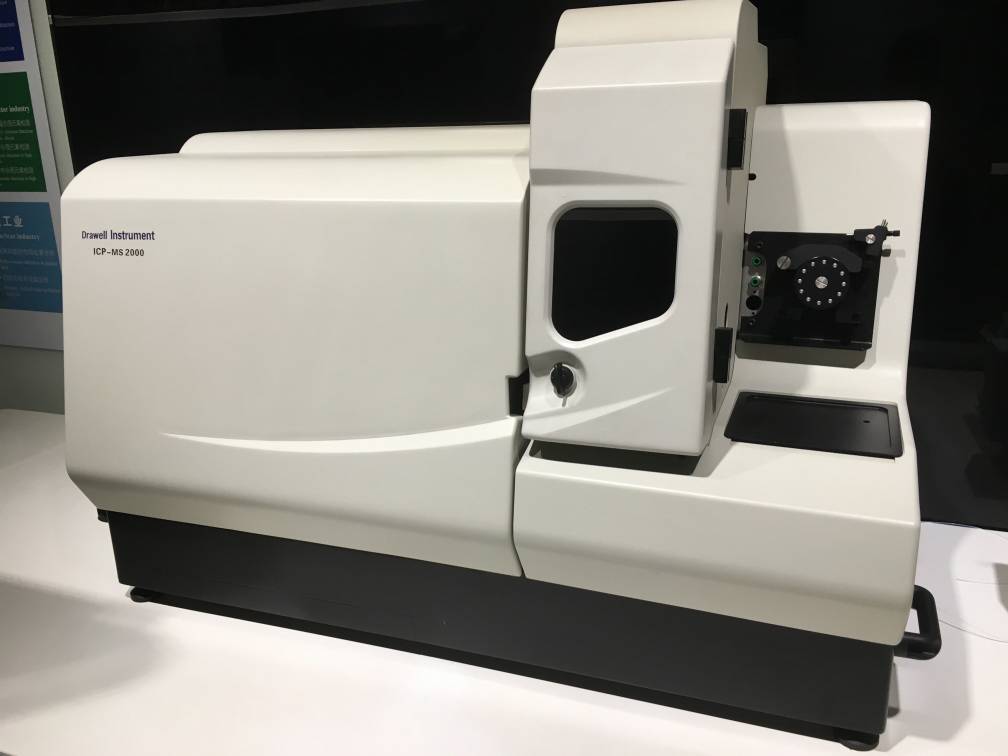
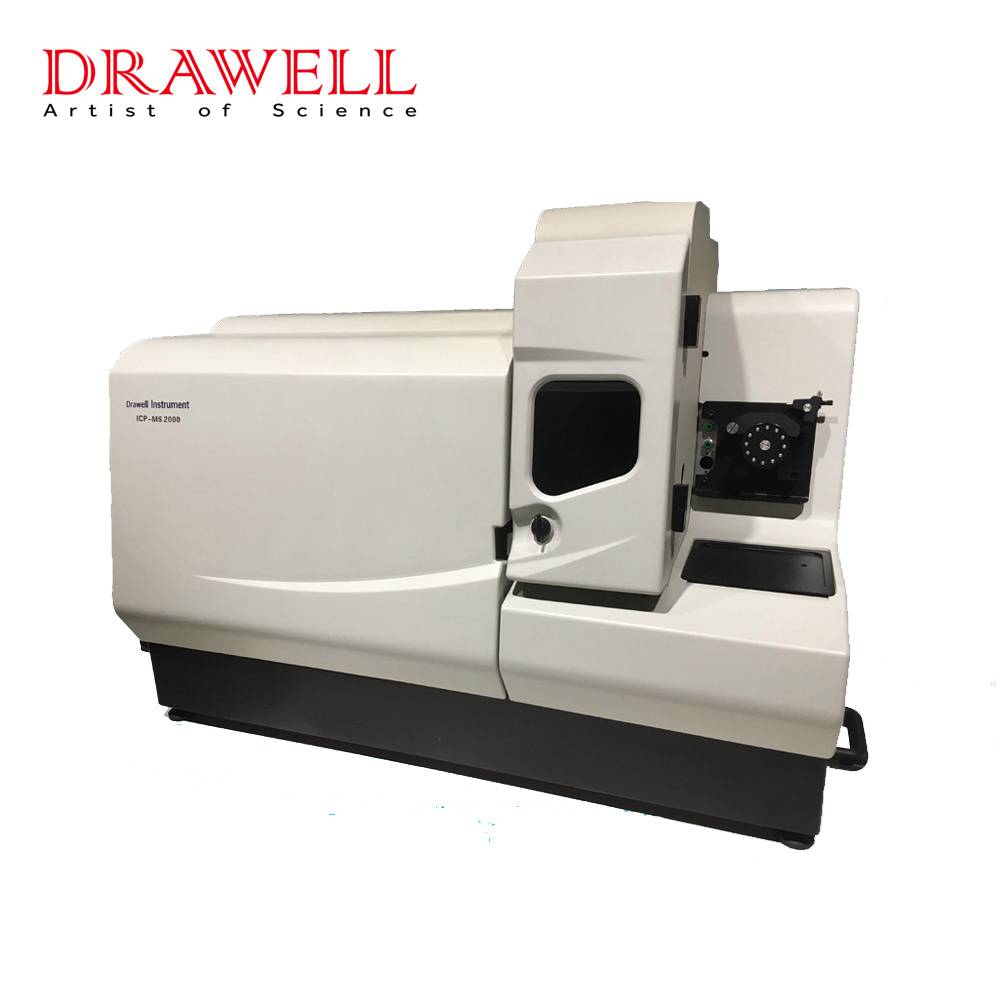
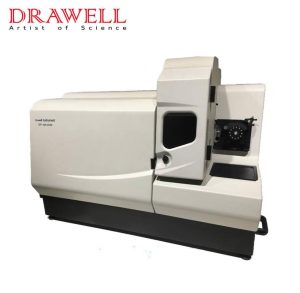
For high-volume testing facilities needing reliable daily uptime, robust configurations like the Drawell ICP-MS 2000 Instrument are built to handle complex pharmaceutical matrices efficiently).
3. Food and Agriculture Analysis
Food safety regulators and agricultural scientists focus on screening food chains to protect consumers from toxic exposure while verifying nutritional quality.
Which food safety hazards and nutrients are targeted? Testing programs target contaminant heavy metals (such as lead and cadmium in grains, leafy vegetables, dairy, and infant formula), pesticide residues containing trace metals, and essential macro- or micro-nutrients in agricultural crops and animal feed.
How do high-organic food matrices impact the workflow? Food products are rich in organic matter like fats, proteins, and sugars. Introducing them directly causes severe plasma quenching and carbon deposition. Testing therefore requires rigorous closed-vessel microwave digestion to completely break down organic structures into clear aqueous solutions before analysis.
What capabilities are essential for food screening labs? Laboratories need exceptionally low detection limits (LOD) to capture trace toxic elements at parts-per-billion or parts-per-trillion levels, alongside rapid data acquisition speeds to process multi-element panels efficiently.
4. Geological and Mining Applications
Geologists, mining corporations, and geochemical exploration laboratories rely on precise elemental data to assess mineral deposits and drive economic decisions.
What elements drive resource exploration and ore grading? Analyses focus on major, minor, and trace elements across rock cores, ores, sediments, and minerals, including high-value rare earth elements (REEs) and precious metals like gold and platinum group elements (PGEs).
How are refractory geological samples handled? Geological matrices are exceptionally tough and refractory. Dissolving them often requires aggressive acid digestion protocols involving hydrofluoric acid. Furthermore, ore grades span an enormous concentration range—from major rock-forming elements down to ultratrace precious metals—posing a severe test for detector linearity.
Selecting the right instrument for geochemical analysis: Geological facilities prioritize a wide dynamic range to prevent detector saturation when switching between high-concentration matrix elements and trace precious metals, paired with chemical-resistant sample introduction hardware.
5. Material Science and Industrial Applications
Advanced manufacturing and electronics producers operate under ultra-strict tolerances where microscopic contamination can ruin entire production cycles.
What microscopic impurities threaten product integrity? Testing focuses on trace elemental impurities in high-purity chemicals, specialized metal alloys, industrial ceramics, and semiconductor silicon wafers.
Why is environmental background control so critical? In semiconductor fabrication, even parts-per-trillion (ppt) levels of transition metal contamination can destroy the electrical properties of silicon wafers. Preventing background contamination from the laboratory environment and sample handling tools is just as challenging as the measurement itself.
Key specifications for high-purity industrial labs: Facilities require instruments with exceptionally low background noise, ultra-clean sample introduction pathways, and high sensitivity for refractory and transition metals.
6. Forensic Analysis
Forensic scientists and criminalists use chemical profiling to uncover objective evidence from microscopic items recovered at crime scenes.
What trace evidence can be chemically profiled? Work involves capturing elemental fingerprints in microscopic trace evidence, such as gunshot residue (GSR) particles, single strands of hair, tiny paint chips, shattered glass fragments, and fiber traces.
How does the system manage microscopic sample scarcity? The defining constraint in forensic analysis is sample scarcity. Investigators often work with minuscule amounts of material, meaning the analytical system must achieve high signal sensitivity using very small sample volumes without sacrificing precision.
What performance metrics matter in forensic investigations? Forensic facilities look for superior transient signal processing capabilities (ideal for laser ablation or single-particle workflows) and high analytical reproducibility to stand up to legal scrutiny in court.
7. Health and Biomedical Research
Biomedical researchers and toxicologists study how elemental uptake, distribution, and metabolism interact with human health and disease pathways.
How does ICP-MS support toxicological and clinical studies? Research centers track physiological metal accumulation, trace element distribution in tissue biopsies, cellular fractions, and the biological impacts of metal toxicity or nutritional deficiencies.
What makes biological sample preparation uniquely delicate? Biological tissues and fluids represent complex organic matrices prone to external contamination. Handling small-volume biopsies requires scrupulous clean-room protocols and specialized sample introduction setups (such as micro-concentric nebulizers) to prevent sample clogging.
Core instrument traits for biomedical applications: Researchers in this domain value low sample volume consumption, high analytical precision, and robust interference management to accurately measure transition metals in complex biological backgrounds.
8. Nuclear and Radiochemistry
Nuclear energy operators, national security agencies, and specialized radiochemistry facilities operate under stringent safety and monitoring protocols.
What radioactive isotopes and ratios are analyzed? Work centers on measuring specific isotopic ratios and trace long-lived radionuclides (such as uranium, plutonium, and fission product isotopes) in environmental, operational, and waste-stream samples.
Overcoming isobaric interferences in radiochemical samples: Measuring radioactive materials safely requires specialized containment infrastructure. Analytically, distinguishing target radionuclides from overlapping isobaric interferences requires advanced mass-resolving power or active reaction cell control.
Technical priorities for nuclear-grade facilities: Laboratories look for high-precision isotopic ratio capabilities, exceptional measurement stability over time, and software compliance features suited for highly regulated nuclear oversight.
Ready to Upgrade Your Trace Analysis Capabilities?
Understanding the principles behind ICP-MS is just the first step toward building a more accurate, high-throughput testing workflow. Whether you are expanding your environmental screening capabilities or upgrading your pharmaceutical quality control line, choosing the right instrumentation makes all the difference. Explore reliable analytical instruments tailored to your laboratory’s needs today, or reach out to our team at Drawell to discuss your custom testing requirements and find the perfect configuration for your facility.
Frequently Asked Questions (FAQ)
Get Quote Here!
Latest Posts

What Next?
For more information, or to arrange an equipment demonstration, please visit our dedicated Product Homepage or contact one of our Product Managers.


