


A successful autoclave cycle is about more than high temperature or pressure. It is the combination of saturated steam, temperature, pressure, and sufficient exposure time that makes steam sterilization effective.
An autoclave is a sterilization device that uses pressurized steam to treat laboratory materials, instruments, glassware, culture media, and other suitable items. In this article, we explain how an autoclave kills microorganisms, why steam is so effective, how pressure and temperature work together, and what can cause a sterilization cycle to fail.
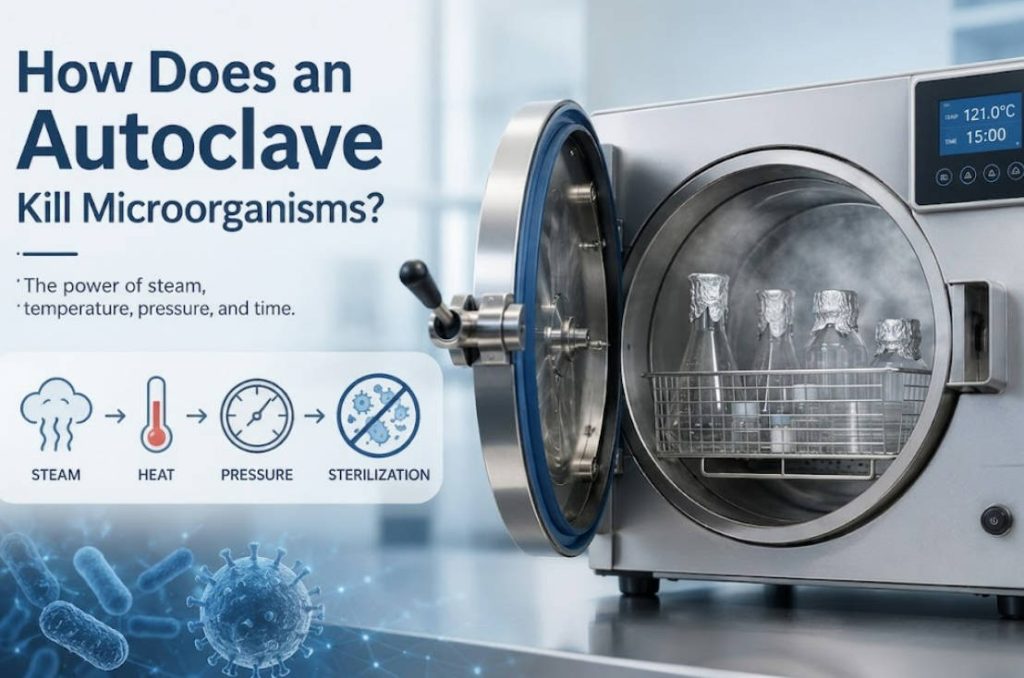
How Steam Inactivates Microorganisms
An autoclave primarily kills microorganisms through moist heat delivered by saturated steam.
When steam comes into contact with a cooler load, it transfers heat efficiently to the material. The heat damages essential proteins and other cellular structures, eventually making microorganisms unable to survive or reproduce. Bacterial endospores are much more resistant than ordinary vegetative cells, which is why achieving the correct sterilization conditions is important.
The process can be simplified as:
Pressure → higher steam temperature → steam contacts the load → efficient heat transfer → microbial inactivation
It is worth making one point clear: pressure itself is not what directly kills microorganisms. Instead, pressure allows the autoclave to produce steam at temperatures higher than water’s normal boiling point. CDC identifies steam, pressure, temperature, and time as the main parameters of steam sterilization.
The Role of Moist Heat
Heat is highly effective at damaging microorganisms, but moist heat has an important advantage over dry heat. Saturated steam can transfer heat efficiently when it contacts the load.
During steam sterilization, steam condenses on cooler surfaces and transfers heat to them. This helps the load reach the required sterilization temperature.
This is why an autoclave is not simply a very hot chamber. The steam needs to reach the surfaces that need to be sterilized. If air remains trapped around or inside the load, the steam may not make proper contact with those areas.
Denaturation of Proteins
Microorganisms depend on proteins for many essential functions. These proteins have specific structures that allow them to work properly.
High-temperature moist heat damages these structures. As proteins lose their functional structure, important cellular processes can no longer continue normally.
This protein damage is one of the major ways heat contributes to microbial inactivation during autoclave sterilization.
Damage to Cell Structures and Nucleic Acids
Heat can also damage other essential components of microorganisms.
Cell structures can lose their normal function when exposed to high temperatures, while damage to DNA and RNA can interfere with the ability of microorganisms to reproduce and maintain their biological functions.
The exact damage depends on the type of microorganism and the conditions used during sterilization. For this reason, it is better to think of autoclaving as a controlled moist-heat sterilization process, rather than assuming that every microorganism is destroyed in exactly the same way.
Why Some Microorganisms Are More Heat Resistant
Not all microorganisms have the same resistance to heat.
Vegetative bacterial cells are generally easier to inactivate than bacterial endospores. Some bacteria can form endospores that have structures and properties that help them withstand unfavorable environmental conditions.
These resistant spores are particularly important when evaluating steam sterilization. WHO identifies Geobacillus stearothermophilus spores as a biological indicator commonly used to evaluate moist-heat sterilization processes.
Why Temperature and Exposure Time Matter
A sterilization cycle is not defined by temperature alone.
For example, 121°C maintained for an appropriate exposure period can provide effective steam sterilization under specified conditions. Higher temperatures can shorten the required exposure time, but the actual cycle still depends on the sterilizer, load, packaging, and other factors.
CDC notes that common steam-sterilization temperatures include 121°C and 132°C, while recognized exposure times vary depending on the type of sterilizer and the items being processed.
This means that simply asking, “Does the autoclave reach 121°C?” is not enough. A better question is:
Did the entire load receive the required temperature for the required amount of time, with adequate steam contact?

How Do Steam and Pressure Help an Autoclave Kill Microorganisms?
Steam and pressure are central to autoclave operation, but they have different roles.
Steam Generation
An autoclave heats water to generate steam inside or supply steam to the sterilization chamber, depending on the equipment design.
For effective steam sterilization, the goal is to provide saturated steam under pressure and allow it to contact the surfaces of the load.
WHO describes autoclaving as saturated steam under pressure and identifies moist heat in the form of autoclaving as an effective method for sterilizing laboratory materials.
Why Does an Autoclave Use Pressure?
At normal atmospheric pressure, water boils at about 100°C. Increasing the pressure allows water and steam to reach higher temperatures.
This is the main reason pressure is used in an autoclave.
Pressure helps the system reach the temperature needed for rapid microbial inactivation; it is not pressure alone that provides the sterilizing effect.
For example, Drawell’s vertical autoclave range includes models designed around pressurized saturated steam, with temperature and time controls and safety functions such as over-temperature and over-pressure protection.
Steam Penetration and Heat Transfer
Steam must reach the surfaces of the items being sterilized.
When steam contacts a cooler surface, it can transfer a large amount of heat through condensation. This makes steam an efficient way to deliver heat throughout the load.
However, simply filling the chamber with steam does not guarantee that every part of the load has received the required conditions.
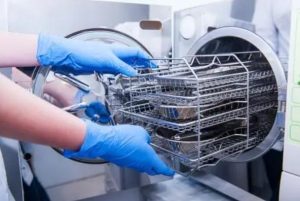
Wrapped items, porous materials, containers, and tightly packed loads can make steam penetration more difficult. This is why load arrangement and air removal are important parts of the sterilization process.
Why Air Removal Matters
Air inside the chamber can interfere with steam contact.
In a gravity-displacement autoclave, incoming steam pushes the heavier air out through the chamber’s drainage path. In a pre-vacuum system, a vacuum stage is used to remove air before or during steam introduction.
WHO notes that active vacuum cycles are useful for loads such as waste bags, glassware, and equipment where trapped air cannot reliably be removed by passive methods.
CDC also explains that entrapped air can prevent steam from reaching parts of the load and describes gravity-displacement, pre-vacuum, and steam-flush pressure-pulse systems as different approaches to air removal.
So, when considering how an autoclave kills microorganisms, steam quality and air removal are just as important to understand as temperature and pressure.
Uniform Heat Distribution
A properly designed and operated autoclave should allow the sterilizing conditions to reach the load as intended.
But uniform heating is not something that should be assumed simply because the chamber reaches the set temperature. The actual result can be affected by:
- How the load is arranged
- How tightly the items are packed
- Whether the items are wrapped
- Whether air can escape
- The type of sterilizer
- The selected cycle
- The characteristics of the material being sterilized
This is why the sterilization cycle should be selected according to the load rather than using one cycle for everything.
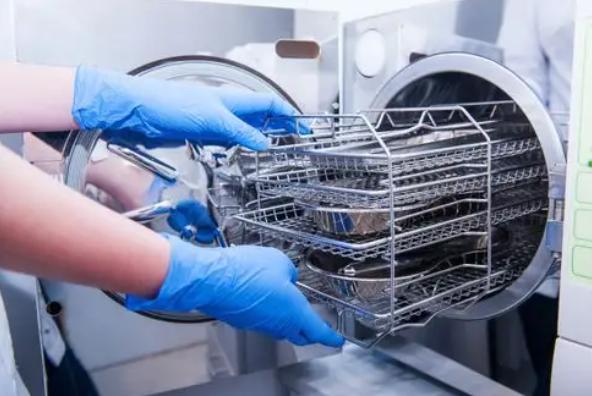
Which Microorganisms Can an Autoclave Kill?
Autoclaves are designed to inactivate a wide range of microorganisms when the required sterilization conditions are achieved.
The level of resistance varies between microorganisms, so it is more accurate to discuss the process in terms of microbial resistance and validated sterilization conditions rather than simply saying that an autoclave kills everything at the same temperature and time.
| Microorganism | Key consideration |
| Vegetative bacteria | Generally susceptible to moist heat when appropriate conditions are achieved |
| Viruses | Heat sensitivity varies among viruses |
| Fungi | Fungal cells and spores can have different levels of resistance |
| Bacterial endospores | Highly resistant and especially important when evaluating steam sterilization |
| Some parasites | Heat sensitivity varies by species and life stage |
Bacteria
Autoclaves can effectively inactivate many bacterial cells when the appropriate steam sterilization conditions are achieved.
The heat damages proteins, membranes and other essential structures, preventing the cells from continuing normal biological functions.
However, bacterial spores are much more resistant than ordinary vegetative bacterial cells and therefore require particular attention during sterilization validation.
Viruses
Viruses do not have the same cellular structure as bacteria, so it is better not to describe their inactivation using exactly the same mechanism.
Appropriate moist-heat sterilization conditions can inactivate a wide range of viruses by damaging their structural components and genetic material.
The important point is that the effectiveness of a cycle depends on achieving the required process conditions, rather than simply reaching a particular chamber temperature for a few seconds.
Fungi
Moist heat can inactivate many fungal cells and structures, but resistance varies by organism and life stage.
As with bacteria, the effectiveness of an autoclave depends on proper temperature, exposure time, steam contact, and load conditions.
Bacterial Spores
Bacterial endospores are among the most resistant forms relevant to steam sterilization.
This is one reason biological indicators are important when evaluating an autoclave. WHO identifies Geobacillus stearothermophilus as a biological indicator for moist-heat sterilization.
Parasites
Some parasites and parasite-related materials can be inactivated by appropriate heat treatment, but resistance varies considerably by species and life stage.
For routine laboratory autoclave applications, bacterial spores are generally more relevant when discussing the challenge of validating steam sterilization.
How Long Does an Autoclave Need to Kill Microorganisms?
There is no single exposure time that applies to every autoclave cycle.
The required time depends on factors such as:
- Sterilization temperature
- Type of autoclave
- Load size and composition
- Whether items are wrapped
- Material type
- Presence of porous materials or lumens
- Steam penetration
- Air removal
CDC gives examples of recognized minimum exposure periods for specific healthcare loads, including 30 minutes at 121°C in a gravity-displacement sterilizer and 4 minutes at 132°C in a pre-vacuum sterilizer for wrapped healthcare supplies. These are specific validated conditions, not a universal rule for every autoclave or every load.
WHO also provides example laboratory cycles, including 15 minutes at 121°C and shorter holding times at higher temperatures, while emphasizing correct loading and appropriate operation.
For this reason, users should follow the sterilizer manufacturer’s instructions and the validated cycle appropriate for the specific load.
For example, Drawell’s vertical autoclaves include adjustable sterilization temperature and time, with different models covering different chamber capacities and operating requirements.
How Is Autoclave Sterilization Verified?
Reaching the programmed temperature and pressure is important, but monitoring the sterilization process is also essential.
CDC describes three main types of monitoring for steam sterilization:
Mechanical Monitoring
The autoclave can monitor physical parameters such as:
- Temperature
- Pressure
- Exposure time
Modern equipment may record these parameters during the cycle, allowing operators to check whether the programmed conditions were reached.
Chemical Indicators
Chemical indicators change in response to specific sterilization conditions.
They can provide a quick indication that the item or pack has been exposed to the intended process conditions, although they do not replace biological monitoring.
Biological Indicators
Biological indicators provide a more direct way to challenge the sterilization process using highly resistant microorganisms.
For steam sterilization, Geobacillus stearothermophilus spores are commonly used. CDC identifies these spores as the biological indicator organism for steam sterilization, while WHO also identifies G. stearothermophilus for moist-heat sterilization.
In practical terms, this gives laboratories several layers of information:
Did the equipment reach the required physical conditions? → Did the chemical indicator respond as expected? → Did the biological indicator confirm effective microbial inactivation?
The exact monitoring program should follow the requirements applicable to the laboratory, healthcare facility, equipment, and sterilization process.
What Can Cause Autoclave Sterilization to Fail?
A sterilization cycle can fail even when the operator expects the autoclave to work normally.
Common causes include:
1. Insufficient Exposure Time
If the load does not receive the required temperature for the required time, microbial inactivation may be incomplete.
2. Inadequate Temperature
The chamber or load may not reach the required sterilization temperature.
3. Trapped Air
Air pockets can prevent steam from reaching certain areas of the load.
4. Poor Load Arrangement
Overloading or tightly packing materials can make steam penetration and heat transfer more difficult.
5. Incorrect Cycle Selection
A cycle suitable for glassware may not be appropriate for a different type of load.
6. Equipment Problems
Problems with steam delivery, temperature control, pressure control, seals, sensors, or other components can affect the sterilization process.
CDC notes that positive biological indicator results can be associated with factors such as operator error, inadequate steam delivery, or equipment malfunction.
This is why autoclave sterilization is a process, not simply a temperature setting.
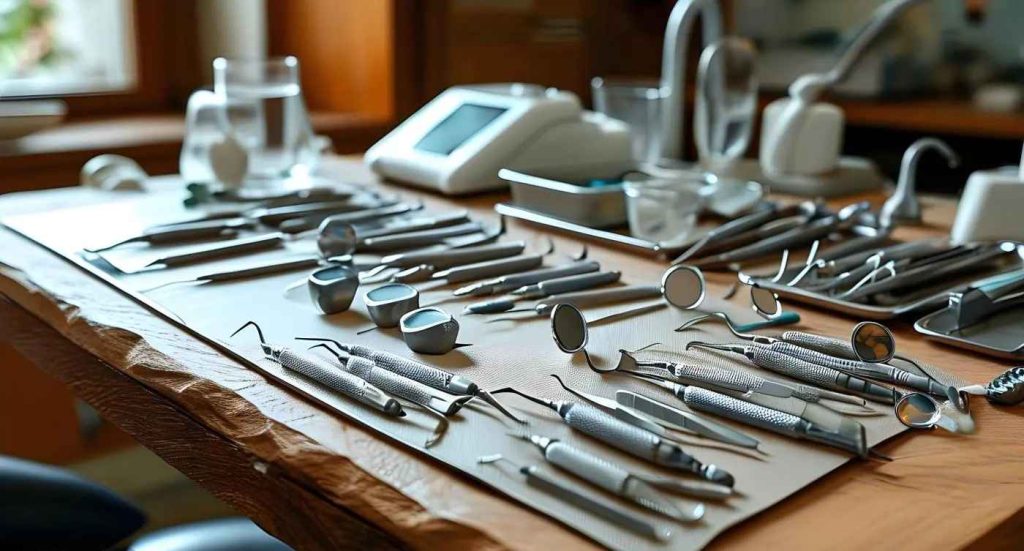
What Should Not Be Autoclaved?
Not every material is suitable for steam sterilization.
Autoclaves should not be used for materials that are incompatible with high temperature, moisture, or pressure. Drawell’s vertical autoclave information, for example, specifically cautions against using these systems for flammable, explosive, readily oxidizable materials, and certain strong acid, alkali, and saline solutions.
Before placing an item into an autoclave, check:
- Is the material heat resistant?
- Is it compatible with moisture?
- Can the container safely withstand pressure?
- Is the material compatible with the selected cycle?
- Does the manufacturer of the material allow autoclave sterilization?
Never assume that a material is safe to autoclave simply because it fits inside the chamber.
Choosing a Laboratory Autoclave
If you are selecting a laboratory autoclave, start with the items you need to sterilize rather than choosing a machine based only on chamber size.
Consider:
- Load type — glassware, culture media, instruments, waste, liquids, etc.
- Capacity — match chamber volume to your routine workload.
- Sterilization temperature and time — make sure the equipment supports the cycles you need.
- Air removal — important for loads where trapped air may be a concern.
- Drying function — useful for applications where dry loads are required.
- Safety features — such as over-temperature, over-pressure, and water-shortage protection.
- Control system — consider whether manual, digital, or automatic control is appropriate.
- After-sales support — technical guidance, spare parts, manuals, and maintenance support can matter just as much as the initial equipment price.
Drawell offers a range of laboratory autoclaves including vertical and portable models, as well as larger horizontal systems. Its vertical autoclave range covers different capacities and configurations, while some models provide features such as automatic cooling, drying, digital displays, water-feeding systems, and pre-vacuum functions.
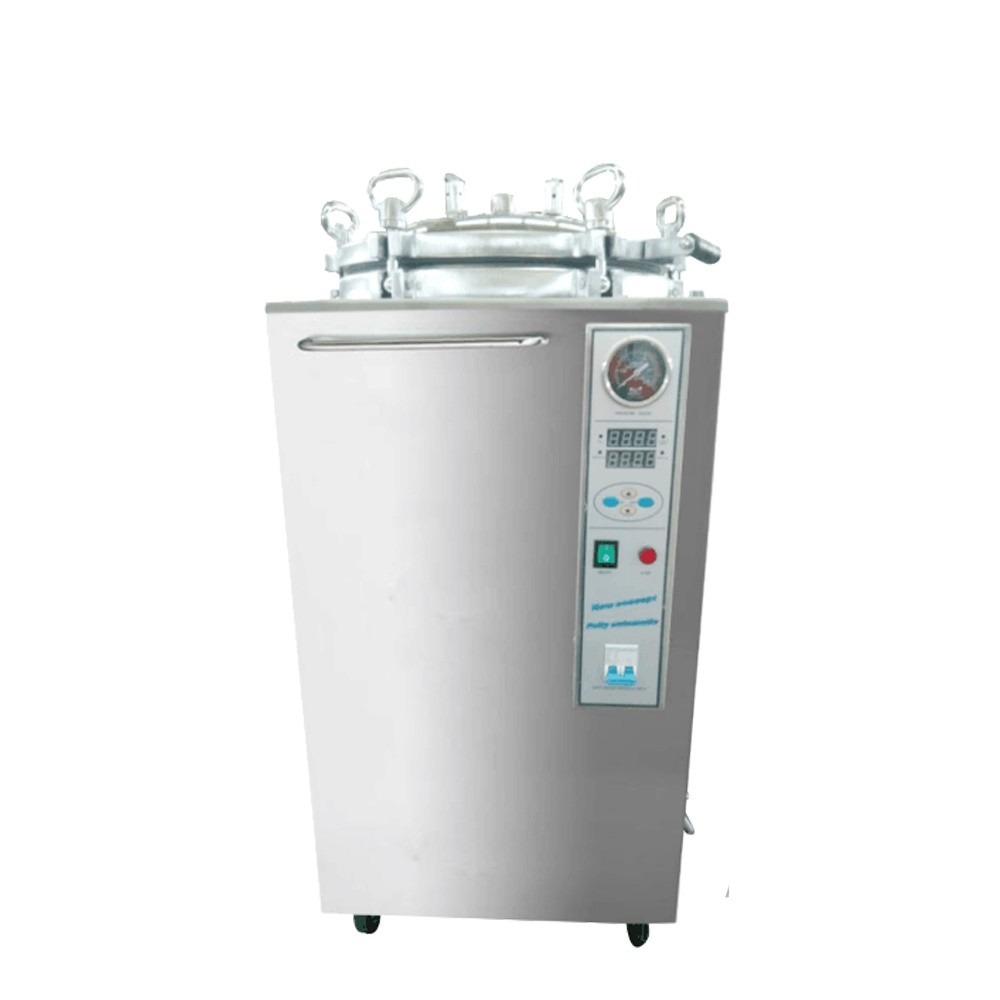
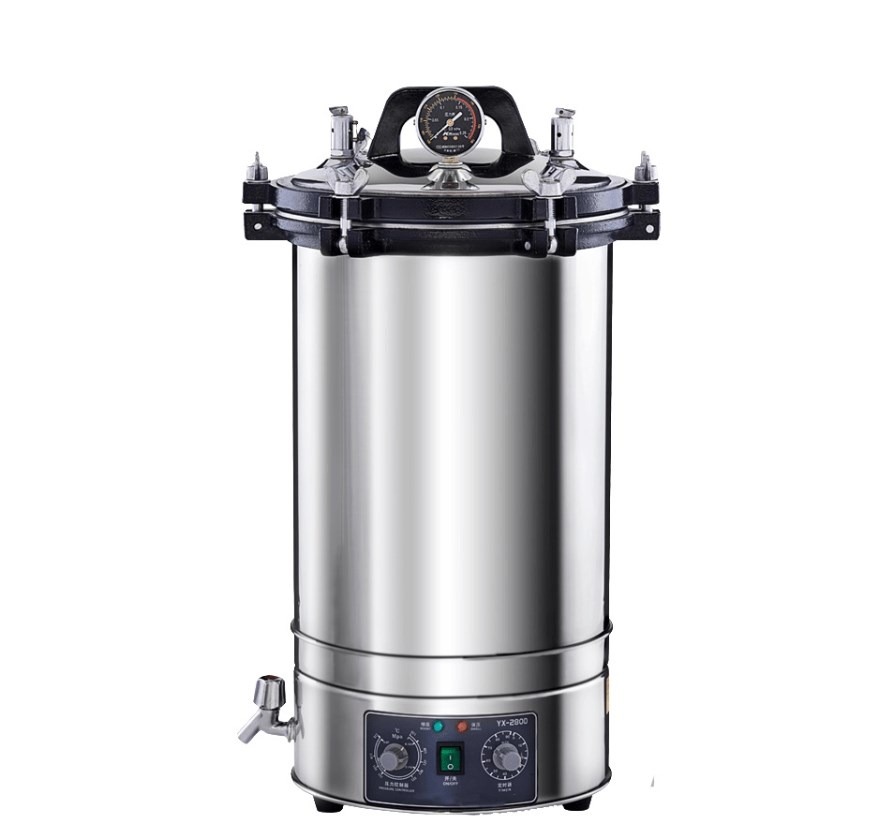

For smaller or mobile applications, Drawell also offers portable steam autoclaves in several configurations and capacities.
As a laboratory autoclave manufacturer, Drawell also provides technical support, operating guidance, spare parts, and after-sales support for its equipment.
If you’re not sure which autoclave is suitable for your load, it is usually better to discuss the material, load size, required cycle, and application with the team before choosing a model.
Get Quote Here!
Latest Posts

What Next?
For more information, or to arrange an equipment demonstration, please visit our dedicated Product Homepage or contact one of our Product Managers.


