


Gas Chromatography (GC) is among the most commonly performed analytical methods in laboratories and is required to separate and study volatile compounds. Although the GC is essentially highly reliable, due to several problems that users constantly face, curiosity might arise toward the appearance of certain “interfering substances” in their results, causing reproducibility or sensitivity problems. Knowing the reasons and effective troubleshooting methods for these issues for one to be able to restore optimal operation of gas chromatography, is crucial.

The Importance of Troubleshooting the Problems of Gas Chromatography
Troubleshooting the problems in gas chromatography ensures that the results produced by the method are accurate, reliable, and reproducible. By identifying issues like baseline drift, poor peak resolution, peak distortions, and low sensitivity, one can proffer effective solutions that will maintain instrument performance and prolong the life of the column. Proper troubleshooting will not only save time and resources but will also enhance data quality necessary for supporting a highly confident choice in challenging research, quality control, and industrial activities.
Common Problems of Gas Chromatography
| Problem | Description | Possible Causes |
| Poor Peak Resolution | Peaks are broad, overlapping, or not well-separated. | Column degradation, incorrect temperature program, or improper flow rate. |
| Baseline Noise or Drift | Unstable or fluctuating baseline during analysis. | Contaminated carrier gas, leaks, or detector issues. |
| Ghost Peaks | Unexpected peaks appear in the chromatogram. | Contamination from previous samples, solvents, or column residues. |
| Retention Time Shifts | Peaks appear at different times than expected. | Temperature fluctuations, carrier gas inconsistencies, column aging. |
| Sample Decomposition | Sample breaks down before or during analysis. | High injector temperature or reactive column. |
| Detector Saturation | Peaks are excessively large, distorting the signal. | Sample concentration too high or detector settings incorrect. |
| Air or Moisture in System | Poor reproducibility, erratic peaks, or baseline instability. | Leaks, insufficient gas drying, or contaminated carrier gas. |
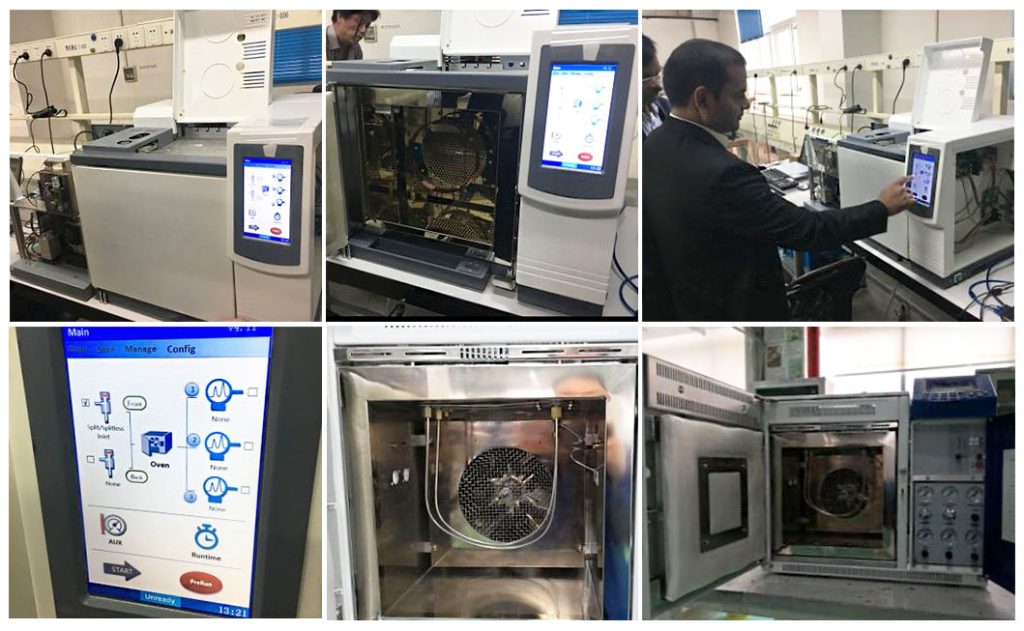
Effective Methods to Troubleshoot the Common Issues of Gas Chromatography
Effective troubleshooting methods is essential for maintaining high-performance gas chromatography systems.
1. Addressing Baseline Noise and Drift
A stable baseline is the bedrock for accurate peak integration; noise and drift in baseline are common problems, which mostly result from instability in the detector, column contamination, leaks, or temperature variations. The solution is to make certain that the detector is clean and well conditioned, to a more effective level using some sort of carrier gas, maintaining stable gas flow. Sometimes, columns are blamed, more columns in use, and in fact replication of more columns can be seen. If high purity is being used in combination with a constant flow of carrier gas, drift, such as those originating from the source, should be reduced. Equally important is giving sufficient time for the whole system to stabilize in temperature before proceeding to calibration.
2. Improving Peak Resolution
Very poor peak resolution that causes peaks to overlap is a huge challenge for distinguishing and quantifying the analytes. The reason behind that problem is either the column being overloaded, poorly programmed flow/temperature, or the inappropriate choice of the column. The basic resolution of this problem lies in selecting the proper column with the right stationary phase and drink for the target compounds. Better not to have column overloading due to adjusting the injection volume, and the temperature program can be fine-tuned so as to ascertain separation’s efficiency! Fine-tuning carrier gas flow rates can be an additional step needed to smooth up peak shapes for more precise analyses.
3. Correcting Peak Tailing or Fronting
Distorted peaks, such as tailing or fronting, are typically caused by sample interaction with active sites or column degradation.. Issues of distortion-tearing or fronting-caused by any interaction between the sample and an active site or by column degradation-have been found to weaken accuracy in quantification in a significant manner. Remedying contamination or decay through systems that involve or renew the tubing is an indispensable operation when either is suspected. Routine maintenance of the irironiect burned injection port materials (which prevent sample adsortion) ought to be applied. Their other possibilities are that solvent or sample compatibility with the stationary phase may lower the chance for distortion. Deactivated liners and azeorous grade septa also further diminish any possible interaction that might lead to non-shaped peaks.
4. Improving Sensitivity
Inconsistency of low-sensitivity detector types may facilitate the overlooked minor species in addition to malfunction of the detector. These variations may be because of improper operation, e.g., a system failure, impurities in the carrier gas, low concentrations of the analyte, or inappropriate injection parameters. It is the first and almost mandatory duty to test the detector; if found dysfunctional, it should be immediately recalibrated. Reducing background interference by using high-purity carrier gas and concentrating samples for low analyte concentration may help in improving detection. Optimizing injection parameters helps the maximum transfer of the sample and signal intensity test when choosing between split and splitless modes of injection.
5. Solving Carrier Gas Flow Problems
It is important to have consistent flow of carrier gas for retention times as well as peak shapes to remain reproducible. Leaks, blockages, or incorrect pressure settings can have an effect on flow the time, and so the results are compromised. To troubleshoot gas chromatograph operation, the thing to do is to check all the gas-connecting parts for leaks and iterative out the pressure and flow settings. Cleaning or replacing filters will basically not block the flow and will help the system in properly delivering through the carrier gas flow. Regular maintenance in the form of checks will guarantee a stable carrier gas flow, which will help get reliable support for most of the dedicated applications that is preexisting in your system.
6. Dealing with Column Contamination or Degradation
When column reaches a period of decline on account of sample deposits or thermal stress, however, this manifests in loss of separation power and, most importantly, a change in retention time. There is no point over which guard or pre-coluumns overrun proper maintenance from manufacturer guidelines in prolonging column lifespan by containing contaminations. In turn, the maintenance of separation effectiveness is rendered worse by a series of scenarios: contaminated materials or not the right conditioning conditions. Problems can be averted by clean injection or compatibility testing, as this avoids anything that will pose a threat to the degradation of columns prematurely, which may ensure early troubleshooting of column performance once observed difficulties become evident during retention times and peak shapes.
7. Fixing Sample Injection Problems
Any kind of error while injecting, be it incorrect volumes, not proper mixing, or usage of wrong solvents, can certainly have an impact on the performance of GC. There is certainly an improvement in the delivering of samples only after the injector has been calibrated at some periodic intervals. With some focus on selecting an appropriate solvent and on selection of the appropriate column, the preparation of the sample will still be of due importance. Care exercised in the choice of injection mode according to the concentration of the sample, while epitomizing the condition of the injection apparatus (septa, liner, and syringes), further contributes to improved reproducibility for analytical measurements.
Summary
Troubleshooting gas chromatography always needs a methodical approach, whereby unwanted instability in baselines, compromised peak resolution, peak distortion, insensitivity, carrier gas problems, column degradation, or injection errors can be instantly diagnosed. Well-planned preventive maintenance and method optimization, as well as regular system tests, remain an imperative for ensuring dependable, accurate, and quality GC outcomes.
Get Quote Here!
Latest Posts

What Next?
For more information, or to arrange an equipment demonstration, please visit our dedicated Product Homepage or contact one of our Product Managers.


