


If you work in an organic chemistry lab, a pharma R&D facility, or a botanical extraction plant, chances are you use a rotary evaporator almost every single day. It’s the undisputed workhorse for solvent recovery and sample concentration.
However, running a rotovap and getting the absolute most out of it are two different things. We’ve all seen solvents bump into the condenser, spent way too long waiting for a high-boiling solvent to evaporate, or chased down a mysterious vacuum leak right before a deadline.
Understanding how a rotary evaporator works under the hood isn’t just academic theory—it’s the secret to dialing in your parameter settings, speeding up evaporation rates, and keeping your vacuum pressure rock-solid. In this guide, we’ll cut through the textbook jargon to walk through the working principle, the step-by-step vapor path, essential components like seals and pumps, and real-world setup strategies like the “Rule of 20” to keep your lab running at peak efficiency.
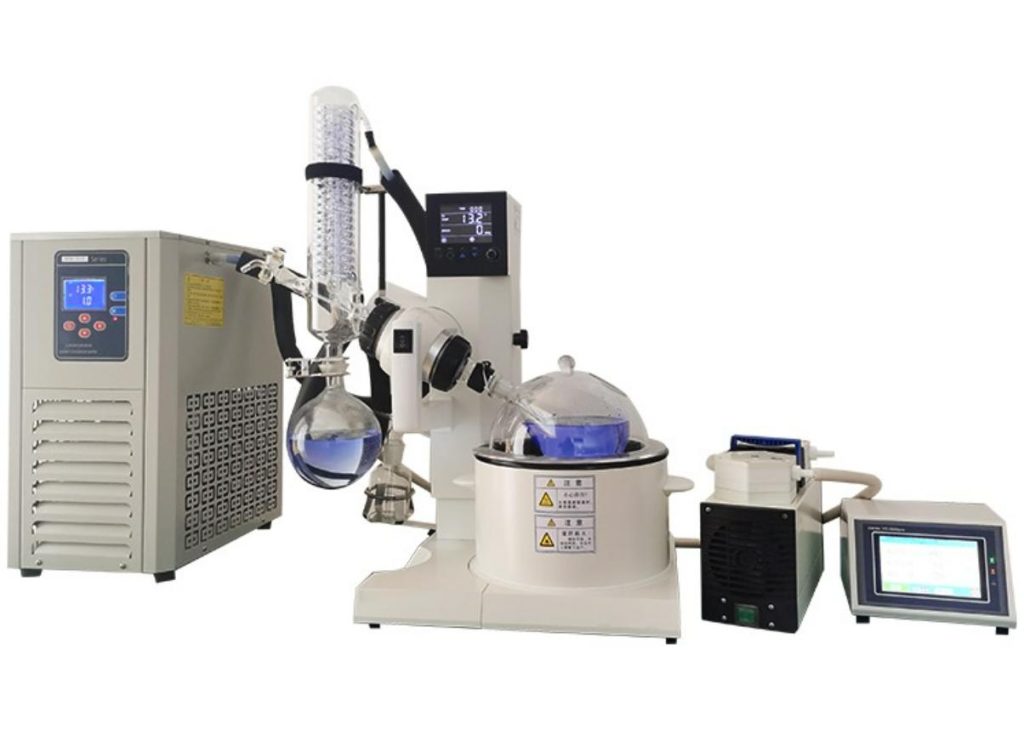
What is a Rotary Evaporator?
A rotary evaporator—often called a “rotovap” or “rotavapor” by lab technicians—is a specialized laboratory rotary evaporator designed to remove solvents from liquid mixtures gently and rapidly through evaporation.
The Purpose of a Rotary Evaporator
Whether you’re isolating target compounds in pharmaceutical research, purifying essential oils, or concentrating reaction mixtures, the primary purpose of a rotary evaporator is simple: separate liquids with different boiling points while protecting heat-sensitive compounds from getting burned or degraded.
The Core Scientific Principle: Why It Works So Well
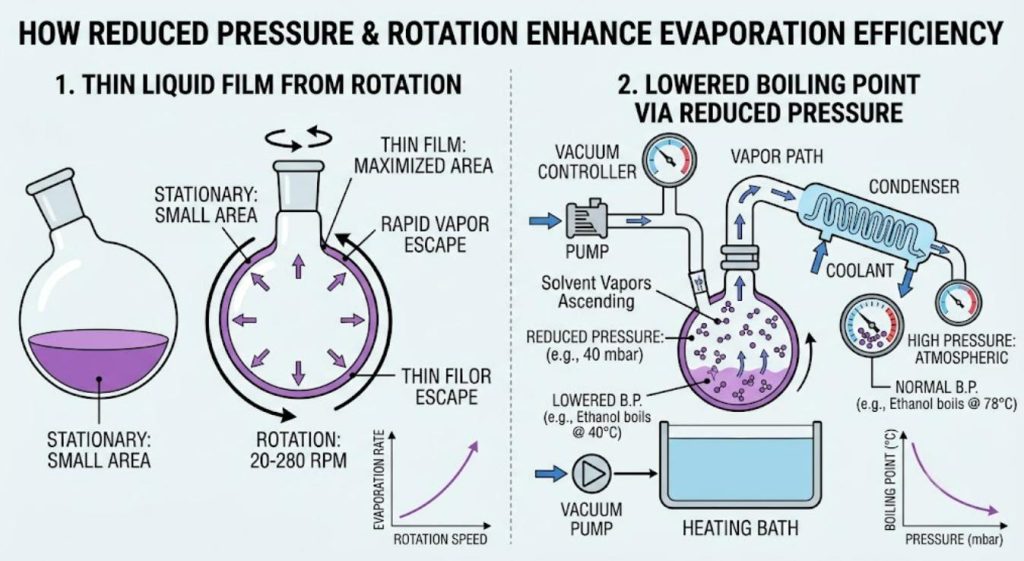
Traditional distillation relies on brute-force heating, which can destroy delicate molecules. A rotovap gets around this problem using two clever scientific tricks:
- Reduced Pressure (Lower Boiling Point): Inside a closed system, a vacuum pump lowers the air pressure above the liquid. According to the Clausius-Clapeyron relation in physics, when atmospheric pressure drops, the boiling point of a solvent drops right along with it. For example, water boils at 100°C under normal atmospheric pressure, but under a deep vacuum (e.g., 40 mbar), it boils at just 29°C!
- Rotation (Increased Surface Area & Thin Film Effect): The motor continuously spins the evaporating flask submerged in a warm bath. This rotation spreads the sample liquid thinly across the entire inner wall of the glass flask. This ultra-thin liquid film dramatically increases the surface area exposed to heat, speeding up evaporation while preventing bumping (uncontrolled sudden boiling).
What are the Key Components of a Rotary Evaporator?
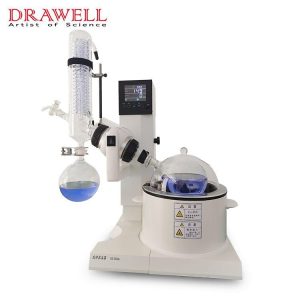
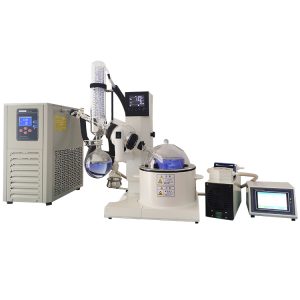
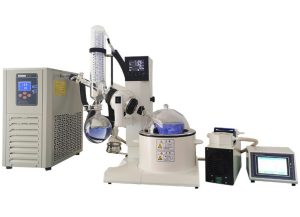
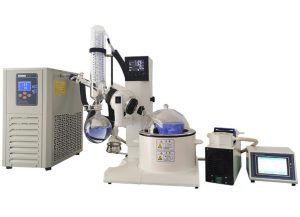
To understand rotary evaporator working dynamics, let’s look at the machinery involved. A complete rotovap setup relies on several high-precision components working in sync:
1. Evaporating Flask & Vapor Duct
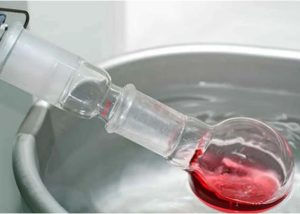
This is the glass bulb where your sample liquid lives. As the flask spins in the heating bath, the solvent boils off and ascends through the vapor duct—a leak-proof glass conduit that connects the rotating flask to the rest of the stationary system.
Pro Buying Tip: Always make sure your glassware is crafted from High-Borosilicate Glass 3.3. This premium glass withstands extreme temperature shifts and harsh chemical corrosion without cracking.
2. Heating Water or Oil Bath
The bath supplies uniform heat energy to compensate for the cooling effect of evaporation. Water baths are perfect for temperatures up to 90°C–99°C, while oil baths are used for high-boiling-point solvents requiring temperatures up to 180°C.
3. Vacuum System & Main Shaft Seals (The Unsung Heroes)
Note: Many basic guides overlook this, but without a reliable vacuum source, a rotovap is just a fancy slow-cooker!
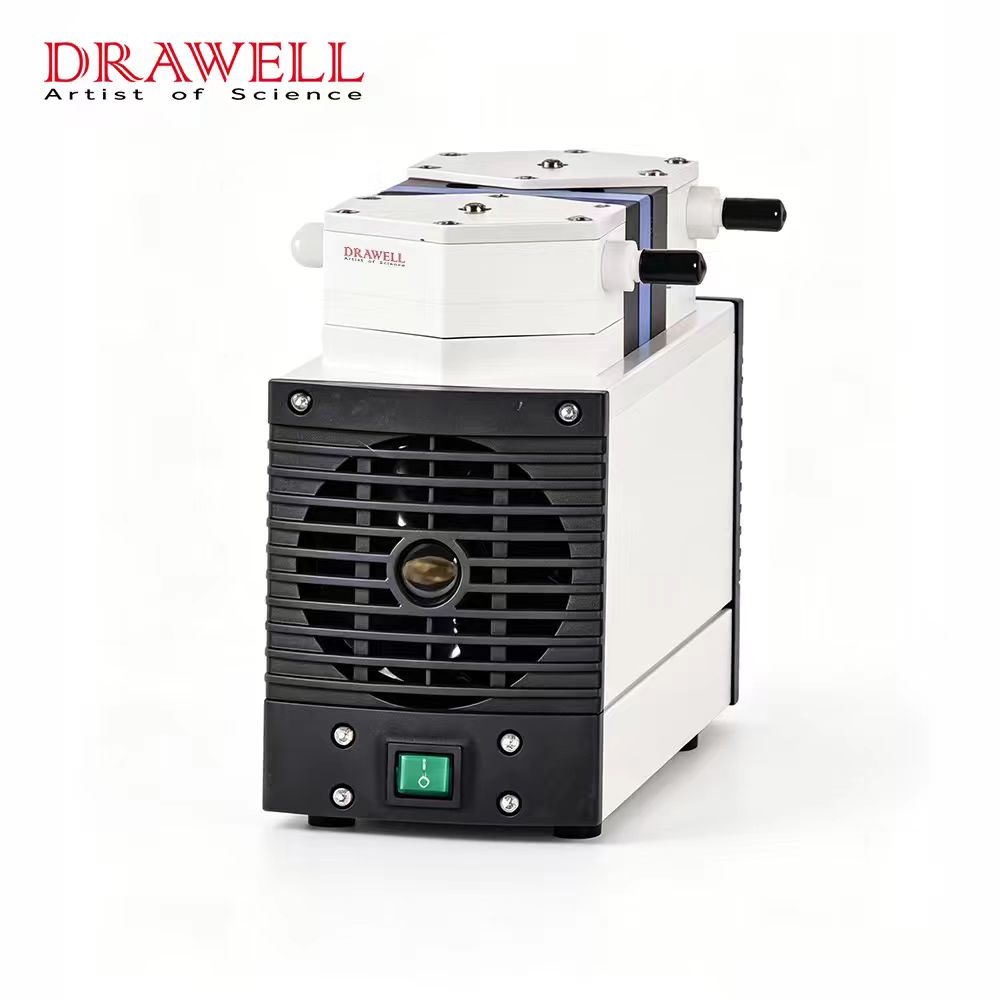
The vacuum pump pulls air out of the system, while specialized seals prevent leaks.
Durability Note: The primary cause of vacuum loss in aging rotovaps is seal wear. Look for systems using a dual PTFE and Viton seal assembly, which resists aggressive organic solvent vapors and holds negative pressure reliably over long shifts.
4. Rotating Motor & Drive Mechanism
The motor spins the evaporating flask smoothly (typically between 20 to 280 RPM). Modern units utilize brushless DC motors, which deliver consistent, sparkless torque—a crucial safety feature when evaporating flammable liquids like ethanol, acetone, or hexane.
5. Glass Condenser & Collection Flask
The condenser sits above the collection flask and contains a tightly coiled glass tube. Cold liquid flows through the coil, cooling hot solvent vapors until they turn back into a liquid state. The condensed solvent then drips safely into the receiving flask below.
 Evaporating Flask
 Evaporating Flask
 Evaporating Flask
 Multi-manifold
 Washer
 Washer
 Cooling Device
 Evaporating Flask
 Heating Pot
What are the Working Processes of a Rotary Evaporator?
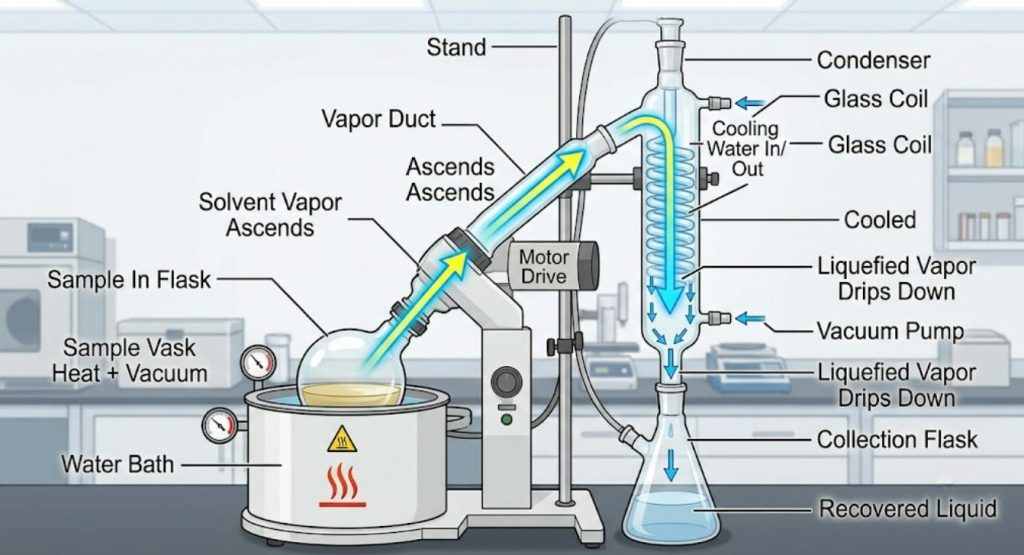
When you turn on a laboratory rotary evaporator, what actually happens to the solvent molecules inside? Let’s follow the step-by-step journey of a solvent vapor particle from start to finish:
Step 1: Preparation & System Check: The user fills the evaporating flask (no more than 50% full to leave room for vapor expansion) and applies a light dab of vacuum grease to all glass ground joints to ensure a tight seal.
Step 2: Pressure Drop: The operator turns on the external vacuum pump. Air rushes out, lowering internal pressure to the solvent’s specific target boiling point.
Step 3: Rotation & Film Formation: The motor turns on. The spinning flask spreads the liquid mixture thin along the warm glass wall, rapidly absorbing heat from the bath below.
Step 4: Vaporization & Ascent: Solvent molecules reach their reduced boiling point and evaporate rapidly. The vapor climbs up the neck of the evaporating flask and passes through the central vapor duct.
Step 5: Condensation: The vapor enters the main condenser chamber, hitting the icy surface of the internal cooling coils. Heat transfers from the vapor to the coolant, causing the vapor to instantly liquefy.
Step 6: Collection: Gravity pulls the liquid droplets down into the receiving/collection flask at the base of the condenser, leaving pure, concentrated sample residue behind in the spinning flask.
The Expert Setup: The “Rule of 20” for Parameters
Knowing how a rotary evaporator works in theory is great, but how do you set up your parameters in real life? Many lab technicians struggle with setting the right bath temperature, vacuum level, and cooling rate.
That’s where the industry-standard “Rule of 20” (ΔT = 20°C) comes in.
What is the Rule of 20?
To achieve maximum solvent recovery efficiency without overloading your condenser or freezing your chiller, keep a 20°C temperature differential between your three thermal zones:
Bath Temperature – 20°C = Vapor Temperature = Cooling Temperature + 20°C
- Heating Bath Temp: Set to 60°C.
- Solvent Vapor Temp: Adjusted via vacuum to boil at 40°C.
- Chiller/Cooling Temp: Set to 20°C.
Quick Reference: Common Solvents & Recommended Vacuum Settings
Below is a practical reference table for running common laboratory solvents under the Rule of 20 (assuming a 60°C bath and 40°C vapor target):
| Solvent | Normal Boiling Point (1 atm) | Required Vacuum for 40°C Boiling Point | Recommended Bath Temp |
| Acetone | 56.1°C | ~556 mbar | 60°C |
| Methanol | 64.7°C | ~337 mbar | 60°C |
| Ethanol | 78.4°C | ~175 mbar | 60°C |
| Water (H₂O) | 100.0°C | ~72 mbar | 60°C |
| Toluene | 110.6°C | ~77 mbar | 60°C |
Lab Safety & Troubleshooting: Avoiding Common Mistakes
Working under vacuum pressure with glass and flammable solvents requires attention to safety. Here are two real-world operational challenges and how to handle them:
1. How to Prevent “Bumping”
Bumping occurs when a liquid overheats suddenly and surges violently up into the vapor duct, contaminating your condenser and wasting your sample.
The Fix: Never fill your flask past 50% capacity. Increase the motor speed to create a thinner film, and never lower the vacuum level abruptly. Adjust the vacuum controller step-by-step until boiling stabilizes smoothly.
2. Preventing Implosions
Because a rotovap operates under negative pressure, any microscopic hairline crack in your glass can lead to an implosion.
The Fix: Inspect all glass components before turning on the vacuum pump. For high-volume or heavy-duty environments, consider using glass coated with a protective safety film that traps glass shards if a rupture occurs.
Summary & System Sizing Guide
Understanding how a rotary evaporator works boils down to controlling three variables: heat, vacuum, and rotation speed. When these factors are balanced according to the Rule of 20, you can recover over 95% of your solvents cleanly and efficiently.
Choosing the Right Rotary Evaporator Size
When shopping for a unit, match your selection to your daily processing volume:
- Benchtop R&D & Small Labs (1L to 5L capacity):
Ideal for general academic research, small-scale extractions, and analytical prep. Compact units with digital displays make monitoring simple.
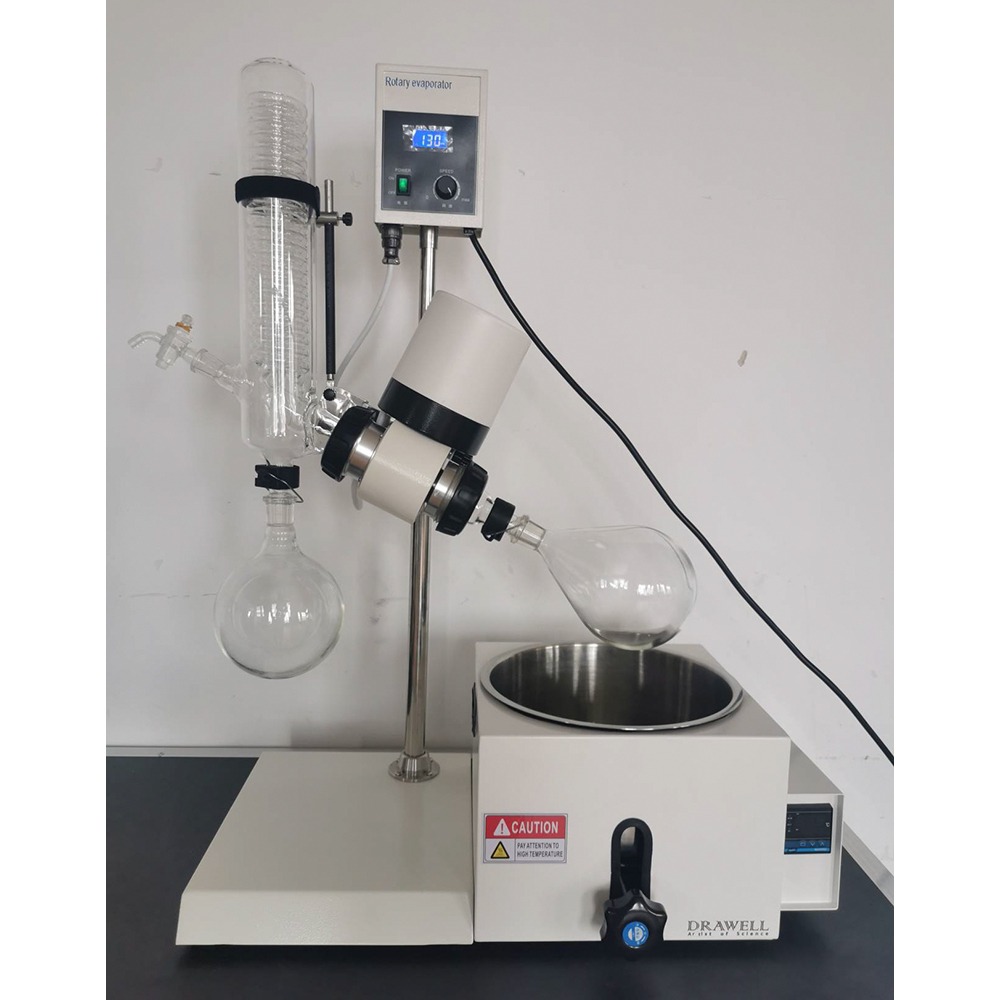
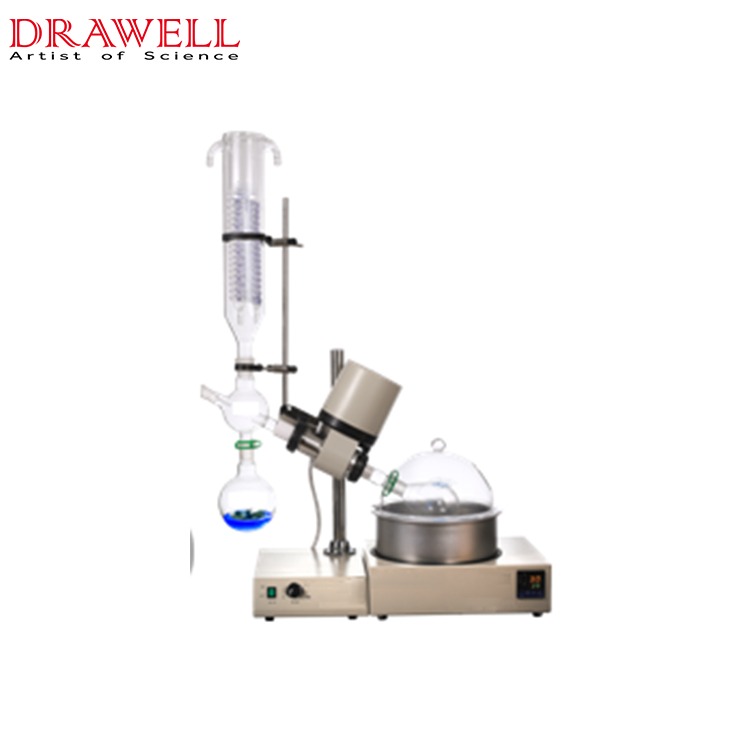
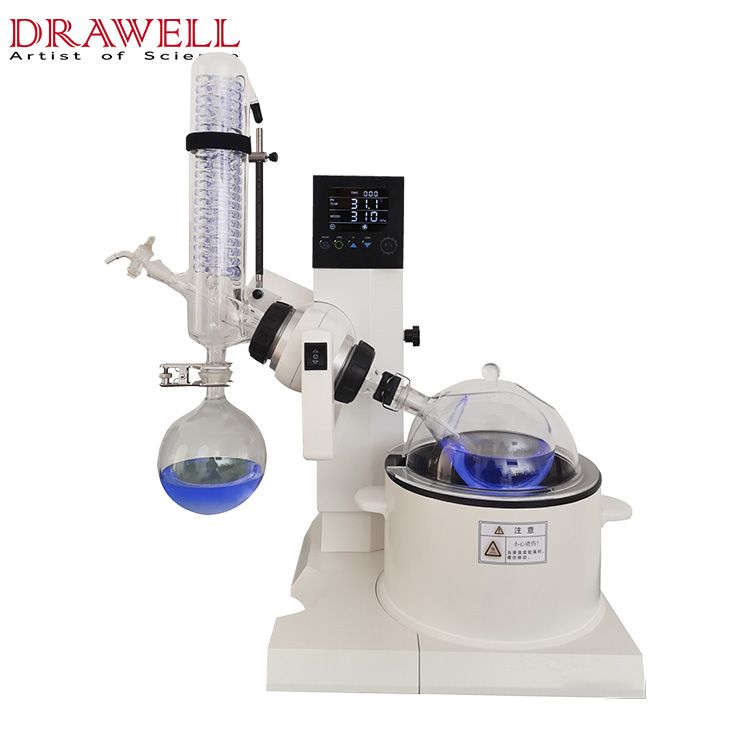
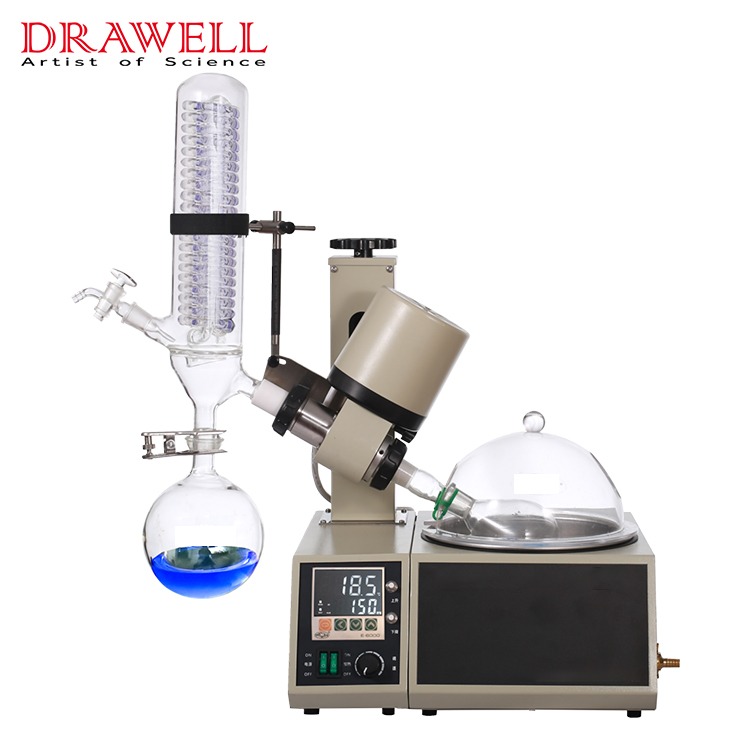
Suggested Reference: Check out standard benchtop setups like the DW-RE Series water bath rotary evaporator or the budget-friendly DW-RE-52AA water bath rotary evaporator.
- Multi-Sample Processing:
If your lab processes multiple smaller samples simultaneously, specialized multi-channel units speed up throughput without taking up extra bench space.
Suggested Reference: Look into multi-manifold setups like the DW-ADQ series multi-manifold rotary evaporator.
- Industrial Pilot & Pilot Production (10L to 50L capacity):
For high-throughput industrial extraction, botanical processing, or pharmaceutical manufacturing, heavy-duty floor-standing units with motorized lifts are required.
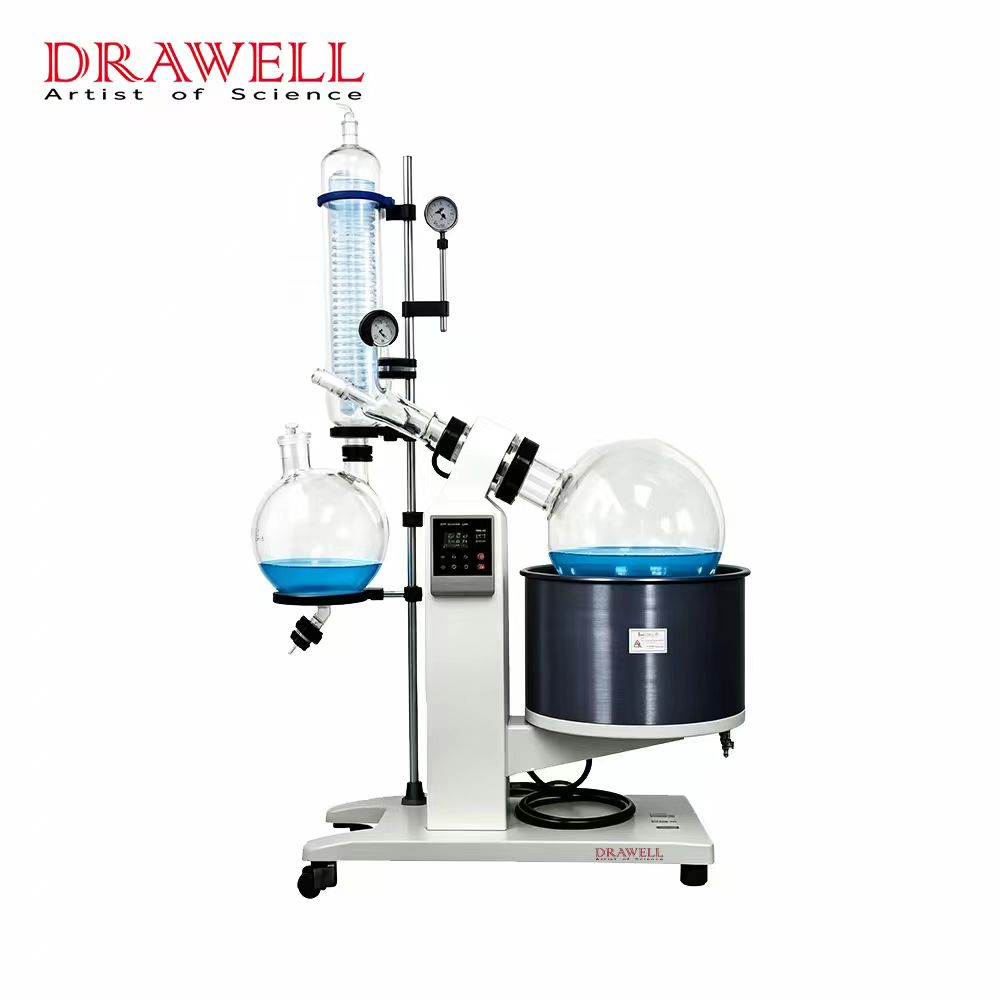
Suggested Reference: See heavy-capacity models like the DW-5210A large capacity floor type rotary evaporator or explore the general DW-52 series of water bath rotary evaporator lineup.
- Complete Turnkey Solution Note:
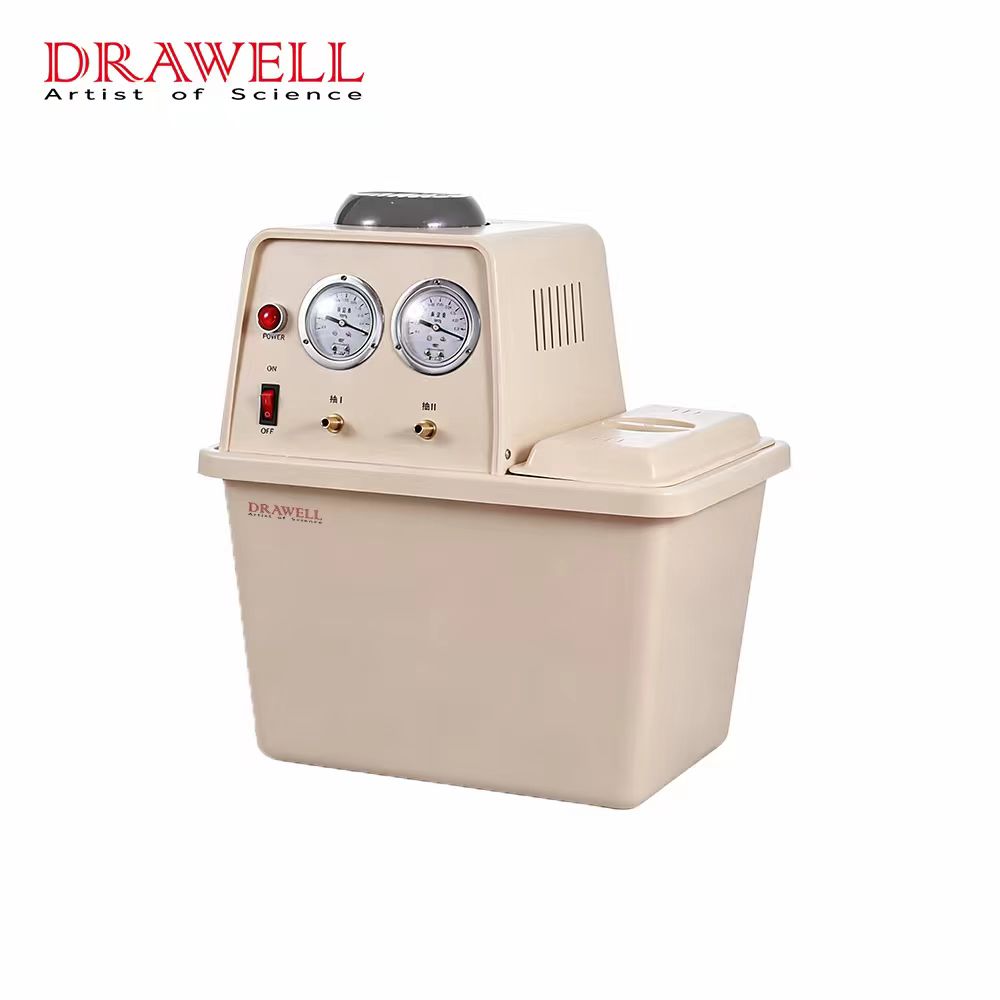
Remember that a rotovap needs clean water and a dependable vacuum source to function. Pairing your system with dedicated accessories—such as an SZ series automatic pure water distiller for pure bath water—helps prevent mineral scale buildup and extends your equipment’s operational life.
Need Help Finding the Perfect Setup for Your Lab?
Whether you’re setting up a new lab from scratch or upgrading an old distillation system, getting the right combination of vacuum pumps, chillers, and glass capacity makes all the difference.
Contact the Drawell Engineering Team today to get expert guidance, request a customized quote, or explore our complete catalog of analytical and laboratory instruments!
Get Quote Here!
Latest Posts

What Next?
For more information, or to arrange an equipment demonstration, please visit our dedicated Product Homepage or contact one of our Product Managers.


