


If you are running a pawn shop, managing a jewelry refinery, or handling precious metal recycling, one question keeps you up at night: Is this gold piece actually real, and exactly how pure is it? Making a mistake by even half a karat can drain your profits instantly.
The use of portable X-ray fluorescence across the industry has been remarkable over the past few years. Originally born in the alloy and scrap metal recycling industry, the technology was later determined to be effective in various industrial testing and material analysis fields. Thanks to constant updates of XRF technology, modern spectrometers are now highly responsive and accurate. These changes have revolutionized the way professionals conduct real-time, non-destructive elemental analysis.
However, when moving from basic metal sorting to high-value metallurgy, you need an instrument engineered specifically for precious metals—a specialized XRF gold analyzer—rather than a generic scanner.
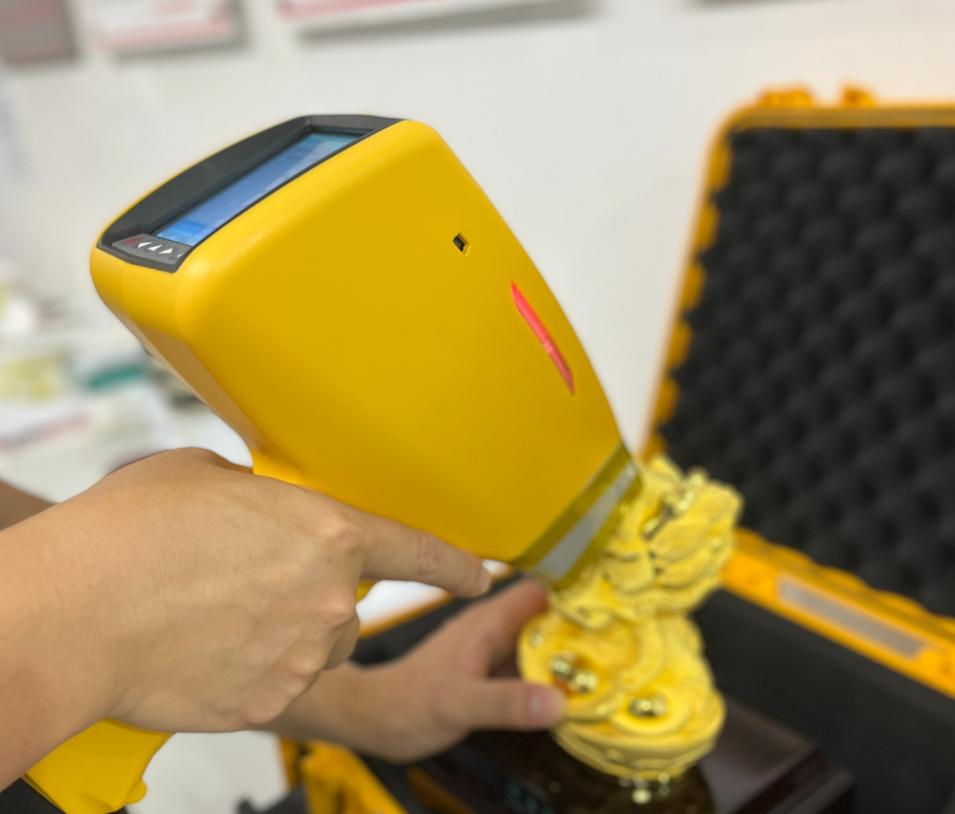
Can a Portable XRF Analyzer Be Used Directly to Test Gold Purity?
In traditional gold evaluation, the most common working method is the fire assay or flame test method. The metal is melted down by a flame, and the exact concentration of gold or other metal components is detected. For a long time, the fire assay method was known as the gold standard for testing. But let’s be honest: such detection methods are completely destructive. Breaking, cutting, or melting down a beautifully crafted piece of jewelry is highly unfriendly to pawn companies, collectors, and jewelry retailers.
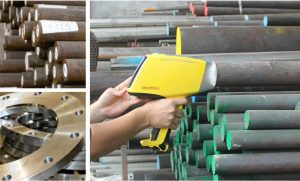
This is exactly why portable X-ray fluorescence (XRF gold testing) technology has become the go-to technique in pawn shops, cash-for-gold businesses, and jewelry stores worldwide. By utilizing a high-precision precious metal spectrometer, shop workers can measure the content of all gold, platinum, and other precious metals in real time.
How it works without damage: The instrument fires primary X-rays at the piece. The atoms inside the gold become excited and emit secondary X-rays (fluorescence). The built-in detector captures these rays to determine the presence and concentration of trace elements, alloying elements, and even hazardous heavy metals (like Lead or Cadmium) without destroying the item’s valuation. This dramatically increases the integrity and transparency of your transactions.
When we developed our Handheld XRF Gold Analyzer TrueX Gold, we analyzed six large flat objects made of different grades and compositions of gold. We cross-checked the data and found that the accuracy was typically within 0.1% or 0.2% of the destructive fire assay results. The experiment concludes that modern portable devices can completely test the composition of gold items with exceptional accuracy.

Advantages of Portable XRF for Gold Alloy Analysis
An intelligent non-destructive testing instrument built on X-ray fluorescence analysis technology (xrf gold analysis) can accurately quantify the content of various elements in gold, platinum, palladium, K-gold, K-platinum, and other jewelry alloys.
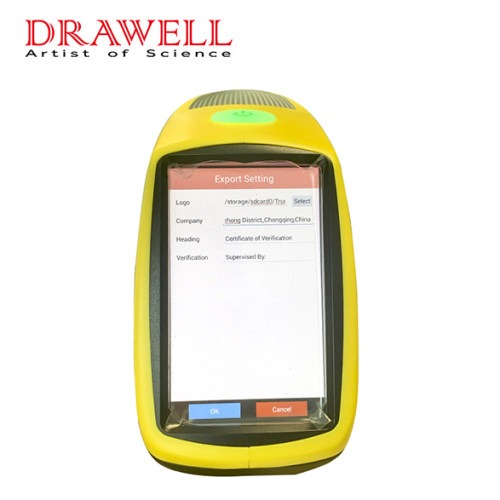
Modern precious metal analyzers apply advanced multi-channel analyzers and spectrum analysis technology. This allows the system to vividly present the exact content and ratio of Gold (Au), Platinum (Pt), Palladium (Pd), Silver (Ag), Rhodium (Rh), Copper (Cu), Zinc (Zn), and Nickel (Ni) in the form of a clear visual spectrum on the screen.
The main advantages of using XRF for precious metals include:
- Non-destructive testing: The sample remains 100% intact, which is critical for finished jewelry and investment bullion.
- Wide measurement range: All kinds of gold alloys, platinum group metals, and silver alloys can be analyzed simultaneously.
- Fast measurement speed: According to the specific precision requirements, reliable measurement results can be obtained within just a few seconds to a few minutes.
- High measurement precision: The measurement error is minimal, keeping within ±0.1% for pure gold.
Choosing the Right XRF Spectrometer for Your Business
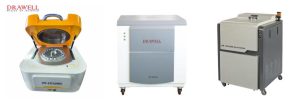
As an experienced XRF Supplier, Drawell understands that a jewelry workshop requires different technical specifications than an outdoor mineral exploration site. To help you make an informed decision, here is how our targeted configurations match real-world business scenarios:
| Application Scenario | Key Business Need | Recommended Drawell Model | Core Technology Advantage |
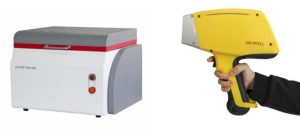
| Pawn Shops & Retail Counters | Rapid karat sorting, fast customer turnaround, high portability. | K-8000 Handheld XRF Gold Analyzer | Fast Si-PIN detector; delivers instant alloy and karat identification within seconds. |
| Jewelry Refineries & Labs | Maximum precision for pure gold (99.99%), trace element separation. | Handheld XRF Gold Analyzer TrueX Gold | Advanced SDD detector; higher resolution to separate overlapping precious metal spectrum lines. |
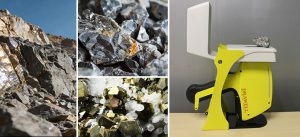
| On-site Mining & Field Geology | Geochemical analysis, boundary determination, multi-element ore scanning. | Handheld XRF Mineral Analyzer DW-EX7000 | Tailored for multi-element mineral and ore matrix calculations in rugged environments. |

Can X-ray fluorescence completely replace fire assay?
It is undeniable that X-ray fluorescence can not only accurately check the authenticity of gold, but also, most importantly, analyze the exact purity of gold. What directly affects a pawnshop or refinery’s income is often the hidden purity of the gold alloy. XRF is an incredible method for detecting gold, but buyers must understand its physical boundaries: it is a surface analysis technique.
X-rays can typically penetrate the metal surface up to a depth of roughly 10 to 20 micrometers (µm). If a rogue counterfeiter creates a thick tungsten core and wraps it in a heavy layer of real gold plating, a standard XRF scan might only read the outer gold shell. Therefore, XRF still cannot fully detect heavy core counterfeiting on its own.
To eliminate this financial risk, we strongly recommend a dual-testing strategy for high-value bulk transactions: use XRF to verify the exact surface purity and alloy composition, and combine it with a hydrostatic density test (the water gravity method) to check for internal weight mismatches.
If you are looking to secure your business against counterfeits and upgrade your testing precision, exploring a professional spectrometer is the best next step. Our Handheld XRF Gold Analyzer series will be your most powerful, reliable helper in analyzing precious metals. Feel free to contact our technical team at Drawell to get a customized quotation or find the perfect hardware match for your facility.
Get Quote Here!
Latest Posts

What Next?
For more information, or to arrange an equipment demonstration, please visit our dedicated Product Homepage or contact one of our Product Managers.


